If the line runs flush along the side of a wall, does it count as crossing or not? I'm thinking of this situation:
..A♦
..♦♦
..B♦
Does A have line of sight to B, where ♦ is a wall?
Aoooooo
ooooooo
wwooww
wwooBo
In DDM, that scenario would not have been LoS. The reason being that you actually draw a line through 2 corners of a wall. The first one doesn't count because it's the point of origin, but as soon as you touch the corner on the way out, it blocks LoS. If this is NOT the case, then how do you rule on straight diagonal lines that merely clip the same kind of corner?
Aoooooo
ooooooo
wwooww
wwooBo
A has line of sight. Line of sight is different from cover. It only means that you can see the other creature. The cover can be partial or superior but you still have line of sight. Think of it this way. Two gunmen are hiding behind columns or barricades. They have superior cover vs each other but that doesn't mean they don't have line of sight.
I thought any wall or enemy blocked LoS and granted cover.
Kinda like an earth elemental hiding behind two halflings.
Do the rules make a distinction between line of sight and cover, in so far as what blocks it? I didn't think so, but I could be wrong.
I thought any wall or enemy blocked LoS and granted cover.
Kinda like an earth elemental hiding behind two halflings.
Yes, there are very clear distinctions.
Taken straight from the rulebook:
Line of Sight: To determine if an attacking creature (or any other source) has line of sight to a target creature, draw a straight line from 1 corner of any square in the attacking creature’s space to any corner of at least 1 square in the target creature’s space. If that line does not cross a wall, or a square occupied by another enemy creature or an obstacle, the attacking creature has line of sight to the target. Allied creatures and tokens or markers on the battlefield do not block line of sight.
Cover: Terrain that does not block line of sight might still provide some protection from ranged attacks. If you can draw a straight line from 1 corner of any square in the attacking creature’s space to all 4 corners of at least 1 square in the target creature’s space without crossing a wall, or a square occupied by another enemy creature or an obstacle, the attacker has a clear shot at the enemy. Otherwise, the enemy has cover from the attack.
A creature in an obstacle square has cover against ranged attacks even if you can draw line of sight to it. However, if a Large figure is only partially in an obstacle and you have a clear shot to at least 1 square in its space, it does not have cover against that attack. [Emphasis added.]
Line of Sight requires only 1 corner open. However, to have a clear shot you need to have line of sight to all 4 corners of a square. So line of sight is a prerequisite to determining cover.
What makes this rule even more interesting is that it depends on the way the map is drawn. If you look at the example picture in the rulebook with the War Wizard and Shadow Mastiff, the LoS lines actually pass through the square that has the wall drawn on it, but they don't cross the wall as drawn. The ruling (according to the rulebook) is that the War Wizard has LoS to the Mastiff in that case, and the Mastiff does not have cover.
Line of Sight: To determine if an attacking creature (or any other source) has line of sight to a target creature, draw a straight line from 1 corner of any square in the attacking creature’s space to any corner of at least 1 square in the target creature’s space. If that line does not cross a wall, or a square occupied by another enemy creature or an obstacle, the attacking creature has line of sight to the target. Allied creatures and tokens or markers on the battlefield do not block line of sight.
Cover: Terrain that does not block line of sight might still provide some protection from ranged attacks. If you can draw a straight line from 1 corner of any square in the attacking creature’s space to all 4 corners of at least 1 square in the target creature’s space without crossing a wall, or a square occupied by another enemy creature or an obstacle, the attacker has a clear shot at the enemy. Otherwise, the enemy has cover from the attack. [Emphasis added.]
I have Bolded the parts that matter to my statement. If the same rule applies to both LoS and Cover, then the other corners don't matter (to my argument). In my example (below) the line draws through the same corner of a wall.
AoDoooo
ooooooo
wXooww
wwooBo
wCoooo
B has line of sight to A, but A has cover because the line from B to A touches X at the corner
C has no line of sight to D because the line drawn touches X at the exact same corner
or this is flipped
C has LoS to D then A has no cover from B
No offense Dardor... but I was kinda hoping Chris would jump in on this one ;)
Still waiting ;)
A has line of sight to B if you can draw a line from ANY corner of A to ANY corner of B without crossing a wall.
B has cover from A UNLESS you can draw a line from ANY corner of A to ALL corners of B without crossing a wall.
For large creatures you can pick ANY individual square of the large creature to be the square used for testing. The choice is the attacker's (ergo if any square of a large creature isn't in cover, it isn't in cover).
I'm willing to quibble on what it means to cross a wall square if the line trace basically is placed exactly on the dividing line between a non-wall and wall square, though if merely touching the wall is enough to count, then here
. . B .
. . . X
. . . A
B would have cover from A. Under my interpretation of the wall test, it would not.
C has LoS to D then A has no cover from B
I had to load this up in masterplan, because the ASCII stuff is too busy for my eyes.
i182.photobucket.com/albums/x3/thewok/Bt...

B has LOS to A, and A has no cover. One line from B nicks the corner of a wall, but it doesn't cross the wall.
i182.photobucket.com/albums/x3/thewok/Ct...
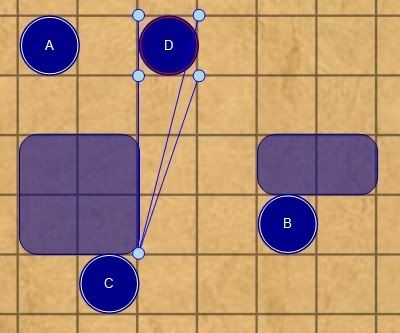
C has LOS to D, and D does not have cover. Two lines from C run along the wall, but they do not cross the wall.
DC is a little trickier, of course, because very often the walls start somewhere in a square instead of being the square, as was the case in SWM. So you only have to draw LOS along the walls, not necessarily its square's border lines. That makes using diagrams like
AoDoooo
ooooooo
wXooww
wwooBo
wCoooo
a little tricky and misleading.
Having a sight line to that intersection does not mean you can see space B. Following on from that, just because you can see an intersection, does not mean you have LoS to every square meeting at the intersection.
Back to OP, Hreth, question ... A and B do not have LoS to each other. Focus on the example on page 13 of rule book, in particular the intersection of the top right hand corner of the Shadow Mastiffs space. Break it down what the "seeing" that particular intersection means to the three squares in the example. Having a sight line to that intersection does not mean you can see space B. Following on from that, just because you can see an intersection, does not mean you have LoS to every square meeting at the intersection.
Again, this has been proven by multiple posters to be untrue. A and B do have LoS to each other. LoS does not require sight lines to each corner...They have LoS but both have cover against the other...
Back to OP, Hreth, question ... A and B do not have LoS to each other. Focus on the example on page 13 of rule book, in particular the intersection of the top right hand corner of the Shadow Mastiffs space. Break it down what the "seeing" that particular intersection means to the three squares in the example. Having a sight line to that intersection does not mean you can see space B. Following on from that, just because you can see an intersection, does not mean you have LoS to every square meeting at the intersection.
Again, this has been proven by multiple posters to be untrue. A and B do have LoS to each other. LoS does not require sight lines to each corner...They have LoS but both have cover against the other...
In this scenario, there is no LOS, if the wall encloses the whole square:
..A♦
..♦♦
..B♦
Should the wall only enclose part of the square (as often is the case), A and B do have LOS to and cover from each other.
The diagram is inaccurate.
Going back to the examples in the rule book, why is there no LoS to space B (diagram on page 13)?
I do not see a difference between running along a wall (as in the OP) and merely touching the corner of a wall square at the intersection (as in the diagram on page 13).
I can see a LoS article coming up just as with DDM OE, DDM RE and SWM to help resolve this ...
So nicking square B on page 13 doesn't grant LOS to it. Otherwise nicking the wall would grant the Mastiff in that example cover, since nicking it, would be looking through it.
If the WarWizard has a clear shot at the Mastif, then he would have LoS on square B as well. The same corner that does not grant cover for the mastif would not block LoS either.
The old DDM rule clarified this mess a bit better. Basically anything on the same side of a line with the attacker and a wall was considered behind the wall. But it won't really work the same here, because enemies grant the same protection, and that would get ridiculous. DDM didn't have this issue, because you had to target the closest creature.
There's no easy fix to this, it will have to go one way or the other. One way makes it too easy to get cover and the other way makes it too difficult.
Maybe just changing the wording of Cover to say "touching a wall" as opposed to "crossing a wall". That way LoS is only blocked if it actually intersects, but cover is granted by merely nicking the wall corner. This still leaves a crappy cover system in which adjacent creatures grant cover to each other at all times.
DDM worked that way. SWM worked that way. The DC rulebook example works that way.
People confuse "nicking corners" with "crossing squares/walls". I would bet good money that I am right. Probably WotC should clear this up, but I don't see why I should be wrong.
C has LOS to D, and D does not have cover. Two lines from C run along the wall, but they do not cross the wall.
It is this example my question refers to (although it would have been cleaner if you had placed D one square to the left and inquired about LoS instead of cover).
To be specific, when a line runs along a wall, does it count as "crossing the wall"? That is the heart of my question.
It is this example my question refers to (although it would have been cleaner if you had placed D one square to the left and inquired about LoS instead of cover).
To be specific, when a line runs along a wall, does it count as "crossing the wall"? That is the heart of my question.
No! Of course it doesn't. For example:
ooooBx
ooooox
ooooox
ooooox
ooooAx
Would you consider A not having line of sight from its 2 right corners to B's 2 right corners? Of course not. In that case, why would:
ooooBx
ooooox
ooooxx
ooooxx
ooooAx
be any different? A's 2 left corners still have line of sight to B's 2 left corners. There is still cover though.
It is this example my question refers to (although it would have been cleaner if you had placed D one square to the left and inquired about LoS instead of cover).
To be specific, when a line runs along a wall, does it count as "crossing the wall"? That is the heart of my question.
No! Of course it doesn't. For example:
ooooBx
ooooox
ooooox
ooooox
ooooAx
Would you consider A not having line of sight from its 2 right corners to B's 2 right corners? Of course not. In that case, why would:
ooooBx
ooooox
ooooxx
ooooxx
ooooAx
be any different? A's 2 left corners still have line of sight to B's 2 left corners. There is still cover though.
This looks completely wrong! If my whole square is behind a wall, why should a mini standing directly opposite of mine have LOS? This makes absolutely no sense. IMHO you take a (admittedly) sloppy wording and change the complete LOS rules, WotC have used in the past, into a whack version of it. The picture example of page 13 tells us the complete opposite. Why do you ignore that?
Please, some WotC person clear this mess up! The way that LOS is interpreted here makes my head hurt, because years of gaming tell me otherwise.
Please, some WotC person clear this mess up! The way that LOS is interpreted here makes my head hurt, because years of gaming tell me otherwise.
That's your problem, not mine. And my LoS definition isn't incorrect. What's the point of taking cover behind a wall if you can't see your target? I'm starting to wonder how you rule LoS through arrow slits and murder holes...
Please, some WotC person clear this mess up! The way that LOS is interpreted here makes my head hurt, because years of gaming tell me otherwise.
That's your problem, not mine. And my LoS definition isn't incorrect. What's the point of taking cover behind a wall if you can't see your target? I'm starting to wonder how you rule LoS through arrow slits and murder holes...
Not my problem, because I will keep playing it the way LOS has been handled by the other WotC games in the past, until someone official tells me otherwise. If a wall covers the whole square, there is no reason why I should be able to see the square on the complete opposite side of the wall. Why do you ignore the picture on page 13 and tell us that it is possible to "look through/around" a wall? The picture clearly erases any questions about the wording (that could work one way or the other). That is why they put it into the rulebook.


As per the rules, both Wizard positions are exactly the same for making a ranged attack onto the cat.
In both images the Wizard has LoS and the cat does not have cover.
Not my problem, because I will keep playing it the way LOS has been handled by the other WotC games in the past, until someone official tells me otherwise.
That's fine, and it's a good house rule for you to use if you want. In organized play, however, you'll have to use the rules in the rulebook, which state that if you can trace a straight line from one corner of the attacker's square to one corner of the defender's square (or one corner of a square in the defender's space), then the attacker has line of sight, and the attack can proceed.
In the case of both being behind a wall, think of it as the figures will have to lean out to attack, and they shoot each other when they peek out.
If a wall covers the whole square, there is no reason why I should be able to see the square on the complete opposite side of the wall. Why do you ignore the picture on page 13 and tell us that it is possible to "look through/around" a wall? The picture clearly erases any questions about the wording (that could work one way or the other). That is why they put it into the rulebook.
As I said above, you're leaning out to fire. You're not staring through the wall. Try it in real life. If you peek around a corner of a sufficiently short wall (say, five feet long), you'll be able to see some of the ground on the other side of the wall.
The picture in the rulebook doesn't have anything at all to do with this case. It's a completely different case that shows how line of sight works. The case in question now is a special one, and it meets the requirement of having line of sight, with the defender having cover.
This is a new game, and the rules are slightly different from what has come before. Comparing it to the old system creates confusion, which is evident in this thread.
The picture in the rules actuallly is EXACTLY this situation. According to your interpretation of the rules of "peeking around corners and being shot in the face" the War Wizard should also be able to see the Mastiff on square B, because his LOS touches the corner of it. Now please tell me, why the War Wizard doesn't see it, when you only need to touch a corner (according to your interpretation of the rules)?
Don't get me wrong, I don't "want" to be right on this one, I just don't belive that you are, when WotC handled LOS otherwise in all their other previous minis games, where it caused no confusion. As soon as Chris or some other official rules guy (or gal) tells me how it works, I will gladly play it that way. I have no problem with this game working slightly otherwise than the previous ones, if I should be wrong on this one.
If you prove to be right, I will salute you for your better understanding of the rules, where I failed, although I really tried to see it your way, but the example in the rulesbook tells me otherwise. The only statement I read about the example picture was something like "the picture must be wrong". Since there is no other official resource about LOS yet, I assume that the picture is correct and WotC meant LOS to work the way it did in the past with SWM and DDM.
The picture in the rules actuallly is EXACTLY this situation. According to your interpretation of the rules of "peeking around corners and being shot in the face" the War Wizard should also be able to see the Mastiff on square B, because his LOS touches the corner of it. Now please tell me, why the War Wizard doesn't see it, when you only need to touch a corner (according to your interpretation of the rules)?
It's not exactly the same, no. It is similar, though; I will grant you that. In the case of the picture in the rulebook, it makes sense that, if the Shadow Mastiff has no cover in its location, then it will still be seen in square B, by the simple fact that those squares share a point. The War Wizard should have line of sight at B, or the Mastiff should have cover in its original location.
In the case of the straight wall, the target square has two corners visible to the attacker. It's similar, but not quite the same, and I could see WotC amending the LoS requirement to 2 corners, which would allow the shooting down the wall and make the picture correct.
Don't get me wrong, I don't "want" to be right on this one, I just don't belive that you are, when WotC handled LOS otherwise in all their other previous minis games, where it caused no confusion. As soon as Chris or some other official rules guy (or gal) tells me how it works, I will gladly play it that way. I have no problem with this game working slightly otherwise than the previous ones, if I should be wrong on this one.
Honestly, I don't care who's right or wrong. I can see your position, since you hold to the picture, while I hold to the text. It is confusing on fourth read here (I tend to skip over example diagrams unless I need them to explain the text. In this case, the text was pretty clear), and a ruling is needed.
Part of my thing may be that I didn't play DDM. I bought the minis, but could find neither the time to go to the store nor the money to maintain a competitive warband in the first place.
If you prove to be right, I will salute you for your better understanding of the rules...
No salute is necessary. There are times when I take great pleasure in being right, but this is not one of them. Those cases tend to be with my friends where I can laugh at them for saying stupid things. In this case, I would simply be right or wrong. No big deal. I imagine a FAQ will be incoming with clarifications on this, confusion gaze, Block, and a few other things.
So it all comes down to defining the term "square" to have easy rulings on this one.
Well, we'll (hopefully) see what the official ruling brings.
As per the rules, both Wizard positions are exactly the same for making a ranged attack onto the cat.
In both images the Wizard has LoS and the cat does not have cover.
Untrue. In the first image the top left corner of the War Wizard's square is unambiguously able to draw a straight line to all four of the Shadow Mastiff's square's corners without being superposed over the border of a wall square. In that case the lower left corner, which is the one shared with the second image and is therefore the one the War Wizard in the second image has to use to look for LOS/cover, is irrelevant.
If you want a better example of how Gapraid's interpretation is clearly in the wrong, just draw a corridor that is a single square wide and put the Shadow Mastiff and War Wizard both in the corridor, and explain that by his interpretation that means the Shadow Mastiff has cover, even though they are both smack dab in the middle of a corridor, because there are no corner of the War Wizard's square that can see all four corners of the Shadow Mastiff's square if you consider the border between an empty square and a wall square to be 'crossing a wall' per LOS rules.
If you want a better example of how Gapraid's interpretation is clearly in the wrong, just draw a corridor that is a single square wide and put the Shadow Mastiff and War Wizard both in the corridor, and explain that by his interpretation that means the Shadow Mastiff has cover, even though they are both smack dab in the middle of a corridor, because there are no corner of the War Wizard's square that can see all four corners of the Shadow Mastiff's square if you consider the border between an empty square and a wall square to be 'crossing a wall' per LOS rules.
To be fair, that is the opposite of what Gapraid is saying. That is what myself, TheWok and Dardor are saying... which is a direct interpretation on the rules and example in the rulebook.
The image is wrong, or the definitions of LoS and Cover are wrong. No question about it at this point. The fact we have no answer yet, probably has something to do with GenCon, but I have faith in Chris and Peter to make things right.
In DDM, this same rule had to be clarified with different rules (see page 18). It's all a bit of a cluster-mind-farg. I personally got hosed in a tournament by some wiggly-finagled LoS loop hole shannannigan ;)
ddmguild.com/downloads/original/Rulebook...
To be fair, that is the opposite of what Gapraid is saying. That is what myself, TheWok and Dardor are saying... which is a direct interpretation on the rules and example in the rulebook.
Thank you very much! I already wanted to protest.
Actually DarkAngel1979 gave me a very good argument why "my version" of the rules is correct:
If you count the lines surrounding the squares as being part of the square itself, that would be also true for walls, covering a complete square (see the Dungeon tiles). Then why should you be able to "see around corners", if you actually crossed a wall square?
To be fair, that is the opposite of what Gapraid is saying. That is what myself, TheWok and Dardor are saying... which is a direct interpretation on the rules and example in the rulebook.
I'm sorry, what? I am in agreement with DarkAngel1979 here.
As per the rules, both Wizard positions are exactly the same for making a ranged attack onto the cat.
In both images the Wizard has LoS and the cat does not have cover.
Untrue. In the first image the top left corner of the War Wizard's square is unambiguously able to draw a straight line to all four of the Shadow Mastiff's square's corners without being superposed over the border of a wall square. In that case the lower left corner, which is the one shared with the second image and is therefore the one the War Wizard in the second image has to use to look for LOS/cover, is irrelevant.
If you want a better example of how Gapraid's interpretation is clearly in the wrong, just draw a corridor that is a single square wide and put the Shadow Mastiff and War Wizard both in the corridor, and explain that by his interpretation that means the Shadow Mastiff has cover, even though they are both smack dab in the middle of a corridor, because there are no corner of the War Wizard's square that can see all four corners of the Shadow Mastiff's square if you consider the border between an empty square and a wall square to be 'crossing a wall' per LOS rules.
So confused...
It would, however, explain the puzzling LOS example image in the rulesbook.
To be fair, that is the opposite of what Gapraid is saying. That is what myself, TheWok and Dardor are saying... which is a direct interpretation on the rules and example in the rulebook.
I'm sorry, what? I am in agreement with DarkAngel1979 here.
I clearly wrote that according to my interpretation of the rules you don't treat the borderlines of the squares as being actual part of the squares. So it is 100% possible to shoot straight through a corridor.
According to your interpretation of the rules you can shoot around 2 corners to hit a mini standing on the opposite side of a wall, because you draw LOS to the borderlines of the square the target is in, but ignore the borderlines of walls, which in itself sounds paradox. If a mini stoud there, where the wall is in that example, you wouldn't be able to shoot around it. Makes sense? I guess not. Or are you able to look around enemy minis as well?
I am quite sure that the designers of the game didn't shoot around two corners, when they playtested it. But I could be wrong, of course. I just think that it makes the game much more complicated to play it the way you do.
I would be very thankful if we could leave it to the official guys to clear this mess up, since we achieve nothing by being able to confirm our points of view, only because the rulebook is flawed on this matter.
According to your interpretation of the rules you can shoot around 2 corners to hit a mini standing on the opposite side of a wall, because you draw LOS to the borderlines of the square the target is in, but ignore the borderlines of walls, which in itself sounds paradox. If a mini stoud there, where the wall is in that example, you wouldn't be able to shoot around it. Makes sense? I guess not. Or are you able to look around enemy minis as well?
Of course you can shoot it. It would have cover (in Dungeon Command) and superior cover (in D&D). So you're most likely not going to hit anything. And even if another mini stood there, you could still shoot around it. Enemy minis grant each other cover though. I haven't changed my stance on this through the whole conversation.
Since it is impossible for me to understand the sense in being able to shoot around a mini, if (by the rules) it should actually block LOS, I quit arguing with you. Until I get an official answer on this, I will play LOS the way I am used to it, as shown on the example picture on page 13. You may, of course, play according to an exploitation (at least that is my thought on that matter) of a sloppily written rule. I wonder why I am the seemingly only person here that is under the impression the rules text might have been written poorly, instead of the example being incorrect?
From now on I will only keep reading this thread and stop responding, as long as my understanding of the rules isn't interpreted wrongly, as happened above. It is tiring to discuss a rule, where the officials don't give a statement. I just wonder, why they don't? Probably because I am right and the rules have been written poorly on LOS?
We'll see.

Cheers,
Merric
It will not be a simple one line fix to explain the 'running along a wall situation (it never has been for the previous miniatures games).
The missing piece of information that will make sense to the old DDM players: the outside wall corners take up 3/4rds of the square - on the old maps, they often were marked with a little plus symbol exactly halfway through the square. All of the corners on the outside maps count as those 3/4 or 1/4 filled squares.
That's why the mastiff has no cover from the war wizard on page 13.
..A♦
..♦♦
..B♦
Does A have line of sight to B, where ♦ is a wall?
A and B do not have line of sight to each other.
Sorry, I was just alerted to the thread.
The missing piece of information that will make sense to the old DDM players: the outside wall corners take up 3/4rds of the square - on the old maps, they often were marked with a little plus symbol exactly halfway through the square. All of the corners on the outside maps count as those 3/4 or 1/4 filled squares.
That's why the mastiff has no cover from the war wizard on page 13.
..A♦
..♦♦
..B♦
Does A have line of sight to B, where ♦ is a wall?
A and B do not have line of sight to each other.
Peter I am so confused...

Can you plz explain why on page 13, if the Mastiff was on B that there is no LoS? I mean the original position, position A, and position B, all have in common 1 corner that should give LoS.
Maybe I am just not understanding.
To determine if an attacking creature (or any other source) has line of sight to a target creature, draw a straight line from 1 corner of any square in the attacking creature’s space to any corner of at least 1 square in the target creature’s space. (You can use a ruler or a piece of string.) If that line does not cross a wall, or a square occupied by another enemy creature or an obstacle, the attacking creature has line of sight to the target.
According to this text, square B satisfies the condition for Line of Sight. It's a huge inconsistency. To be consistent, there needs to be one of two possible rulings:
1: The wizard has a clear shot at the mastiff in its original position, which means he has Line of Sight to the mastiff in squares A and B, but both positions provide cover, or
2: The wizard has line of sight to the mastiff in its original position, but the wall provides cover. In this case, the wizard has no line of sight to squares A and B.
Any other way of ruling this situation is completely alien to any logic I can come up with. The text would support the first. The picture supports neither. Alternatively, the rules for LoS can be rephrased so they reflect the image and posted in an errata document.
Once again, it is clear that "seeing" and intersection of a group of squares does not give LOS to all four squares making that intersection.
As I have pointed out before, the diagram on page 13 with its accompanying text explains this. That knicking the corner of the wall blocks LOS to space B.
At least now everyone knows how it works.
At least now everyone knows how it works.
I actually have no idea. It seems completely arbitrary to me. The rules text needs to be updated with more specific guidelines for determining LoS.
At least now everyone knows how it works.
I actually have no idea. It seems completely arbitrary to me. The rules text needs to be updated with more specific guidelines for determining LoS.
I agree with you regarding the need for an update/clarification. LOS has always caused a few problems in miniatures games, and there has never been a one line fix.
But it is far from arbitrary ... being able to see tiniest slither of a space is important in the game.
Follow the link and have a look at the Wardrums Rulebook, page18. In my opinion, the diagram on the page gives a pretty good explanation of LOS and cover, and spot on what it means for Dungeon Comman, even though it is meant for a different game.
www.wizards.com/default.asp?x=dnd/mi/err...
Below is a copy of the page of the rulebook.

At least now everyone knows how it works.
I actually have no idea. It seems completely arbitrary to me. The rules text needs to be updated with more specific guidelines for determining LoS.
I agree with you regarding the need for an update/clarification. LOS has always caused a few problems in miniatures games, and there has never been a one line fix.
But it is far from arbitrary ... being able to see tiniest slither of a space is important in the game.
Follow the link and have a look at the Wardrums Rulebook, page18. In my opinion, the diagram on the page gives a pretty good explanation of LOS and cover, and spot on what it means for Dungeon Comman, even though it is meant for a different game.
www.wizards.com/default.asp?x=dnd/mi/err...
Below is a copy of the page of the rulebook.
XXXXXXXXXXXXXXXXXXXX
A B
XXXXXXXXXXXXXXXXXXXX
Based on these rules... If 2 creatures were in a 1 square wide hallway, they would NOT have LoS?
None of the lines you use to test for LOS are blocked by a wall.
oh I just re-read it... I understand now.
The missing piece of information that will make sense to the old DDM players: the outside wall corners take up 3/4rds of the square - on the old maps, they often were marked with a little plus symbol exactly halfway through the square. All of the corners on the outside maps count as those 3/4 or 1/4 filled squares.
That's why the mastiff has no cover from the war wizard on page 13.
Peter, if there is a clear line of sight from the War Wizard to the Mastiff through the corner of the wall square, then why isn't there clear line of sight from the War Wizard to the square marked "B"? The Mastiff and the "B" square share the same corner. If line of sight is "blocked by the edge of the wall" to square "B", as the text states, then why isn't the same line blocked to the Mastiff's square?
I see three options:
1.) The diagram is wrong. The line is "blocked by the edge of the wall", as stated in the text, and thus the Mastiff has cover.
2.) The diagram is wrong. The line is not blocked by the edge of the wall, and therefore there is Line of Sight to square "B".
3.) The diagram is correct. Somehow, the line passing near the corner of the wall does not interfere with Line of Sight to the Mastiff, but doesn't provide Line of Sight to square "B".
I suspect that the diagram is correct, and that the design intent is similar to what was in the War Drums rules. Something like:
"A line that runs along a wall, nicks the corner of a wall, or passes through a square containing wall terrain (i.e, near a rounded corner) does not provide line of sight. However, such lines do not grant cover as long are there are other valid lines of sight to the target."
Clarification appreciated.
If you made the lines part of a mini's square, it would make things complicated, since 4 squares would share one corner, thus a mini in 1 square, would stand on the neighbouring squares as well, if they shared the corner. This makes your head hurt, just like the "boomerang" attacks made mine hurt as well.
 It really makes things easier, if you don't treat the surrounding lines of a square as part of a square. Then also the rules text would be accurate. It is all a question of defining the term "square".
Hi Poljack, option 3 is the correct one.
Explaining the situation without adding some 'new' game mechanic that is not supported in the current wording of the rules is the difficulty. There is a possible clue to the mechanic in the diagram on page 13. There are sight lines tested for and drawn in red that have all been blocked.
The problem is using the corners of squares alone to check LOS. I do believe the previous miniatures games (DDM and SWM) used this kind of mechanic and quickly identified unsatisfactory situations, like in the original post and creatures being able to "see" each others space but unable to draw sight using any corners. Perhaps one of the reasons for using corners is that it nicely leads into checking for cover.
In previous minis games the mechanic shifted from using corners to check LOS to using lines drawn from 'source square/space to target square/space'. Perhaps the LOS mechanic needs to be changed to something like in the current DDM RE Battle Rules ...
Line of Sight: A creature has line of sight to a target square, or enemy, if one can draw an unblocked line from any point in the creature’s space to any point in a target's space. A line is blocked if it touches a wall or enters or passes through terrain that can block line of sight.
Cover will still be determined using current rules, though there is further problem based on the wording in the DC rulebook.