These essays start with my initial response to the module, work their way through prep, and will eventually continue with the results of multiple playtests I have planned over the next couple weeks.
Why am I posting them here? Because I think they might be of interest.
The essays are:
First Impressions
First Impressions (With Spoilers)
The Last of the First Impressions
Analyzing Design - The Dwarf Fighter
Analyzing Design - Traps
Analyzing Design - Remixing the Chamber of Statues
Analyzing Design - Rotten Cherubs (and continued here)
Remixing KOTS - Kobolds
Remixing KOTS - The Kobold Lair
Remixing KOTS - Bonus: Slyblade Hunter
Remixing KOTS - Arriving in Winterhaven
Remixing KOTS - On the Street in Winterhaven
Remixing KOTS - Winterhaven NPCs
Remixing KOTS - Winterhaven Developments
Remixing KOTS - Cultists in Winterhaven
Remixing KOTS - The Ruined Keep
Remixing KOTS - Kalarel's Ritual and the Dragon Burial Site
Remixing KOTS - The Three Clue Rule
Playtesting 4th Edition
Playtesting KOTS - The Kobold Lair
Playtesting KOTS - Running It a Second Time
Campaign Journal 1
With more to come. Comments are more than welcome.
For several months now my plan for 4th Edition has been to run the preview adventure -- Keep on the Shadowfell -- for my regular D&D group. My goal is to approach that experience with a completely open mind, see how it goes, and then use it to decide whether or not to spend the money on the core rulebooks. My current campaign, set in Ptolus, would stay 3rd Edition in any case. But if 4th Edition convinces me to make switch, then I'd probably use it for my next campaign.
A couple of days ago my copy of the module arrived from Amazon. I've now read through it, and have a few thoughts to share. So, on that note...
(1) The production values of the module are disappointing. It has a cover price of $30 and Amazon had been advertising it as a hardcover. It isn't. Two flimsy pamphlets and three poster maps are packaged in a lightweight cardboard folder. And when I say "flimsy pamphlet" I mean flimsy. The paper is of a lighter weight than that previously used in Dragon and Dungeon magazine and the "covers" of the pamphlets are of the exact same paper. I am extraordinarily gentle with my reading material, and after a single reading the ink is already being rubbed off the edge of one "cover". Frankly, I will be shocked if these last through a single session.
The poster maps are pretty nifty, although they follow the current WotC style of fetishizing light sources. Everything seems to glow: Walls, ceilings, furniture. These poster maps are lovingly rendered with computer graphics -- but they have no reality to them.
(2) The writing in the Quick Start Rules is abominably bad. For anyone who hasn't been played a roleplaying game before, the content here is completely inadequate for teaching them how to actually play the game. On the other hand, the writer has chosen to address the reader as if they had no idea what an RPG was. So the newbie isn't helped and the experienced player feels like they're being talked down to... who exactly is the target audience supposed to be for this pablum?
(3) The pregenerated characters, instead of being included on separate sheets (which the folder format would have allowed) are instead found at the back of the Quick Start Rules. This makes no sense.
(4) This may have been previously known, but it was the first time I realized that saving throws have a 55% chance of success instead of a 50% chance of success. (Instead of failing on 1-10 and succeeding on 11-20, they fail on 1-9 and succeed on 10-20.) I have no idea why they chose to do it that way.
(5) I am still annoyed that they undid 3rd Edition's fix to the critical hit mechanics.
(6) The streamlined actions (standard/move/minor/free) are nice to see, along with the accompanying simplification of the rules for charging and running. I think they were right to conclude that the complexity of full actions wasn't giving much in return. And I think replacing the concept of a 5-foot step with the idea of a "shift" (which doesn't provoke an AoO but does require a move action) also simplifies the flow of combat.
(7) It is completely impossible to play 4th Edition without miniatures. Unlike every previous version of the game (including 3rd Edition), the game literally does not function without a grid. I typically use miniatures, but this still annoys me.
(You will probably still hear people talk about how 4th Edition can be played without miniatures. But given the sheer number of abilities which are only useful because they allow for very precise movement on the combat grid, this is roughly akin to claiming that you can play Chess without a board. While it's true, it's only because you're explicitly imagining the board in your head. In 3rd Edition this wasn't the case: When I played without miniatures in 3rd Edition, I was imagining the game world and then using the mechanics -- which were all based on real-world measurements -- to adjudicate. The 3.5 revision weakened that connection somewhat by using squares as the default terminology, but the underlying mechanics of 3.0 were still essentially unchanged. 4th Edition embraces the grid completely and irrevocably.)
(8) The fact that you lose unspent action points when you take an extended rest reminds me of this blog post at Rampant Games. It's a mechanic that encourages players to push on without rest... unless, of course, they've expended all their accumulated action points. (However, I have been informed that you can only spend one action point per encounter. This rule doesn't appear in the Quick Start Rules, but if it's true then it obviates this advantage of the system entirely.)
(9) Contrary to the designers' claims, however, I doubt that the 15-minute adventuring day is going anywhere. This was inevitable, of course, because the 15-minute adventuring day had nothing to do with the system (except insofar as the system features daily-based spike powers) and everything to do with DMing style.
SPOILER WARNING
The following thoughts contain minor spoilers for Keep on the Shadowfell. If you don't want to be spoiled, don't read it. And if you're in my gaming group then you definitely shouldn't be reading it.
You have been fairly warned.
THUS ENDETH THE SPOILER WARNING...
(10) The editing is atrocious. I can only hope they do a better job with the actual core rulebooks. For example, I'm pretty sure that the Empire of Nerath and the Empire of Nareth are actually the same thing.
(11) Unfortunately, these types of gratuitous errors aren't limited to the fluff content. The rules are also riddled with errors. For example, the quick start rules define two types of cover: Normal Cover and Superior Cover. These are naturally referred to in various places throughout the adventure: A treeline or a boulder or a piece of furniture will either grant normal cover or it will grant superior cover.
Unfortunately, some obstacles will also grant "cover" -- which is neither "normal cover" nor "superior cover". I'm guessing that I'm supposed to interpret "cover" as being "normal cover", but when you take the trouble to define a precise technical term then you should make the effort to actually use the precise technical terms you've defined.
(12) Other rules aren't explained properly. For example, when describing the rules for handling a pit trap, the module states "if a bull rush forces a creature into the pit, it can immediately attempt a saving throw to avoid going over the edge". Fair enough. But I've been led to understand from other sources that this is true for any type of forced movement that would cause a character to suffer falling damage. Almost all of the pregen PCs, in fact, have forced movement abilities. Why didn't they include the complete rule?
(13) Another example: Upon first reading the Quick Start Rules, I was annoyed by the fact that a dying character was doomed to die unless someone helped them. According to the Quick Start Rules, a dying character must make a saving throw each round. If they succeed, their condition stays the same. If they fail three times, however, they die. Apparently, I thought, no one ever wakes up on their own after being knocked unconscious in 4th Edition Land.
I have since been led to understand that, in other preview material, the full rule has been revealed: If you roll a natural 20 on your saving throw, you wake up with one-quarter your hit points. Why on earth wasn't that sentence included?
(14) Several NPCs in the adventure use rules (like the recharge rules and aura rules) which are never explained. This, frankly, is completely inexcusable in an introductory product.
(15) Making the rules even more confusing is the fact that there are actually two sets of Quick Start Rules: One for the players and another for the DM. At first I thought this was a practical piece of utilitarian design: The DM can have a copy of the rules for easy reference and so can the players.
But then I discovered that they were actually two different sets of Quick Start Rules. And for reasons beyond my comprehension, the player's Quick Start Rules don't include a lot of the rules the players will need to play their characters. (For example, they don't even include all of the rules necessary to understand the abilities on the pregenerated character sheets.)
So, for me, the entire player's Quick Start Rules packet is useless: I'll be xeroxing the pregenerated characters out of it (so that they can actually be used) and I'll be xeroxing the DM's Quick Start Rules so that my players will actually have the rules they need to play the game.
(16) The first two encounters in the adventure use the exact same map and the exact same concept (kobolds ambush the party while they're traveling on the road). The sense of deja vu was palpable even as I was reading it. I can only imagine the experience at the game table will be moreso.
What makes this design even more ridiculous is that the second ambush on the road doesn't make sense. The first ambush happens while the PCs are on their way to the village of Winterhaven. The second is supposed to happen shortly after they leave it. But after leaving Winterhaven, the adventure assumes the PCs will go to one of two locations: Either a dragon burial site or the kobold lair.
Neither of these locations lie on the road. The most direct route from Winterhaven to either location is, in fact, directly through the wilderness. So why does the adventure assume you'll be able to (essentially) reuse the ambush-on-the-road scenario when the PCs won't be on a road?
(17) "The tall hobgoblin calls to the others in Common: 'Don't kill 'em. We can sell 'em to the Bloodreavers as slaves.'"
This is apparently a bit of foreshadowing for H2 Thunderspire Labyrinth. Pity they didn't include any rules for dealing nonlethal damage.
(18) The skill challenges in this adventure are particularly lackluster. In particular, they continue to demonstrate the same railroading qualities that the sample posted to WotC's website did. It's possible that this is merely because this is an introductory adventure, but it certainly didn't do much to convince me that the core rulebooks are going to resolve any of the problems I have with the mechanics WotC has shown us.
(19) Speaking of skill challenges, let's talk about Sir Keegan. Sir Keegan was the last commander of the keep before being driven mad by the emanations of the Shadowfell Rift. In his madness he killed his wife and his closest friends before the garrison of the keep turned on him, drove him into the dungeons beneath the keep, and sealed the entrance behind him. In the dungeons, Sir Keegan regained his sanity and, overcome with remorse, poisoned himself. He somehow ended up as a sentient undead skeleton (the details here are vague), and dedicated himself to making sure that the Shadowfell Rift was never open.
Now, bearing that story in mind, consider how the PCs will encounter Sir Keegan for the first time:
The raised dais in this old crypt holds a single coffin. Carved on the lid of the coffin is a warrior in plate armor with a sword laid across his chest, the point toward his feet. The heavy coffin lid explodes in a flurry of dust. A humanoid skeleton girded in plate armor rises from the cloud. It holds aloft a longsword. "The rift must never be opened!" it croaks. "State your business, or prepare to die!"
Wow. Dramatic.
But let's take a moment and analyze this: Who, exactly, built this crypt for him? Did he just decide to have one built for himself on the off-chance he might need it in the event that he would be driven insane, go on a murderous rampage, and then be trapped in the dungeons beneath the keep by his own men?
Well, perhaps Sir Keegan was a master stone-carver. And, after being trapped in the dungeons without any food, quickly chiseled out a crypt for himself before poisoning himself. And, naturally, after dedicating himself to making sure that the rift was never opened again he would just seal himself inside that crypt and never emerge... even while cultists set up shop next door and begin working to open the rift.
Makes perfect sense... right?
Okay, setting those problems aside, let's turn our attention to the meat of this encounter: The social skill challenge that Sir Keegan triggers. A social skill challenge that will result in brilliant conversational gems like this one:
KEEGAN: You wear a fearsome demeanor. Are you really as formidable as you look?
PC: Yup!
KEEGAN: Awesome. Well, in that case I totally believe that you're here to stop the cultists. Would you like my magic sword?
... sound kinda cheesy? Well, perhaps you'll prefer this one:
KEEGAN: If you trust your senses not to betray you, tell me what you see before you.
PC: Umm... a dead guy standing in the remains of his crypt?
KEEGAN: Wow! You've got keen eyes! With eyes like those you must be here to stop the cultists. Would you like my magic sword?
Seriously. I'm not even kidding around. Keegan's first bit of dialogue in each example is lifted straight from the module, as is the suggested skill check. In order to succeed at this social skill challenge, the PCs have to make four successful skill checks before failing at four skill checks, with each skill check representing a Q&A exchange. (The PCs can also decide to go with straight up Diplomacy and/or Bluff checks if they prefer.)
(20) They finally fixed the encounter format they pioneered in the waning days of 3rd Edition. They're still using the useful and easy-to-access two-page spread for each encounter, but rather than splitting crucial information across two different locations (by having a keyed description in one place and the encounter information in another), they're using the encounter format for each keyed area.
I note, however, that the format requires every last square inch of a dungeon to be covered by an encounter. I suspect they consider this a feature: "After all," they'll say, "An empty room is a boring room."
But, of course, just because a room doesn't have a monster or a trap in it doesn't mean that it's empty or boring. More importantly, if the PCs know that there's going to be something exciting behind every single door that they kick in, it rather lessens the moment of anticipation.
The other thing I'll note about the new format is that the designers made a big deal in their pre-release publicity about how 4th Edition would be featuring multi-room encounters. I guess this is sort of true, but the only thing that's really changed is that they're drawing their arbitrary "monsters won't go past this point" lines in slightly different ways. I doubt I'll be seeing any meaningful difference in play, since my 3rd Edition campaigns already feature multi-room running battles on a regular basis. This is another one of those areas where my experience seems to have been considerably at odds with the "common wisdom".
But we'll see what happens in actual gameplay. It would actually be pretty awesome if I was totally surprised.
My overall impression with the plot and structure of the adventure can be pretty much summed up with this: I kept flipping back to the credits page to convince myself that Mike Mearls and Bruce Cordell were actually responsible for this.
Bruce Cordell, for example, also wrote the inaugural module for 3rd Edition: The Sunless Citadel. The Sunless Citadel was a piece de resistance. I've played it once and ran it twice and I consider it one of the best D&D modules ever written.
Keep on the Shadowfell, on the other hand, seems rather lifeless and predictable. It's a paint-by-numbers D&D adventure.
Generic Fantasy Village #1 (a.k.a. Winterhaven) is lifeless, filled with cardboard cut-outs who are scripted with quests as if they were stock pieces lifted from Ye Local CRPG.
The Generic Goblin Encounters are uninspiring: Ambush. Guards. Barracks. Boss. Repeat.
Fight zombies in underground crypt. Fight skeletons in graveyard.
Fight Evil Priest in Demon Fane.
And I know that these are all classic archetypes that get used all the time. Heck, I'm using some of them right now in my Ptolus campaign. But you can use classic archetypes and breathe fresh life into them and you can use classic archetypes and end up with bland cardboard.
My impression of Keep on the Shadowfell, having read through it, is one of bland cardboard.
But this puts me in something of an awkward position. I still want to use Keep on the Shadowfell as a test run for 4th Edition, but I've only got one of two options:
(1) Run the adventure as written, despite the fact that I think there are fundamental adventure design problems that largely have nothing to do with the 4th Edition ruleset.
(2) Try to redesign the adventure.
The problem with option one is that the design problems could end up poisoning the well. If the session flops, is that because 4th Edition is a flop? Or does it just mean that the adventure isn't any good?
The problem with option two is that I don't actually know 4th Edition. If I go in and start mucking around with the encounter designs, I could very easily end up unwittingly sabotaging things that make 4th Edition fun to play in ways that 3rd Edition isn't. In other words, I could end up inadvertently obviating the entire point of the exercise.
So I think what I'll probably end up doing is something like a remix of the module: Leave the encounter design alone, but go in and futz around with the fluff text. Give the adventure a stronger backbone and a richer mythology. Flesh out Winterhaven to give it some unique character and depth. Maybe add a few more encounters to make the threat posed by the Keep a little more real and pervasive.
We'll see how that goes. I'll post an update once I've actually run the playtest. (Which, unfortunately, may not be for a couple more weeks. We had originally scheduled it for May 24th. But then the release date was pushed back and I didn't actually get the module until May 22nd, so that was out of the question.)
I thought I was done talking about Keep on the Shadowfell for a bit, but as I was prepping the adventure yesterday I had some interesting thoughts that I felt like sharing. These should give you some insight not only into how I go about prepping an adventure, but also how I analyze game design issues (both in the design of the system and in the design of the scenario).
Let's start by looking at the pregenerated fighter character. As most of you probably already know, there are basically three different kinds of abilities in 4th Edition: At-will abilities (which can be used as often as you like); Encounter abilities (which require a short rest to recharge); and Daily abilities (which require an extended rest to recharge).
(Some at-will abilities will also recharge irregularly or in response to conditions on the battlefield.)
I've been kinda thinking of these different abilities like this: At-will abilities are the ones which define your character; encounter abilities are nifty; and daily abilities are awesome.
With that in mind, let's take a look at the at-will abilities that the pregenerated dwarf fighter has at 1st level: Cleave and reaping strike.
CLEAVE - Fighter Attack 1
You hit one enemy, then cleave into another.
At-Will - Martial, Weapon
Standard Action - Melee weapon
Target: One creature
Attack: +6 vs. AC
Hit: 2d6+3 damage, and an enemy adjacent to you takes 3 damage.
REAPING STRIKE - Fighter Attack 1
You punctuate your scything attacks with wicked jabs and small cutting blows that slip through your enemy's defenses.
At-Will - Martial, Weapon
Standard Action - Melee weapon
Target: One creature
Attack: +6 vs. AC
Hit: 2d6+3 damage
Miss: 3 damage
I'm very impressed by the ways in which the utility of these abilities interlock with each other.
First, there is the obvious situational advantage: Cleave is going to be preferable when you're standing in the middle of a minion mob; reaping strike is going to be useful when you're facing off against a single opponent.
But, there's also another trade-off point that happens because reaping strike is more useful than cleave when an opponent becomes sufficiently difficult to hit. Here's the math:
The average expected damage per round for cleave is:
The average expected damage per round for reaping strike is:
If the probability to hit is 50/50, for example, then you end up with cleave doing an average of (13 x 50%) 6.5 points of damage per round and reaping strike doing an average (10 * 50% + 3 * 50%) 6.5 points of damage per round.
So if my math here is correct, reaping strike is going to deal more damage to your opponents in any situation where you have to roll a natural 12 or higher to hit. (With a slight hiccup because minions aren't affected by missed attack damage like reaping strike.)
On the one hand, I'm impressed by how two distinctive fighting styles emerge quite naturally out of these probabilities. When you're using cleave you're swinging away like wild because your significantly superior to your opponents (you have a 50/50 or better shot of hitting them); in the other you're performing a variety of jabs and cutting blows against a more skilled opponent, trying to find the weakest spots in his defense.
On the other hand, I'm impressed because of the meaningful tactical choice that these interlocking utilities give you. Either utility, by itself, doesn't constitute a meaningful tactical choice: If one ability is merely better against multiple opponents and the other is better against solitary opponents, there's no meaningful choice to be made. If you're fighting multiple opponents you'd use cleave and if you're fighting a single opponent you'd use reaping strike.
Similarly, if one ability was merely better against difficult-to-hit opponents and the other was better against easy-to-hit opponents, there's no meaningful choice to be made. If you're fighting difficult-to-hit opponents you'll use reaping strike and if you're fighting easy-to-hit opponents you'd use cleave.
But once you combine the two, meaningful choices emerge. There will still be times when the decision basically boils down to running the math and figuring out what your best expected damage is, but in most situations involving multiple foes you'll actually be making a meaningful choice about what your immediate goal is and how you want to pursue it. (I also have a fair degree of confidence that, as tactical choices proliferate at higher levels, these choices will become increasingly non-trivial.)
Now, there is one caveat to this, which is that the minion rules pretty much muck it up.[i
For one example of this, let's look at reaping strike: Because minions never suffer damage from missed attacks, reaping strike is completely useless against minions. So if you're trying to hit a minion, there will never be any conceivable benefit to using reaping strike. The tactical choice has once again been rendered completely moot.
On other hand, if minions were damaged -- and, thus, killed -- by missed attacks, the tactical choice between cleave and reaping strike is meaningful: Do you use reaping strike for a guaranteed kill on one minion or do you use cleave for a chance to kill two minions? It becomes a trivial decision when you're only facing off against a single minion, of course (since cleave has no advantage over reaping strike) -- but that's true of any situation when you're facing off against a single opponent and minions are designed to come in large numbers.
(Of course, this change would make reaping strike more effective on average. And I hardly know enough about the complete panoply of 4th Edition abilities to know what other effects such a change might have.)
But, overall, these are well-designed abilities that give rise to a well-designed character. It'll be interesting to see what the other 1st level fighter abilities are and how they interact with cleave and reaping strike.
One of the features of 4th Edition that has been widely touted in WotC's promotional material have been the new trap design focusing on active traps. Basically, the argument is made that traditional traps either (a) suck up a lot of time because they encourage players to make constant Search checks; (b) are nothing more than random dice rolls that deal out arbitrary damage; and/or (c) focus the spotlight on the player of the rogue while everyone else sits around twiddling their thumbs. The new 4th Edition-style traps will allow everyone in the party to participate in overcoming the trap.
This seems like a laudable goal, but the actual examples we were given turned out to be fairly lackluster. They still required skill checks to detect them. They were slightly more interactive than a simple pit trap, but were pretty tame compared to some of the stuff we saw in the Book of Challenges (a 3rd Edition supplement that came out back in 2002), Traps & Treachery (a D20 supplement from Fantasy Flight Games that came out in 2001), or Grimtooth's Traps (an entire line of supplements that date back to 1981).
(Which ties into one of the reasons I've been perpetually turned off by the 4th Edition preview material. They seem to be constantly shouting about how they've reinvented the wheel. I like wheels as much as the next guy, but when somebody asks me to get excited about them I tend to get turned off by the fake enthusiasm.)
As for the effort to make traps into something that everybody can take part in, that seems to have boiled down to: The rogue makes a lot of skill checks and, if that doesn't work, then everybody else can beat the crap out of it.
For example, here's the countermeasures for the Whirling Blades trap (the first example of their "innovative" 4th Edition traps):
- A character can engage in a skill challenge to deactivate the control panel. DC 22 Thievery. Complexity 2 (6 successes before 3 failures). Success disables the trap. Failure causes the whirling blades to act twice in the round (roll a second initiative for the trap).
- A character can attack the whirling blades contraption (AC 16, other defenses 13; hp 55; resist 5 all) or the control panel (AC 14, other defenses 11; hp 35; resist 5 all). Destroying either disables the entire trap.
Color me unimpressed. I mean, there's nothing wrong with that. But when you claim that one of the fundamental gameplay elements of D&D for the past 30+ years have "rarely had a positive effect on the game", then the examples you give of "fixing" the "problem" probably shouldn't look exactly like the stuff we've been seeing in our D&D supplements for the past 30+ years.
Keep on the Shadowfell has a few traps: There's a bog standard pit trap. There are some runes that cause characters to flee in panic. And then there's Area 16: The Chamber of Statues.
The Chamber of Statues is a two-part trap, but I'm only going to be talking about the first part. In this section there are three statues, starting with a large titan statue in the middle of the room which acts like a monster. On its initiative it uses its sweeping blow ability:
SWEEPING BLOW (standard; at will)
Close burst 3; +11 vs. AC against all non-Evil creatures in burst; 1d6+6 damage, and the target is knocked prone
In other words, the titan statue picks a square in either its own space or immediately adjacent to its space. That square is the center of an 7-square by 7-square area. It then makes an attack against all non-Evil creatures within that area.
The titan statue is accompanied by two dragon statues, each of which use a force breath ability:
FORCE BREATH (standard; at will)
Close blast 5; +7 vs. Reflex; 1d6+6 force damage, and the target is pushed 3 squares
In other words, if you try to circle around the titan statue's reach the dragon statues will hit you with their force breath and push you back towards the titan statue. It's a simple dynamic, but it has a lot of potential to be fun in play. Unfortunately, there are several design problems here.
THE WALK AROUND: One of the ways you can work your way through the trap is to make an Athletics check to jump onto the statue. This allows you to avoid the titan statue's attacks. So you could potentially jump onto the statue, avoid its attacks, jump off the other side and head to safety on the other side of the room (without ever getting close enough to the dragon statues to get targeted by their force breath).
The problem is that there's absolutely no reason to do that: You can simply walk right past the entire trap. Why? The titan statue's sweeping blow isn't triggered as a reaction -- its an action taken on the titan statue's initiative. Nor does the titan statue have reach (which would allow it to take opportunity attacks). That means, once the titan statue makes its first attack, everyone is free to walk right past it.
LACK OF COOPERATION: As with the sample traps posted on WotC's website, this trap features the ability to either whack on it or disable it. This theoretically opens up a bit more interactivity than the website samples because, in this trap, there are multiple targets that aren't dependent on each other: The thief could be working on the titan statue while the other characters are whacking away on the dragon statues.
Only that isn't actually true, because there's no reason to go anywhere near the dragon statues (even if you don't simply walk right past the entire trap): If you stick to the west side of the titan statue you're completely out of their range.
LACK OF COOPERATION 2: This trap also introduces the ability for non-Thievery checks to disable traps: The dragon statues (but not the titan statue) can be disabled by either four successful Thievery checks or six successful Arcana checks.
Setting aside the fact that disabling the dragon statues is completely irrelevant, there's a deeper design problem here: The Thievery and Arcana checks can't be used in conjunction with each other. Either you disable the trap using Thievery checks or you disable the trap using Arcana checks -- you can't mix-and-match.
Based on other traps in the adventure, this seems to be a frequent (but not required) feature of magic-based traps. However, it always requires more Arcana checks than Thievery checks, which means that you'll always see the exact same dynamic in play with traps of this type: The guy with the Thievery skill will try to disable the trap. If he fails, the guy with the Arcana skill will try to disable the trap.
This doesn't actually make the trap any more interactive, nor does it actually get more players involved in the process. (At any given time, there's still just one guy making skill checks.) It just means that the entire thing takes more time and becomes a lot more monotonous.
WotC claims that one of the problems with traps in 3rd Edition was that the rogue made a Disable Device check while everyone else sat around and watched him. So explain to me how this is "fixed" by giving us a trap in which the rogue makes 6+ skill checks in order to disable the trap while everybody else stands around watching them work?
(Why 6+ checks? An Athletics check to jump up on the statue. A Perception check (DC 25) to find the access panel. And then at least four Thievery checks to disable the statue. So it will take a minimum of 6 checks, but given the probable skill modifiers of the pregenerated rogue PC they'll probably be making 9 or 10 checks in total.)
JUST BEAT THE CRAP OUT OF IT: But none of what I've described actually matters because none of these statues can move and none of them have relevant ranged attacks. This means that the PCs will stay in the safe area by the northern door and use their ranged attacks to whittle away at the titan statue's hit points.
So this entire elaborate trap which, at first glance, appears to be filled with interesting possibilities, will, in fact, be resolved in one of three exceptionally boring ways:
(1) One of the PCs will suffer 1 or 2 attacks from the statue and then they'll all walk out of the room.
(2) The rogue will make a half dozen or more skill checks and then they'll all walk through the room.
(3) The PCs will engage in the most boring combat imaginable: Standing where the opponent can't possibly hurt them, the players will repetitively roll dice until they finally manage to rack up the magic number and can walk through the room unimpeded.
I honestly don't understand how such a lackluster encounter got designed. I also don't see how it could have possibly been playtested without such fundamental design errors being exploited by the playtesters. (And if it was playtested and the playtesters exposed its flaws, why weren't they fixed?)
Tomorrow I fix it.
I think someone really likes to see his on words on a page.
?
You don't like the review?
?
You don't like the review?
It's not a review. It's an essay(per the OP).
It's not a review. It's an essay(per the OP).
Nice dodge. Now could you answer my question?
What were you trying to say?
I am really very tired of people on these boards whos seem to surf them only to make snippy, snotty comments at other people's expense.
I think someone really likes to see his on words on a page.
One might make the same facile comment about the words on the pages of KotS. The key difference being JustinA's words are original and thoughtful, he didn't charge me $30 for the benefit of them, and they don't wipe off as I'm reading.
Lets take a gander at his first twenty, yes I said twenty, points.
1. the standard it's not what I thought it would be complaint. I don't know about anyone else, but I don't seem to have sweaty hands and rub my adventure like some genie lamp.
Call me crazy.
The 'light' sources around the object is for, shocker here, easy identification for all people playing.
2. I guess he didn't figure out that this is an introductory adventure. Should it come as a surprise that it may sound like it is reading down to supposed 'experienced players'?
3. Of course it makes sense. It's production sureties. Least amount of separate items that have to go into a product the more the quality control. I wonder how many adventures are missing some maps? Heck or are even missing the actual adventure. Now you want five separate character sheets to go in there as well?
4. Once he gets the rules maybe he'll know why?
5. 3e's crit system sucked. It fostered way, way, way too many cookie cutter builds. Thank the dice that it is gone.
6. Wow first item he likes.
7. No idea how you were able to play 3e without the grid, just too many feats, spells, ranges, etc. that required the grid. There is a number of people who are not able to visualize as well as others, giving them the grid helps in their understanding.
8. No comment until the rules are in my hand.
9. We wont know what happens with the 15 minute work day until the actual game is out for a while. Why even make a comment about it?
11. & 12. Instead of worrying about grammatical errors, it's not like this adventure is some grand work of modern writing, worrying if it's spelled nerath or nareth, is beyond me.
Meh this is getting to boring to even worry about.
Seems to me that the Op didn't read page 18, 21, 32, 35 These pages talk about how to embellish what is written on the page.
Of course he can't make all his points with the ideas in mind, then he would have something like six points less.
I wholeheartedly concur with almost everything JustinA has to say in his review, and I very much appreciate the lengths he has gone to to make his criticisms clear and concise.
I am really very tired of people on these boards who seem to surf them only to make snippy, snotty comments at other people's expense.
How about the people that are long winded, just to be verbose? Blasting people with a wall of text just to complain about spelling errors.
Perhaps instead of worrying about grammar or paper quality or if the math formula is concise with the fighter. He could have looked at the map and seen that everything is within a mile of the village Yet no one knows that much about what is going on? That stretches my suspension belief to far.
One might make the same facile comment about the words on the pages of KotS. The key difference being JustinA's words are original and thoughtful, he didn't charge me $30 for the benefit of them, and they don't wipe off as I'm reading.
Is it the norm for humans to have severe sweaty palm syndrome?
I've used the adventure in four sessions already, had 6 different people flip through it and not a single ink smudge. I did fold a couple pages on accident.
But I would take issue with your very first point. (Delivered in a typical snotty fashion.) I don't have sweaty hands either, but the ink is coming off my copy of the book, front and back. Indeed, it's a very common complaint.
Quite simply, the standard of the physical product is below par. And the adventure itself is lacking in atmosphere and originality.
This is not explained by the fact that it is a 'beginners' adventure. If anything, a lack of drive to the story will make it difficult for novice DMs to focus their players and thus much harder to DM.
Your complaint that he - in a review - should ignore grammatical and other errors is simply ridiculous. It doesn't have to be a 'great work' to merit proper editing. In fact most 'great works' of literature cost a helluvalot less than this to buy and pack a damn site more words into their pages.
We also don't know just how common of a complaint the ink is, we don't have the exact figures on how many have been sold compared to the number of ink smudging is occurring.
I've had more problems with the old style adventures with the cardboard covers, they all seemed to have the covers come off, except the ones that didn't even have their covers attached, but that was from 1e and 2e. This is my first premade adventure I have bought since The Night Below box set.
Again the adventure explains how to 'focus' the players onto the storyline. Truth be told the flow of the story is better than what I have witnessed from Dms who think they are really good at story telling and from the more recent products from third party publishers. It is also the one thing that people will always complain about. No matter what story they will try to tell there will be people who don't like it.
Like the age of wyrms from paizo. I thought the story line in that was absolute garbage and was a thinly veiled monty haul game, yet a chunk of people thought it was blessed bliss.
A critique is supposed to be objective. The Op has shown repeatedly that he is not.
The 'light' sources around the object is for, shocker here, easy identification for all people playing.
When did walls and furniture become light sources?
2. I guess he didn't figure out that this is an introductory adventure. Should it come as a surprise that it may sound like it is reading down to supposed 'experienced players'?
What part of, "For anyone who hasn't been played a roleplaying game before, the content here is completely inadequate for teaching them how to actually play the game." Didn't you understand?
9. We wont know what happens with the 15 minute work day until the actual game is out for a while. Why even make a comment about it?
Because some of us are actually capable of critical thinking.
I was actually hoping that once the rulebooks were published, people would stop using the "don't judge it until it's published!" excuse. But apparently it's just morphed into "don't judge it until it's been published for some unspecified amount of time!"
10. & 11. Instead of worrying about grammatical errors, it's not like this adventure is some grand work of modern writing, worrying if it's spelled nerath or nareth, is beyond me.
What part of, "Unfortunately, these types of gratuitous errors aren't limited to the fluff content. The rules are also riddled with errors." Did you not understand?
Blasting people with a wall of text just to complain about spelling errors.
20 words were spent mentioning the spelling errors. It was literally one sentence offering a quick example of the editing problems. When did 20 words and a single sentence become a "wall of text"?
Perhaps instead of worrying about grammar or paper quality or if the math formula is concise with the fighter. He could have looked at the map and seen that everything is within a mile of the village Yet no one knows that much about what is going on? That stretches my suspension belief to far.
So first I complained about too many things, and now the problem is that I didn't complain about enough things? Which is it?
Also: The Keep is more than a mile from Winterhaven and even moreso if you follow the winding road to get there. Since (a) the module specifically states that the villagers avoid the Keep; (b) the other locations are in the middle of the wilderness; and (c) the villagers do, in fact, have some awareness of what's going on, I don't see the problem.
However, there is a problem with the overland map: Where are all the farmers? Winterhaven has a population of 977, and "the majority of villagers are farmers". (They'd have to be, the village only has about 20 buildings in it.) But there's no farmland on the map. The cleared area around Winterhaven is obscured somewhat, but it's no more than a quarter square mile -- scarcely enough room for 100+ large farm families to be plowing the land.
They might all be off to the west or east somewhere, but then the position of Winterhaven in relation to the farms doesn't make much sense. And, given the ambushes taking place, I would have to assume that Winterhaven would now be suffering from a severe food shortage problem.
I will agree that the story does flow, however vapid the subject matter. Fantasy stories don't have to be deep and fulfilling. However save for the forked path at the beginning it feels a bit railroady (this is not in itself a bad thing, especially as an introductory adventure)
I am really very tired of people on these boards whos seem to surf them only to make snippy, snotty comments at other people's expense.
One might make the same facile comment about the words on the pages of KotS. The key difference being JustinA's words are original and thoughtful, he didn't charge me $30 for the benefit of them, and they don't wipe off as I'm reading.
I also don't understand what JustinA's essay/review is doing to offend Alyri.
The essayist was looking for things to be wrong and by golly he found them. Then he got on a very large soapbox....
Large? You were the first response. How large could it be? Also, it's not a "soapbox", it's a forum where posters are encouraged to share their thoughts.
snipLets take a gander at his first twenty, yes I said twenty, points.
1. the standard it's not what I thought it would be complaint. I don't know about anyone else, but I don't seem to have sweaty hands and rub my adventure like some genie lamp.
Call me crazy.
The 'light' sources around the object is for, shocker here, easy identification for all people playing.
2. I guess he didn't figure out that this is an introductory adventure. Should it come as a surprise that it may sound like it is reading down to supposed 'experienced players'?
3. Of course it makes sense. It's production sureties. Least amount of separate items that have to go into a product the more the quality control. I wonder how many adventures are missing some maps? Heck or are even missing the actual adventure. Now you want five separate character sheets to go in there as well?
4. Once he gets the rules maybe he'll know why?
5. 3e's crit system sucked. It fostered way, way, way too many cookie cutter builds. Thank the dice that it is gone.
6. Wow first item he likes.
7. No idea how you were able to play 3e without the grid, just too many feats, spells, ranges, etc. that required the grid. There is a number of people who are not able to visualize as well as others, giving them the grid helps in their understanding.
8. No comment until the rules are in my hand.
9. We wont know what happens with the 15 minute work day until the actual game is out for a while. Why even make a comment about it?
10. & 11. Instead of worrying about grammatical errors, it's not like this adventure is some grand work of modern writing, worrying if it's spelled nerath or nareth, is beyond me.
Meh this is getting to boring to even worry about.
Seems to me that the Op didn't read page 18, 21, 32, 35 These pages talk about how to embellish what is written on the page.
Of course he can't make all his points with the ideas in mind, then he would have something like six points less.
When did walls and furniture become light sources?
I double checked and sure don't see what your talking about. Every torch placement has shadows in the correct manner.
What part of, "For anyone who hasn't been played a roleplaying game before, the content here is completely inadequate for teaching them how to actually play the game." Didn't you understand?
Because this isn't about teaching them how to play the actual game. this is teaching them how to play this particular module. Perhaps maybe you didn't grasp that concept?
Because some of us are actually capable of critical thinking.
I was actually hoping that once the rulebooks were published, people would stop using the "don't judge it until it's published!" excuse. But apparently it's just morphed into "don't judge it until it's been published for some unspecified amount of time!"
Sure knee-jerk reactions is 'critical thinking'
What part of, "Unfortunately, these types of gratuitous errors aren't limited to the fluff content. The rules are also riddled with errors." Did you not understand?
Didn't you notice that I mention both points eleven and twelve at the same time or were you just itching to say did you not understand again?
20 words were spent mentioning the spelling errors. It was literally one sentence offering a quick example of the editing problems. When did 20 words and a single sentence become a "wall of text"?
Points two, ten, eleven, twelve, thirteen, fourteen, and fifteen all deal with grammar and editing
So first I complained about too many things, and now the problem is that I didn't complain about enough things? Which is it?
Also: The Keep is more than a mile from Winterhaven and even moreso if you follow the winding road to get there. Since (a) the module specifically states that the villagers avoid the Keep; (b) the other locations are in the middle of the wilderness; and (c) the villagers do, in fact, have some awareness of what's going on, I don't see the problem.
However, there is a problem with the overland map: Where are all the farmers? Winterhaven has a population of 977, and "the majority of villagers are farmers". (They'd have to be, the village only has about 20 buildings in it.) But there's no farmland on the map. The cleared area around Winterhaven is obscured somewhat, but it's no more than a quarter square mile -- scarcely enough room for 100+ large farm families to be plowing the land.
They might all be off to the west or east somewhere, but then the position of Winterhaven in relation to the farms doesn't make much sense. And, given the ambushes taking place, I would have to assume that Winterhaven would now be suffering from a severe food shortage problem.
You complained about trivial things in order to make a complete essay.
yeah complaining about light sources which, from my maps, I'm not seeing what your talking about. compared to actual distance. I know which I would comment about. It would be the later.
Or how about there's three roads going to Winterhaven yet on page 18 where Winterhaven is actually shown there is only one road going into town or that according to the townfolk the burial site is southwest of town yet according to the map it is south southeast of town or that there is a water source at the kobold lair yet no water is shown of the map
They also mention that the town has hunters yet the town doesn't know the full extent of what is going on around their own village? Where do these hunters go to actually hunt, the market square?
But instead of these types of complaints you would rather (point nineteen) embellish the encounter with Sir Keegan trying to make a point, which by the way the book covers on page 18, 21 and 32. I guess you failed to grasp that concept when you were so worried about the proper spelling of Nerath/Nareth.
You're right! We'll run out of internet!
You laugh now, but just wait until the Terabyte Quota Wars of 2012.

Sounds logical to me.
And even though I like my copy of KotS, it's nice to discuss these issues so I can "fix" them when I run the adventure.
(easiest fix is to just lower the population)
I'm tempted to go the other way: Give the village a little farmland immediately to the southwest, but then add some information about how they've been cut off from the farms beyond the Gardbury Downs by the kobold incursions and food shortages are beginning to become a problem for the craftsmen living in the village: The local farmers are hoarding and the shipments they were expecting from Gardbury haven't arrived.
It helps raise the stakes, gives you some roleplay fodder for the village, and maybe even provides some material to develop additional encounters during the adventure.
This is why, BTW, I just kind of shake my head sadly at people like Alyri who seem to be filled with rage at the thought of anyone applying critical thinking to a module. Applying that critical thinking is the first step in making the game better.
I think any pre-made adventure (and not a general adventure hook) is going to feel a bit "railroady", but I agree that this is a good thing for an intro.
Actually, I don't think the adventure came across as particularly railroady at all. I mean, once the PCs arrive in Winterhaven, they're free to go to any of the three locales where the villains are hanging out. I mean, there's an implied sequence in the adventure -- but in practice, I suspect that sequence will vary a lot depending on what the PCs choose to do.
Now, one thing I'm planning to do as I kitbash this adventure is to make the locations feel more connected so that the choice of where to go becomes a little more meaningful: For example, I suspect I'll put a kobold guard on the approach to the Keep -- if the PCs root out the kobold lair, those guards will be pulled back and it will be easier to reach the Keep. Similarly, I want to develop a more robust explanation for what the cultists are doing at the burial site (which can give the PCs an additional path for finding out more about what Kalarel is up to).
Why? Cause he evaluates things differently than you? Because he *gasp* doesn't like the product? You can evaluate something and not like it without blindly "bashing" it.
Sure you can, but when you evaluate a product with snarky comments you are bashing not reviewing.
Sure you can, but when you evaluate a product with snarky comments you are bashing not reviewing.
Only if your points don't have merit.
Because this isn't about teaching them how to play the actual game. this is teaching them how to play this particular module. Perhaps maybe you didn't grasp that concept?
The Quick Start Rules aren't designed for people who don't own the core rulebooks? Then why was this published before the core rulebooks? And why are the Quick Start Rules included at all?
What part of, "Unfortunately, these types of gratuitous errors aren't limited to the fluff content. The rules are also riddled with errors." Did you not understand?
Didn't you notice that I mention both points eleven and twelve at the same time or were you just itching to say did you not understand again?
Actually, I didn't. I did, however, notice you mention points 10 and 11 at the same time. And that's precisely the reason I was wondering why you ignored point 11 in order to post your nonsensical "reply".
Points two, ten, eleven, twelve, thirteen, fourteen, and fifteen all deal with grammar and editing
But only 20 words actually deal with spelling errors, which is what you claimed was the problem.
Now, if you want to honestly claim that contradictory, confusing, unclear, and incomplete rules aren't a problem in an introductory product, then that's an entirely different claim than saying that I was "blasting people with a wall of text just to complain about spelling errors".
(Incomplete rules, in this case, specifically meaning the lack of rules required to play the adventure.)
You complained about trivial things in order to make a complete essay.
It's almost as if two completely different people are posting from your account. In one message you'll complain that I was "sniping" and then you'll flip-flop completely and complain that I was being too complete in my complaints.
Or how about there's three roads going to Winterhaven yet on page 18 where Winterhaven is actually shown there is only one road going into town or that according to the townfolk the burial site is southwest of town yet according to the map it is south southeast of town or that there is a water source at the kobold lair yet no water is shown of the map
... and then flip-flop back again to complain that the real problem is that I didn't list everything that was problematic in the module. Which is true. The point of this particular essay was to give a broad review of the types of problems found in the module -- not an encyclopedic cataloging of every individual fault.
As for this specific instance, however, there's not really a problem. The map and text indicate that Winterhaven was built as a defensive fortification on a hill. The logical conclusion is that the NE-SW road shown on the area map doesn't run through the center of town, but instead runs past the walled fortifications. The road shown on the detailed map of Winterhaven leads down to the crossroads between this unnamed road and the King's Road running away to the east.
I guess you failed to grasp that concept when you were so worried about the proper spelling of Nerath/Nareth.
And you can't seem to make up your mind about whether I was too exhaustive in complaining about the editing problems with the rules or if, in fact, the editing problem really just boiled down to a spelling error.
Tell ya what: You come up with a coherent and consistent critique of what I wrote, and I'll respond to that. As it is, I'm getting dizzy trying to figure out if your primary objection is that I was too critical of the module or that I criticized it too much.
Tell ya what: You come up with a coherent and consistent critique of what I wrote, and I'll respond to that. As it is, you appear to just be a fanboy randomly throwing out bitter, bile-filled hatred because somebody doesn't think that Keep on the Shadowfell is a perfect product.
See this is funny I gave you a number of things wrong with the the product, that to me has 'actual merit,' yet I am a fanboy who thinks it's perfect?
As it is, you appear to just be a critic randomly throwing out bitter, bile-filled propaganda because WotC failed to see that your that good of a contributor.
See this is funny I gave you a number of things wrong with the the product, that to me has 'actual merit,' yet I am a fanboy who thinks it's perfect?
Remember, you're the one who started attacking his critique.
As it is, you appear to just be a critic randomly throwing out bitter, bile-filled propaganda because WotC failed to see that your that good of a contributor.
Der-what? Where are you getting this crap?
Remember, you're the one who started attacking his critique.
Only because you asked me to. I was perfectly fine with my original statement of I think someone really likes to see his on words on a page.
Der-what? Where are you getting this crap?
Guess you haven't gone to his website? Maybe you should. Then perhaps you could make an informed opinion.
If you did you would notice that he has made a number of assumptions based on rumor and used those assumptions to make grand 'essays'
Plus, in 4th Edition saving throws are always strict 50/50 affairs -- there are no modifiers. So you can quickly calculate that there's only a 50% chance a victim who has been affected by the spell will fall asleep at all; and only a 0.9% chance that they'd stay asleep for even 1 minute.
See he has the wrong information but, already has solutions for nonexistent problems. Dwarves has a +5 bonus vs Poisons it's called cast iron stomach, right there on the dwarf fighter character sheet.
Which brings me back to this statement:
I was actually hoping that once the rulebooks were published, people would stop using the "don't judge it until it's published!" excuse. But apparently it's just morphed into "don't judge it until it's been published for some unspecified amount of time!"
You know that statement you thought was so funny you
 at it.
If, now this might sound strange to some, people would actually wait until the rules are out with an errata up if it's needed(mostly likely it will be) then go ahead and do what you think needs to be done.
Only because you asked me to. I was perfectly fine with my original statement of I think someone really likes to see his on words on a page.
That, in itself, didn't constitute an attack, if not a personal attack against JustinA?
Guess you haven't gone to his website? Maybe you should. Then perhaps you could make an informed opinion.
My opinion is as informed as it needs to be. I have no obligation to seek out additional information to judge this thread other than what is stated in this post
If you did you would notice that he has made a number of assumptions based on rumor and used those assumptions to make grand 'essays'
Plus, in 4th Edition saving throws are always strict 50/50 affairs -- there are no modifiers. So you can quickly calculate that there's only a 50% chance a victim who has been affected by the spell will fall asleep at all; and only a 0.9% chance that they'd stay asleep for even 1 minute.
See he has the wrong information but, already has solutions for nonexistent problems. Dwarves has a +5 bonus vs Poisons it's called cast iron stomach, right there on the dwarf fighter character sheet.
Then maybe you should critique those points. You're saying he's being disgenuous because he doesn't have all the information?
Which brings me back to this statement:
I was actually hoping that once the rulebooks were published, people would stop using the "don't judge it until it's published!" excuse. But apparently it's just morphed into "don't judge it until it's been published for some unspecified amount of time!"
You know that statement you thought was so funny you
If, now this might sound strange to some, people would actually wait until the rules are out with an errata up if it's needed (mostly likely it will be) then go ahead and do what you think needs to be done.
What I find humorous is that you're trying to shift the focus of the discussion from "review" to "essay" and now to "errata" to excuse your rude, casual dismissal of JustinA's efforts, none of which you were obligated to read.
Gentlemen, might I propose that we ignore Alyri's incoherent ramblings and inexcusable personal attacks, and retire to the billiard room for cigars and brandy?
I would have liked to have used this thread to engage in a sensible discussion in regards to improving this product and my player's experience of it. In fact, I still would. Justin, please continue to post your views.
Gentlemen, might I propose that we ignore Alyri's incoherent ramblings and inexcusable personal attacks, and retire to the billiard room for cigars and brandy?
You know, I guess I should make a more 'coherent' response just for you.
Oh I fixed you post to be grammatically correct(that's the red marks, in case you didn't know)
What I find humorous is that you're trying to shift the focus of the discussion from "review" to "essay" and now to "errata" to excuse your rude, casual dismissal of JustinA's efforts, none of which you were obligated to read.
My second post stated that the OP stated this was an essay not a review I even mentioned again, a number of times. You have been the one saying it's a review.
Errata has nothing to do with what you are implying besides just another catch word to throw in the mix.
1. Quality of product:
My thoughts are different than the OP's. I like the soft cover. Having the soft cover enhances my Dming, by allowing me to fold over the adventure because I use multiple notebooks and scratch pads. I don't have to lay everything on top of each other.
I seem to be in the extreme minority of not having any problems with my ink rubbing off. I haven't tried to rub it off, but so far nothing has happened. I have already used this adventure book on four occasions already just mentioning that as a point of reference.
Regarding the maps and the glow effect. I have no idea what the OP is talking about. I see torches with shadow effects coming off the torches in the right directions, none of my other objects seem to have what he terms 'glows'
2. Writing:
It's a quick start rulebook. I've been around the block a couple times now. I don't expect brilliance in writing. I even gave it to my sons(11, 13) to read to see if they could follow along, they didn't have any major problems. Are there areas where it is vague? Of course there is. Can you still play with the least amount of weird looks going on? Sure you can. It depends on just how much you read the adventure before hand. If you give adequate reading then you will have spotted the weak areas and addressed them.
If you wait until after the release of the core books, this problem is moot.
3. Pregenerated characters:
It's about quality control. The least amount of individual parts needed to make the product the more quality control can minimize the rate of which parts will be missing. No one wants to get the adventure to find out that the cleric and one map is missing. It doesn't take much to photocopy/scan the pages. Again, after the release of the core rules there wont be a need for the pregen characters.
4. On going saves:
Why you should go by official sources instead of what is leaked. This point doesn't really have anything to do with the actual product, it was a misconception on the OP's part.
5. Crit:
Again nothing to do with the product.
6. Completely agree with this point. See I'm not a completely rude.
7. Grid and minis:
I disagree that you could play 3e without minis. It's also a no-brainer not to include minis cross promotion is essential to any company. Look at the Miniature hobby. Notice how many of the successful companies also produce paints and brushes and basing material, even though their main emphasis is the miniatures. Yes I paint miniatures as another hobby, the inclusion of the grid and minis doesn't bother me in the slightest. I have seen people really start to understand the game better once they saw the minis and room size in the 'flesh'. Not everyone out there has the imagination to understand what is being said to them.
8. Action points:
This is one of them vague areas that really isn't expounded upon in the adventure. I personally don't like the concept of having, say, 4 action points sitting on a character. I have tried to influence the players to use them as much as possible, but thats a personal preference.
9. 15 minute work day:
Again nothing to do with the actual adventure. This will be completely dependent upon each particular group.
10. Editing:
My wife has a BS in English and a minor in professional writing, she worked as a proofreader and editor for six years at an advertising agency. I said that to paraphrase what she says about this concept. "I highly doubt there has been a book published that was error free". Yes they could've done a better job with editing, not denying that is it a deal breaker for having errors, I would hope not.
11. Cover:
I don't see them same problem. Whenever it says cover I take that to mean normal cover. Superior cover is special and I haven';t noticed any place (yet) them it would be ambiguous about which type of cover to use.
12. Forced movement and falling.
I haven't encountered a place (yet) where the rule needs to be further explained then what it is in the adventure. Is there more to the rule? Of course, but this is a quick start rules not the actual game.
13. Dying:
Quick start rules are not the complete rules. They have to explain as much as possible in the shortest amount of space. Yes things are going to be left out.
14. Recharge and auras:
Recharge is explained on page 6. It is assumed people would understand that when something 'recharges' it can be used again. The rat swarm entry on page 38 explains how an aura works.
15. Two quick start rules:
A valid point.
16. first two encounters:
My group didn't feel deja vu, or at least they didn't say anything about it. I did however turn the map around on the second encounter(kept the same positions on the map). we were doing a lot of roleplaying as the group was walking out of the city,that perhaps helped get rid of the feeling, but we are also realists and realize that there is only 6 maps for the whole adventure. The reason I gave for following the road was a map that Eilian drew for both places (Burial site and lair) used the road as a marker, you know follow the road until you get the the old oak tree that was hit by lightning turn left there...
17. Hobgoblin:
I think the foreshadowing was done nicely. It is mentioned and then forgotten. I do have a player that writes any unusual name or place down, yes it is fun throwing out red herrings just for him.
18. Skill challenges:
I put it in the category of introductory adventure and will wait for the books.
19. Sir Keegan:
I completely disagree with the point. Sure if you read verbatim, it can come across a bit stale, but that is why they put page 32 in the adventure. This is a no win situation, no mater what they wrote someone would find it silly, stale, juvenile, , etc.
20. Space:
4e is about movement. WotC has been stating that since the announcement. I like that it's not just one 20 by 20 room anymore but 3 rooms of different sizes all used for the same encounter. Groups that already use this concept wont see much of a difference. Those that didn't should.
We'll start by shifting the layout. I think there are two directions we can go with this.
CENTERPIECE: First, we can make the room larger, put the titan statue in the center of the room, and add some additional dragon statues.
With this layout, whenever the PCs try to circle around the dangerous sweeping blow of the titan statue, the dragon statues will push them back towards the center of the room.
ILLUSION OF SAFETY: This layout has a greater similarity to the original layout and doesn't increase the number of dragon statues.
With this layout, clever PCs will notice the limited range of the titan statue's attack and conclude that they can safely circle around it to the east. But if the try that, the dragon statues will use their force breath ability to push them back towards the titan statue.
The dragon statues in the original encounter already have a force shot ability that interacts with the second part of this trap (which I'm not dealing with here):
FORCE SHOT (immediate reaction, when a creature makes a melee attack against a cherub statue from the exterior of the arcane cage; at will)
Range 10; +7 vs. Reflex; 1d6+6 force damage, and the target is pushed 1 square
We're going to make an adjustment to this ability in order to stop the PCs from getting to a safe distance and then taking pot-shots at the titan statue.
DEFENSIVE FORCE SHOT (immediate reaction, when a creature makes an attack against any statue in this encounter or when they can't use their force blow ability on their turn; at will)
Range 15; +7 vs. Reflex; 1d6+6 force damage, and the target is pushed 1 square
We'll use the original mechanics from the encounter to allow a character to make an Athletics check to jump onto the titan statue or the dragon statue. But we'll add the following detail: The dragon statues won't use their defensive force shot against any creature in the same space as another statue (the designer of the trap didn't want to risk having the dragon statues damage the other statues).
So getting onto a statue makes a character effectively immune against the titan statue's sweeping blow and the force abilities of the dragon statues. However, there's a limited number of such safe zones in the encounter (particularly if you use the Illusion of Safety layout).
By making the dragon statues an active part of the encounter that can't simply be ignored, we've already encouraged a higher level of cooperation: The rogue can only be dealing with one statue at a time, making it necessary for the other characters to deal with the other statues (or at least take actions to avoid them until the rogue can deal with them).
However, we'll go one step further and make it possible for more than one character specialty to work on a single statue at the same time. For the titan statue:
Thievery/Arcana: Eight successful DC 20 checks before four failures to disable the titan statue.
For the dragon statues:
Thievery/Arcana: Four successful DC 20 checks before two failures to disable one of the dragon statues.
Now the rogue and the wizard can work together to rapidly disable the magical statues through the combined use of their skills.
If you really wanted spice things up, you could even make it possible for the statues to be bloodied and then add the following:
Mechanical Ruin: If the statue is bloodied, it counts as 2 successes towards disabling the statue.
Now everybody in the party can work to disable a statue together. Instead of having the characters race against each other (will the statue run of hit points, Thievery checks, or Arcana checks first?), all of the characters can work together towards a common goal.
This also creates a meaningful strategic choice for the group to make as they try to deal with this encounter: Do we split up and try to deal with the dragon statues separately to clear a path to the exit? Or do we all focus our efforts on disabling the tougher titan statue and reach the exit that way?
In this last section, it should be noted, I'm not just talking about adjustments to this particular trap -- I'm talking about house rules which, based on what I've seen of 4th Edition to date, would appear to fundamentally change some of the basic ways in which the game works. But the reward appears to be gameplay which is both more interactive and offers richer strategic and tactical choices.
Gentlemen, might I propose that we ignore Alyri's incoherent ramblings and inexcusable personal attacks, and retire to the billiard room for cigars and brandy?
Ooh! I like brandy!
You know, I guess I should make a more 'coherent' response just for you.
Oh I fixed your post to be grammatically correct.(That's the red marks, in case you didn't know.)
Okay - I know I said I was going to ignore Alyri, but I just can't resist this:
1) liked - well done, I missed that.
2) '...in regards to improving...' You know, making something more verbose and legalistic doesn't make it grammatically correct. There was nothing wrong with my original sentence. Your change is much more clumsy and less coherent.
3) Like a pre-schooler, you have an obsession with commas. Both of the punctuation marks that you presumptiously altered accurately and deliberately conveyed the meaning I wanted to convey. Your commas, while not incorrect, remove that meaning.
4) And this is the best bit: you have made the classic mistake of putting an apostrophe in the wrong place. Your correction suggests I have only one player. I don't, clearly. Thus, players' (plural possession denoted by an apostrophe after the 's') is correct and your correction is wrong. Ironically, that's the very change I went back and made myself in my edit.
So out of the 5 corrections you ingraciously made to my text, only one (the most obvious - a typo) was correct. One was totally wrong. The rest simply displayed poor judgement.
If I was to go back over your posts and pull the same trick, I'd run out of red ink. (Red internet ink at that.)
I don't care what standard of education your wife has, mate - you can't write for sh**.
I would have like to have used this thread to engage in a sensible discussion about what can be done to improve this product and my players' experience of it. In fact... I still would. Justin - please continue to post your views.
Gentlemen, might I propose that we ignore Alyri's incoherent ramblings and inexcusable personal attacks, and retire to the billiard room for cigars and brandy?
I agree with this, Justin, I find them very interesting to read too.

pg 21 under Questions Answered "You can either read each NPC's response out loud to the players, paraphrase the response in your own words, or offer a combination of both by roleplaying an interactive encounter between the adventurers and the NPC"
pg 32 under NPCs are People, Too "Adventurers regularly introduce several NPCs. Some are friendly, others unfriendly. The adventure text provides basic guidance on the motivations and personality of an NPC. However as a DM, you can offer more." Then you have the subheadings of Accent or Favorite Sayings, Favorite Things, Mannerism.
The final heading is Make Up Your Own Stories "Sometimes a game has innocuous events around which you can wrap extra story. This advice is related to the earlier recommendation that you shouldn't feel locked into the adventure text as if it were an unchanging script"
Would I say that these NPCs and encounters are cardboard cutouts?
In the sense that these are typical fantasy tropes, yes. Adding uniqueness is up to the group(which is why they mention doing this on 3 separate occasions). Again this is one of those no-win situations for WotC. No matter what they would put in someone out there will find it lacking in some way. It is better to give basic concepts that allows the more experienced groups to add in their own flavor then to have flavor that people have to take out.
Something else to think about with the two at-wills.
Needing a 12 or higher does the cleave and reaping strike equal out? Cleave gives a bonus 3 damage and reaping strike does 3 damage on the miss? Does that equal out in the end?
This one has me confused.
The chamber of statues is not 2 traps as you said but 3:
page 72, Traps "Traps can be as deadly as any monsters. there are three traps in this chamber" there is the Titan Statue, Dragon Statues, and the Cherub Statues. All are traps.
The activating trap is the Cherub Statues(the trap you didn't mention). It is in the small room to the south. Everyone will already be in the room unless the rogue is that far ahead, if he is, well the chances of him surviving is really, really low. Once the cherubs activate, there is a surprise round, allowing the titan statue and dragon statues to attack whoever is in their area of effect.
So we have one person in the Arcane Cage trap from the cherubs, getting ready to be whirlpooled to death. the rest just got smacked around by the Titan and Dragon statues. Now the players get to act.
There is only an eight square area for the players to be 'safe' at(the area directly south of the north door). Going to that area, signs the death warrant for whoever was trapped by the Arcane Cage.
Now what will the players do?
Again I will stress this, These traps are not activated until a PC goes into the area where the Cherubs are at.
I just don't understand why you are ignoring the actual activating trap for this whole encounter. Did you misread the whole encounter?
Would I say that these NPCs and encounters are cardboard cutouts? In the sense that these are typical fantasy tropes, yes. Adding uniqueness is up to the group(which is why they mention doing this on 3 separate occasions).
If I hand you a book full of blank pages and say, "Write your own novel!" It doesn't mean that I've actually given you a novel.
This is just a variation on the Rule 0 Fallacy, only you're applying it to NPCs instead of rules. You're admitting that the NPCs are inadequate, but you're arguing that it doesn't matter because the book tells us to fix it.
So I'm going to ask what I always ask: Do you apply this same logic to other parts of your life? Do you actually say things like, "My brakes don't need to be fixed because they could be fixed."? Or, "This bucket doesn't have a hole in it because I could patch that hole at any time."?
The activating trap is the Cherub Statues(the trap you didn't mention).
Unsurprisingly, you have failed to read the encounter. All three types of statues have separate triggers. It is highly unlikely that the cherubs will be triggered first.
The chamber of statues is not 2 traps as you said but 3:
Unsurprisingly, you have failed to read what I wrote. I didn't say it was 2 traps, I said it was a two-part trap. I was talking about the fact that the encounter is divided into two sections: The first involves the titan statue and the dragon statues (which is the section I'm talking about here) and the second involves the cherub statues (which I'm not talking about here because there's nothing seriously wrong with the cherub section of the encounter).
There is only an eight square area for the players to be 'safe' at(the area directly south of the north door). Going to that area, signs the death warrant for whoever was trapped by the Arcane Cage.
There are two ways of interpreting what the cherub trap does ("create a wall of arcane magic to enclose the area between the four statues"):
(1) The arcane cage encloses the entire 4x6 hallway, including the cherubs.
(2) The arcane cage encloses just the 2x4 area inbetween the cherubs.
My first impression when reading the encounter was #1, but then I realized that the encounter talks about characters outside the cage attacking the cherubs -- which would be impossible if interpretation #1 was correct.
In neither interpretation, however, are you correct. In interpretation #1 the only characters who can attack the cherubs are those trapped in the arcane cage. There's literally nothing that anyone else can do, so they might as well stay in the safe area to the north.
In interpretation #2, OTOH, there is a 2-square safe zone between the two northernmost statues. (And once one of those statues is destroyed, another 4-square safe zone opens up along the wall of the hall.)
Again I will stress this, These traps are not activated until a PC goes into the area where the Cherubs are at.
Again I will stress that you are, unsurprisingly, completely wrong in everything that you are saying.
If I hand you a book full of blank pages and say, "Write your own novel!" It doesn't mean that I've actually given you a novel.
This is just a variation on the Rule 0 Fallacy, only you're applying it to NPCs instead of rules. You're admitting that the NPCs are inadequate, but you're arguing that it doesn't matter because the book tells us to fix it.
So I'm going to ask what I always ask: Do you apply this same logic to other parts of your life? Do you actually say things like, "My brakes don't need to be fixed because they could be fixed."? Or, "This bucket doesn't have a hole in it because I could patch that hole at any time."?
I look at it this way. 5 people need their brakes fixed. They can go to 5 different mechanics to fix their brakes. They don't have to go to the same exact mechanic to get their brakes fixed. Just like you don't have to go to an AMC movie theater to watch a movie or go to Wendy's to have a burger or go to Florida to go to the beach. There are options.
They gave a basic concept(like going to Wendy's for a burger) for each NPC and allow you to improvise or improve upon those NPC and story concepts to best fit your personal group's play style.
This is also why I said it is a no-win situation. They cannot make every NPC or encounter or obstacle to be completely compatible with all the various groups. It just cannot be done.
No I don't find the NPCs inadequate. They are fine just as they are (for my group)
I'm a realist in that this adventure isn't about the NPC or really even about the actual adventure itself. It's about what the characters can do, how they interact with each other and creatures, and how the system actually works.
Unsurprisingly, you have failed to read the encounter. All three types of statues have separate triggers. It is highly unlikely that the cherubs will be triggered first.
Your right. I was looking at my notes on that encounter and not the actual encounter in the book
Unsurprisingly, you have failed to read what I wrote. I didn't say it was 2 traps, I said it was a two-part trap. I was talking about the fact that the encounter is divided into two sections: The first involves the titan statue and the dragon statues (which is the section I'm talking about here) and the second involves the cherub statues (which I'm not talking about here because there's nothing seriously wrong with the cherub section of the encounter).
You can call it a two-part trap but the book calls it three traps. Tomato- potato.
There are two ways of interpreting what the cherub trap does ("create a wall of arcane magic to enclose the area between the four statues"):
(1) The arcane cage encloses the entire 4x6 hallway, including the cherubs.
(2) The arcane cage encloses just the 2x4 area inbetween the cherubs.
My first impression when reading the encounter was #1, but then I realized that the encounter talks about characters outside the cage attacking the cherubs -- which would be impossible if interpretation #1 was correct.
In neither interpretation, however, are you correct. In interpretation #1 the only characters who can attack the cherubs are those trapped in the arcane cage. There's literally nothing that anyone else can do, so they might as well stay in the safe area to the north.
In interpretation #2, OTOH, there is a 2-square safe zone between the two northernmost statues. (And once one of those statues is destroyed, another 4-square safe zone opens up along the wall of the hall.)
I put the Arcane Cage in the 2 squares between the northern cherubs. That allowed people on both sides to interact with the cherubs.
Again I will stress that you are, unsurprisingly, completely wrong in everything that you are saying.
Okay just how can I be completely wrong with what I am saying,(because I changed the encounter), yet somehow you are completely right when you change the encounter?
See I can admit when I am wrong.
But you didn't even comment on my interpretation of the Chamber of Statues. All you have done is belittle my mistake, I guess to try and score 'net points, instead of looking at what I did. You talked at length about not seeing that big of a change between the new and old traps. I gave a decent spin to this encounter. That does make it more suspenseful(which it was when my group went through it)
I don't understand what you wanting from people here.
With more to come. Comments are more than welcome.
Are comments more then welcome? Really? Or are you only wanting comments that agree with your interpretations? So far I have been the only person to actually comment on what you wrote unless this:
I wholeheartedly concur with almost everything JustinA has to say in his review, and I very much appreciate the lengths h has gone to to make his criticisms clear and concise.
is all you are actually wanting.
There are two ways of interpreting what the cherub trap does ("create a wall of arcane magic to enclose the area between the four statues"):
(1) The arcane cage encloses the entire 4x6 hallway, including the cherubs.
(2) The arcane cage encloses just the 2x4 area inbetween the cherubs.
My impression is that a wall is created between the two North cherubs, blocking access to the North room, and containing the water which is being poured. The only possible connection the cherubs have to the trap created by the other three statues, is that when this trap is destroyed, the flow of water out of the suddenly missing cage knocks the PCs to within two squares of the titan statue, well within range of its attack.
Your right. I was looking at my notes on that encounter and not the actual encounter in the book
Wow. Everything really does come back to the Rule 0 Fallacy for you.
Okay just how can I be completely wrong with what I am saying,(because I changed the encounter),
Because you claimed that the encounter said something that it doesn't say. I, on the other hand, was specifically talking about how the encounter can be changed. How is it even possible that you can't understand that?
See I can admit when I am wrong.
You honestly believe that saying, "How can I be wrong?" constitutes an admission that you're wrong? How is it even possible that you could believe that?
But you didn't even comment on my interpretation of the Chamber of Statues. All you have done is belittle my mistake,
So I didn't discuss it except insofar as I discussed it?
AFAICT, you are posting from Bizarro World.
My impression is that a wall is created between the two North cherubs, blocking access to the North room, and containing the water which is being poured. The only possible connection the cherubs have to the trap created by the other three statues, is that when this trap is destroyed, the flow of water out of the suddenly missing cage knocks the PCs to within two squares of the titan statue, well within range of its attack.
Huh.
Okay, looks like there is a serious problem with the cherub section of the encounter. I think we have now had four mutually incompatible interpretations of what the arcane cage does. And, AFAICT, they're all legitimate interpretations of the text describing the actual arcane cage.
Here's the original text:
Arcane Cage (immediate interrupt, when a creature walks past the northern two statues; encounter)
The statues create a wall of arcane magic to enclose the area between the four statues. The wall lasts as long as at least three statues remain intact. The wall cannot be damaged and is affected only through the destruction or disabling of the cherub statues.
And I believe these are the four proposals for what that might look like:
To that we can also add some confusion from the phrase "when a creature walks past the northern two statues". There seem to be two meaningful possibilities:
Of course, if you go with the second possibility for the force cage, the answer to this question is pretty obvious (it'll be the one that traps the triggering character inside the force cage).
Okay, thinking about this a bit, I think we can narrow down the possibilities by taking two facts into consideration:
(1) Barrier effects "run along the edge of a specified number of squares". Since each statue is entirely within one square, the statues either have to be inside the barrier or they have to be outside the barrier -- they can't be both.
(2) The dragon statues are supposed to be able to use their force shot ability against characters outside the barrier making attacks the statues. Therefore, the statues have to be outside the barrier. (And even if this wasn't true, you wouldn't want a scenario where only the character trapped inside the cage can lower the cage: If they get killed by the whirlpool effect, not only are they unretrievable, but the location of the cage effectively prevents the rest of the group from reaching the end of the adventure.)
Thus we can conclude it must be one of these two scenarios:
And we can further conclude that it can't be the latter because, in that case, you would never be able to destroy 3 of the statues and, thus, escape the arcane cage.
So the correct pairing is:
OTOH, this doesn't make any sense: First, because the cherubs have to be inside the cage (they're pouring water and the trapped character is slammed against them for damage). Second, because under this interpretation the guy inside the cage is effectively taken out of the game: There's nothing they can do to escape. All they can do is hang tight, soak up the damage, and hope somebody gets them out.
Hmm... I dunno. The encounter doesn't seem to work (or work well) with the RAW. I think you pretty much have to use the last pairing and then ad hoc it. Or redesign it so that the cherub statues each take up 2-squares (and thus you can have them half-in and half-out of the arcane cage without breaking the RAW.)
(1) Barrier effects "run along the edge of a specified number of squares". Since each statue is entirely within one square, the statues either have to be inside the barrier or they have to be outside the barrier -- they can't be both.
This is where the problem arises. I am thinking the barrier is meant to run through the middle of the squares (thus making the squares in question unenterable) with the statues themselves being the corners. The statues are positioned in such a way that they can pour the water down into the cage, in theory drowning the character who is stuck inside. The fact that there is no mention of drowning damage, however, means that it is expected that the trap will be dismantled long before the water reaches such a level, or swimming is an assumed skill (much like reading for non barbarians in 3.5)
The fact that there is no mention of drowning damage, however, means that it is expected that the trap will be dismantled long before the water reaches such a level, or swimming is an assumed skill (much like reading for non barbarians in 3.5)
FYI, the water stops at a height of 5 feet. That's stated in the water trap section of the cherub statue's stat block.
And reading for non-barbarians is stated in the Speak Language skill description in 3.5: "A literate character (anyone but a barbarian who has not spent skill points to become literate) can read and write any language she speaks."
The fact that the Athletics skill doesn't help with the trap is probably because there's absolutely no way to avoid the whirlpool damage, so there's nothing to help with.
I am thinking the barrier is meant to run through the middle of the squares (thus making the squares in question unenterable) with the statues themselves being the corners.
Just to add fuel to this fire, I was looking through my friend's copy of the PHB and discovered something that only serves to deepen the confusion over what the arcane cage is supposed to be doing.
In the Quick Start Rules that came with Keep on the Shadowfell, there were three areas of effect defined: Barriers, Blasts, and Bursts. In the PHB, on the other hand, barriers no longer exist. They've been replaced by walls.
Here are the rules from Keep on the Shadowfell:
Barrier: A barrier runs along the edge of a specified number of squares. A barrier must cross at least one edge of the origin square.
And here are the rules from the PHB:
Wall: A wall fills a specified number of contiguous squares within range, starting from an origin square. Each square of the wall must share a side—not just a corner—with at least one other square of the wall, but a square can share no more than two sides with other squares in the wall (this limitation does not apply when stacking squares on top of each other). You can shape the wall however you like within those limitations. A solid wall, such as a wall of ice, cannot be created in occupied squares.
I have two reactions to this:
(1) Why wasn't this fixed in the Quick Start Rules? Yet another example of sloppy editing.
(2) The encounter still doesn't work.
It can't be option #1 because the arcane cage is a solid wall (otherwise you could walk through it and the trap would be pointless), and therefore it can't be formed in the squares occupied by the cherub statues.
It can't be option #2 because walls must fill contiguous squares and each square must share a side -- not just a corner -- with at least one other square of the wall.
It can't be option #3, obviously, because then there's no interior of the cage for someone to be trapped in.
It can't be option #4 because the trigger for the arcane cage would either result in no one being trapped inside or would make it impossible for the wall to form (since the triggering character would be occupying one of the squares the wall has to fill).
FYI, the water stops at a height of 5 feet. That's stated in the water trap section of the cherub statue's stat block.
touche
Just to add fuel to this fire, I was looking through my friend's copy of the PHB and discovered something that only serves to deepen the confusion over what the arcane cage is supposed to be doing.
.... clip ....
It can't be option #2 because walls must fill contiguous squares and each square must share a side -- not just a corner -- with at least one other square of the wall.
# 2 is correct. There are four separate walls, originating from the statues, and connecting to the adjacent statues. Each wall is at least two squares long, thus each square shares one side with an other square.
# 2 is correct. There are four separate walls, originating from the statues, and connecting to the adjacent statues. Each wall is at least two squares long, thus each square shares one side with an other square.
That's probably the most clear-cut way of fixing the problem (by introducing multiple walls instead of a single wall). Does this allow the character inside the arcane cage to attack the statues? Movement appears to be blocked across that diagonal, but I can't find any rule covering what happens when you have two barriers meeting on a diagonal like that.
That's probably the most clear-cut way of fixing the problem (by introducing multiple walls instead of a single wall). Does this allow the character inside the arcane cage to attack the statues? Movement appears to be blocked across that diagonal, but I can't find any rule covering what happens when you have two barriers meeting on a diagonal like that.
I agree that is problematic, unless you consider the walls to not be the full width of the squares, thus there may be an opening to attack from the inner diagonal...
Just to add fuel to this fire, I was looking through my friend's copy of the PHB and discovered something that only serves to deepen the confusion over what the arcane cage is supposed to be doing.
Everyone seems to have one of those friends these days,
 . From the DDM rules melee combatants need to be able to draw clear lines from every corner of one square in their space to every corner in a specific square of the opponents space. Ranged attacks only need one corner of their space to be able to draw lines to each corner of the opponents space.
In 2, 3 & 4 two of the statues are available for attacks from melee or ranged combatants outside the cage. In case 2, only one square is available for melee while in 3 & 4 there are multiple squares available. Anyone inside the trap would not be able to make attacks against the statues as they do not have clear lines of attack across the diagonal.
The DDM rules are free, and were published on the site while a while ago. I've heard from interviews and reviews that the combat rules are mostly, if not entirely, similar making this a pretty good yardstick to use for these situations. I would be sorely disappointed if the published books didn't cover these types of situations however.
Everyone seems to have one of those friends these days,
In 2, 3 & 4 two of the statues are available for attacks from melee or ranged combatants outside the cage. In case 2, only one square is available for melee while in 3 & 4 there are multiple squares available. Anyone inside the trap would not be able to make attacks against the statues as they do not have clear lines of attack across the diagonal.
I'm trying to figure out what you're trying to say. The section of the post you were quoting wasn't talking about being able to attack the statues from outside the cage -- it was talking about the impossibility of using the wall rules from the core rulebooks in combination with the description of the encounter.
In the section of the post you didn't quote, the discussion was raised regarding whether or not someone inside (not outside) the cage could attack the statues in the specific case of option #2.
However, re-reading my post, I do notice that missed one possibility: Take option #2 and connect the walls at the corners (create a 4-square area inside the cage). This fixes the impossibility of making it a single wall, but it still forces you to rewrite the trigger for the trap. It also makes it impossible for the statues to pour water into the cage or for anyone inside the cage to attack the statue.
So the encounter still doesn't work, but I thought I'd explicate that missing option.
I'm trying to figure out what you're trying to say.
The section of the post you were quoting wasn't talking about being able to attack the statues from outside the cage -- ...
In the section of the post you didn't quote, ...
I shortened my quotes to avoid Huge Wall of Text syndrome. All I needed was the illustrations, I left the first sentence in as I referred to it at the top of my post. I suppose I could have been a little more clear, but it's not hard to figure out to which part of the discussion I was referring.
In any of those scenarios the man inside the trap won't be able to attack a statue. From outside the statue only the two at the top are available for attacks depending on how the lines are drawn. It's pretty simple.
After studying Keep on the Shadowfell, I came to the conclusion that the only way I could run the module would be if I remixed the module in an effort to overcome some of its shortcomings. I previously demonstrated some detail work on a particularly troublesome encounter, but now I'm going to be taking a look at the big picture: Giving the adventure a stronger backbone and a richer mythology; rearranging the setpieces; fleshing out Winterhaven to give it some unique character and depth; adding extra encounters where possible; and so forth.
While working with the kobolds, we basically have the following resources to pillage from Keep on the Shadowfell:
(1) On the Road: Kobold Brigands
(2) A1: Kobold Ambush
(3) A2: Kobold Lair - Outside
(4) A3: Kobold Lair - Inside
Or, to look at that another way, we have the following encounter builds:
(1) Kobold Dragonshields (x2), Kobold Slinger, Kobold Minions (x5)
(2) Kobold Dragonshields (x3), Kobold Skirmisher, Kobold Wyrmpriest
(3) Kobold Dragonshield, Kobold Skirmisher, Kobold Slinger, Kobold Minions (x10)
(4) Irontooth (goblin), Kobold Dragonshields (x2), Kobold Skirmisher (x3), Kobold Wyrmpriest, Kobold Minions (x10) (in two waves)
We're going to leave this encounter largely unchanged. From a conceptual standpoint it serves as a nice introduction to the problems besetting the village of Winterhaven. And from a design standpoint, it's a relatively simple encounter that serves as a nice way to introduce players and DM alike to the new rules.
However, we do need to make one slight adjustment because of some sloppy design. There are two separate triggers for starting this encounter. The PCs are approaching from the east and trigger #1 is:
The minions make themselves visible, darting from their hiding places, when one or more PCs reach the place in the road between the two easternmost boulder piles.
And trigger #2 is:
Alternatively, if one or or more of the PCs decide to move off the road and travel through the grassy terrain, it's possible that some of the kobolds will be spotted in their hiding places. If a PC moves to a square that provides line of sight to a kobold, that creature lets out a screech that alerts its companions.
Sounds good, but look at the map:
All of these kobolds are going to be visible to PCs traveling along the road long before they reach the easternmost boulders. There is some forest just off the right of the map shown here that will help to obscure the northern minion, but this doesn't help the southern minion (who can be spotted from the road 30 feet before the boulders) nor the dragonshields and skirmisher (who appear to have been placed on the wrong side of the boulders they're supposed to be hiding behind).
Worst. Ambush. Ever.
MOVE THE MONSTERS: Obviously we need to move the monsters.
Minions: Put all the kobold minions and hide them behind the western boulders where they can't be seen before the ambush is sprung.
Slingers: You can't see it in the picture here, but on the battlemap there's a small patch of forest just to the west (on the north side of the road). Put the slinger in this patch of forest (where he benefits from cover, but can shoot at the PCs freely).
Dragonshields: Off the east side of the map there is a forest south of the road. Put both dragonshields inside this forest.
PRE-COMBAT: The module suggests the following set-up:
Have the players place the miniatures of their characters on the road within 2 squares of the eastern edge of the map, then give them two rounds to move their characters westward.
I absolutely hate this. First, they've gotten their miniature skirmish game all over my roleplaying game. Second, the setup invites metagaming and ruins any element of surprise. ("Gee, I wonder if we're going to be ambushed...") Third, it creates two really boring rounds of "action" in which the players all take turns with no motivation beyond "head west... I guess".
It's just a poor gameplay experience.
So here's what you do:
(1) You lay out the scenario: "You are on the King's Road traveling west towards Winterhaven. How are you travelling?"
(2) At the very least, you want to establish a marching order (sequence and relative positioning). But, without prompting the players, you also want to find out what active precautions they're taking.
(3) If nobody states that they're specifically watching out for an ambush, use their passive Perception checks (10 + Perception modifier) to determine whether or not they spot the kobold dragonshields hiding in the woods (DC 19). (This is a bit of a cheat because, given the pregenerated characters, I know none of them will detect the dragonshields with a passive Perception check.)
(4) If they do state they're watching out for an ambush, allow them to make an active Perception check (d20 + Perception modifier) to determine whether or not they spot the kobold dragonshields hiding in the woods (DC 19).
(5) If they detect the dragonshields, the encounter starts when they get within 30 feet of where the dragonshields are hiding. Lay out the battlemap, position them according to their marching order, and inform whoever rolled high enough on their Perception checks that they've spotted the dragonshields lurking in the woods.
(6) If they don't detect the dragonshields, the encounter starts when they reach the easternmost boulders. Lay out the battlemap, position them according to their marching order, and describe the kobold minions pouring out of their hiding spots to attack them (see below).
TACTICS: Ideally, the PCs are surprised. The minions will swarm out and engage them. The dragonshields will emerge from the forest onto the road behind them, cutting off their escape. The slinger will being shooting at them from the cover of the forest.
If the PCs detect the dragonshields and attack, the minions will swarm out and come to the dragonshields' defense. The slinger will also emerge from cover, move close enough to attack, and begin firing.
GOALS: Make the ambush actually work as an ambush. Make the start of combat more dramatic, immediate, and exciting.
I talked about this briefly before, but the first two combat encounters in Keep on the Shadowfell are extremely repetitive: In the first, kobolds ambush the PCs on the road. In the second, kobolds ambush the PCs on the road. (And, even worse, if you follow the internal logic of the module, it's highly unlikely that the PCs will actually be on the road at the time that you're supposed to use the second encounter.)
So we're going to completely scrap A1: Kobold Ambush. Instead, we're going to remix this encounter -- using the same opponents in a slightly different scenario.
SETUP: Instead of an ambush, these kobolds are going to be manning a barricade blocking the road leading to the Keep. (Kalarel has placed them here to ensure that he's not disturbed at the Keep.)
BARRICADE: The wooden barricade is 15 feet high (requiring characters to make an Athletics check to climb over it). There is a 10-foot wide platform at the top of the barricade and a ladder leading down the other side.
TACTICS: The wyrmpriest stands atop the barricade, using his energy orb to attack those drawing near the barricade. The dragonshields and skirmishers ready actions to attack anyone attempting to climb the barricade.
If the PCs reach the top of the barricade, the wyrmpriest will blast them with his dragon breath and then jump down on the other side of the barricade. From there the wyrmpriest will continue using his energy orb, while the dragonshields and skirmishers engage the PCs atop the barricade.
An identical barricade is located on the road north of the Keep, too.
DEVELOPMENT: If the PCs wipe out either barricade, the kobolds at the second barricade are pulled back 1d2 days later and lay an ambush in the ruins of the Keep. (I'll be discussing the ruined keep in a later entry.)
In practice, this likely means that the PCs will head towards the keep, overcome one of the barricades, and then spend some time exploring the keep. Then they'll pull back to Winterhaven and, when they return, a kobold ambush will have been laid for them at the keep.
If the PCs completely bypass the barricades on their way to the keep (by circling through the woods), Kalarel might end up pulling back both patrols to lay an ambush in the ruins of the keep. (This depends on how threatened Kalarel feels.)
This encounter is designed to build on the crisis facing the village of Winterhaven (which I'll be discussing at greater length: The farmers southwest of Winterhaven have been cut off from the village by the kobolds. A dwarven farmer named Terrik Sabanar, however, has attempted to break the blockade and reach Winterhaven with a wagon full of supplies.
FARMERS: Terrik Sabanar is a good-hearted dwarf. While he plans to sell the food he's hauling for a fair price (he can't afford not to), his primary motivation for trying to break the blockade is because he knows the people of Winterhaven must be in fairly dire straits.
Terrik was once a member of the Iridescent Guard, a powerful order of dwarven knights. He became disenchanted with the order, however, when his superior officer seduced his wife. Taking his infant son, Alric, Terrik left the dwarven kingdoms and came to Winterhaven. He has adopted the simple lifestyle of a farmer and left his past behind him.
For this dangerous mission, however, Terrik pried up the floorboards of his cottage and took out the +2 resounding warhammer he had once wielded as a knight. Those making a History check (DC 15) can recognize the hilt-marks on the warhammer as belonging to the Iridescent Guard -- a strange sight to see in these lands.
Terrik is accompanied by his son, Alric. Alric knows nothing of his father's history with the Iridescent Guard. Terrik didn't want to bring Alric along, but the boy begged him until he finally relented (fearing, in fact, that if he refused Alric would merely follow him and be in even greater danger).
STATS: For Terrik, use the stats for the pregenerated fighter PC. However, Terrik wields the +2 resounding warhammer (dealing base damage of 1d10+5 and +2d6 thunder damage on a critical hit). For Alric use the stats for the pregenerated fighter PC, but treat him as a minion.
(If you've got the core rulebooks available, feel free to give them unique and/or more appropriate stats as you feel fit.)
SITUATION: Terrik and Alric are ambushed by kobolds along the road. Their wagon is disabled.
KOBOLDS: Use the kobolds from the On the Road: Kobold Brigands encounter, but add two more slingers.
MAP: We can reuse the map from the same encounter, or draw a new one on an erasable battlemap. Roads are easy.
TRIGGER: This encounter can be triggered in several ways:
(1) The PCs are traveling along the road when they hear shouts and the sounds of combat. When they reach the scene, they see the kobold minions and dragonshields clustered around the wagon. Terrik stands atop the wagon, swinging his warhammer.
(2) The PCs in Winterhaven when Alric rides up to the gate begging for help. (As the ambush broke, Terrik dumped Alric onto one of the horses and sent him riding for safety.) The city guard seems confused... perhaps somebody runs to ask permission from Lord Padraig before leaving their posts. (Padraig will be furious that none of his mean seized the initiative, but meanwhile...)
If the PCs think of it, let them make an Intimidate check (DC 20) to convince two of the guards to go with them to help Terrik. If the guards do accompany them, you'll need to figure out stats for them. (Easy to do if you've got the core rulebooks. Otherwise, just use the same stats as Alric.)
If the PCs return with Alric, they see two dead kobolds lying near the wagon. The minions and dragonshields have pulled back, and the kobold slingers are pelting the wagon with their slingstones. Terrik is hiding in the wagon, trying to stay behing cover. (This trigger can be used particularly effectively if Alric rides up to Winterhaven just as the PCs are leaving or entering the village.)
(3) While traveling along the road away from Winterhaven, the PCs pass Terrik and Alric heading in the opposite direction. If they choose to accompany the dwarves, they'll be there when the ambush breaks out a few minutes later. If they continue on their way, just a couple minutes later they hear shouts and the sounds of combat coming from behind them. (If they need further prompting, have Alric ride after them.)
REWARD: If the PCs rescue them, Terrik will gift them with this +2 resounding warhammer. The weapon deals 1d10 damage, +2d6 thunder damage on critical hits, and has a daily power that can be used as a free action when a target is hit with the warhammer, rendering the target dazed.
FOLLOW-UP: Once the ambush has been dealt with, it takes Terrik about 5 minutes to fix the wagon wheel. (If it was 3rd Edition, we could let the PCs help. But, hey, there's no Craft skill in 4th Edition. Who would ever need such a thing? It's not like we could ever be in a situation where you might want to fix a wagon wheel before more kobolds show up. Feel free to throw an ability check in there to compensate for the dumbed down rules.)
The villagers in Winterhaven are thrilled when the supplies, meager as they are, arrive. Terrik, Alric, and the PCs are greeted as heroes.
We're going to continue our remix of Keep on the Shadowfell by looking at the kobold lair. This is the area made up of encounters A2 and A3 in the original module.
The kobold tribe is known as the Clan of the Withered Arm. Once in every generation a child of the clan is born with a withered arm, marking them as the future leader of the clan. The clan's history in the area around Winterhaven actually dates back more than 25 years to a time period when they were driven from their ancestral lands by Necross the Black Mage. The villagers in Winterhaven, however, were largely unaware of their presence: They survived by hunting wild game and generally shunned contact with the civilized races (who they had learned to fear).
Kalarel's arrival in the area changed all that. He sent one of his goblin lackeys -- brutish oaf named Irontooth -- with a band of thugs to take control of the kobolds. They took the kobolds by surprise, overpowered their leader (a kobold named Issitik), and chopped off his arm. Irontooth now wears the withered arm on a chain about his neck.
Encounter A2: The Kobold Lair - Outside is going to remain largely unchanged. In fact, the only major thing we're going to do here is add a little extra flavor to the sacred circle.
SACRED CIRCLE: A circle of worn stone monoliths stands on the ground in this location. When a creature steps within the circle, blue runes glow softly on the surface of the stones and the creature gains a +1 bonus to attack rolls. A Nature check (DC 10) recognizes the circle as a druidic friendship circle. A DC 20 check allows a character to decipher enough of the runes to identify the circle as having once belonged to the Vassals of the Verdant Lord.
TRACKS: A successful Perception check (DC 10) allows a character to notice the large number of kobold tracks in the soft mud along the river bank leading to and from the waterfall. A DC 22 check reveals a few goblin tracks mixed in with the kobold tracks.
WATERFALL: In addition to acting as difficult terrain, the roaring noise of the waterfall imposes a -5 penalty to Perception checks on characters within 4 squares. It imposes a -20 penalty to Perception checks made to hear anything happening on the other side of the waterfall.
This inside of the kobold lair, however, needs a lot more work. Notable problems include:
(1) The encounter descriptions claim that the only entrance into the lair is through the waterfall. The actual battlemap, however, depicts two other entrances.
(2) The edges of the map are left completely open. In fact, you can come in through one entrance, turn immediately to the left, move one square, and... disappear off the edge of the map. Not only does this imply that there's more to the lair than what's described in the module, it also makes this encounter almost impossible to run: Players are going to immediately be asking what they're not seeing off the edges of the map. Can they maneuver back there? Is there anything valuable? Are there more creatures? And so forth.
(3) The map also shows a huge pile of treasure that fills 400 square feet.
However, the module claims -- and I wish I was kidding about this -- that abolutely none of the gold you see there is valuable. The only valuable stuff is in the chest: 420 gp and a suit of magical armor.
There is absolutely nothing wrong with the amount of treasure listed in the module. (Although why Irontooth isn't wearing the magical armor instead of sticking it in the chest is a bit of an open question.) But you just cannot show your players a picture of 400 square feet of gold and then say, "Ha ha! Just kidding!"
(4) The kobolds are supposed to attack in two waves spaced 3 rounds apart. But a single move action from any of the entrances into the lair will put a PC in a location where they can see the kobolds in the second wave. What are these kobolds doing? Are they just standing there? Are they putting on their armor (giving the PCs a potential advantage if they engage early)? The players are going to want to know.
For the most part we're not going to change the fundamental dynamic of this encounter, but we are going to clean it up.
First, when running the outside portion of the encounter leave the battlemap folded in half (so that the inside portion of the lair cannot be seen by the players). Ignore the two additional entrances to the kobold lair and describe that entire side of the area as being a mossy cliff face.
Second, the beautiful color illustration of the waterfall in the module doesn't match the battlemap. (Yet another example of the sloppy production quality of this product.) However, if you can make a high-quality copy of this illustration and then trim the left half of the image you should end up with a pretty good handout.
Third, we're going to scrap the entire interior map of the kobold lair and replace it with a new one that actually makes sense; supports the attack waves designed into the encounter; and also includes more flavor.
TACTICS - SURPRISED: If the kobolds are surprised in their lair, the kobolds attack in two waves as described in the module. The initial locations of the first wave are indicated on the map in green and the initial locations of the second wave are indicated in red.
The dragonshields and Irontooth are sleeping when the PCs arrive. It takes them 1 round to wake up; 1 round to realize what's happening; and then 1 round to grab their weapons. (If the PCs reach them before the second wave is triggered, they probably won't be armed.)
The wyrmpriest's delay is merely due to hesitation. If the PCs burst in on him, he is fully prepared to defend himself.
TACTICS - FOREWARNED: If any of the kobolds outside the lair manage to flee into the lair, this encounter becomes much more difficult. The minions and skirmishers will have all gathered in area 1. The wyrmpriest will have moved to the archway leading from area 1 to area 2, positioning himself so that he can use both his energy orb and incite faith abilities to aid the other kobods. Irontooth, flanked by the dragonshields, will be sitting in the throne in area 2 wearing the withered arm about his neck. ("You fools. Orcus will not tolerate your meddling. Kill them all.") The dragonshields and Irontooth will hold back, but if it looks like the PCs are getting the upper hand (or if the PCs try to attack Irontooth) they'll move to engage.
AREA 1 - THE UNNATURAL CAVE: The pool behind the waterfall is relatively calm and shallow, allowing characters to pass through it normally (although the squares of the waterfall itself are difficult terrain, see Outside the Lair). The kobolds will immediately move to attack intruders (see Tactics, above).
The rough, moisture-slicked walls of the cavern behind the waterfall give way to walls of ancient, worked stone. Here and there can be seen what appear to have once been bas relief statues -- but years of moisture have worn them away to unrecognizable lumps. Through the archway to the east can be seen another large chamber, in the center of which stands a great throne of stone. Set into the back of the throne is a giant fire glowgem, casting an eery red light thorughout the chambers.
A few of the more favored kobolds roost in the antechambers here. (The rest of the kobolds make their nests in treetops throughout the area.)
AREA 2 - THE THRONE ROOM: The fire glowgem on the back of the throne casts a bright light to a distance of 20 squares. It can be pried loose and is worth 500 gp. A Nature check (DC 18) reveals that such thrones are often used as part of druidic initiation rituals.
AREA 3 - DRAGONSHIELD LAIR: The two dragonshields here betrayed Issitik when Irontooth and the goblins came. As a result, they were given a place of honor.
Two thick mats of straw are laid out on the floor in this otherwise nondescript room of plain stone.
AREA 4 - IRONTOOTH'S LAIR: This was once a library maintained by the Vassals of the Verdant Lord. The books here were protected by powerful magicks before the kobolds arrived and broke the seals.
A great, mounded nest of shredded paper has been built up in one corner of the room. It looks surprisingly comfortable. A variety of braziers, each burning a different scented incense, are lit here and there and around the room. The walls are lined with empty stone shelves. A large iron chest has been shoved into a corner.
The nest here is made from the shredded remains of the books. The chest can be opened with the key Irontooth keeps in his pouch or a Thievery check (DC 20). It contains 420 gp and a suit of +1 dwarven chain mail (see module).
AREA 5 - THE WYRMPRIEST'S CHAMBER: This chamber was once a shrine dedicated to the goddess Tiamat (who is held sacred by the Clan of the Withered Arm). Once Irontooth took control of the clan, he forced a conversion of the shrine to the worship of Orcus.
This walls of this crooked chamber appear to have once been covered in colorful mosaics, but these have recently been defaced beyond recognition. In one corner of the room there is a shallow depression in the floor before a plain altar of stone. Atop the altar a golden skull with ram's horns sits in honor.
The far side of the chamber gives way once more to the natural walls of the cavern, in a series of tiered steps leading down into the darkness.
The golden skull is worth 150 gp.
A character making a successful Perception check (DC 15) will notice the following symbol carved into the wall behind the altar:
A Religion check (DC 15) will recognize this as a holy symbol of Tiamat. Characters taking a closer look at the symbol can make an additional Perception check (DC 15) to realize that the hole in the center of the symbol is actually a depressed button. Pushing the button causes a section of the wall to slide back, revealing a stone idol:
This holy idol is dedicated to Tiamat. Touching the idol triggers one of the omen visions (which will be described in a later essay).
AREA 6 - THE DESECRATED TOMB: The stairs leading down to area 6 are uneven and slick with condensation. Characters must make a Balance check (DC 10) while moving down the stairs.
The stairs bottom out into a large, square chamber. In each corner a thick ionic column stands between roof and ceiling. The walls here are covered in small niches. In a few of these niches there are ceramic urns, but it appears that most of these urns have been destroyed: The floor is covered in ash and broken shards of pottery.
In the center of the room, the floor sinks into a circular depression. In the center of this depression a 15-foot wide mass of thick roots run between the floor and the ceiling.
This area was once a tomb for the Vassals of the Verdant Lord. When the kobolds moved in, they desecrated the burial chamber. Their thoughtless and spiteful destruction created a vengeful druidic spirit which still lurks here. The kobolds avoid this entire area now.
If a PC moves more than 15 feet into the room, the druidic spirit will manifest itself:
A howling wind suddenly whips through the chamber. Shards of light burst forth from somewhere within the tangled mass of roots in the center of the chamber, and then the roots begin to move of their own accord -- drawing apart and forming a cage-like sphere in the center of the room. Looking through the gaps between the roots you can see a translucent spirit in the form of a human figure floating in the center of the sphere.
"LEAVE US TO OUR ETERNAL REST."
PCs can attempt a skill challenge (4/2, with Diplomacy and Nature as primary skills) to convince the spirit that they are friendly. Knowing of the Vassals of the Verdant Lord counts as an automatic success in this skill challenge. Swearing fealty or otherwise pledging themselves to the druidic cause also counts as an automatic success.
If the PCs fail, the light in the center of the chamber grows and the spirit begins lashing out with lightning bolts (Range 20, 1d6+2 damage). There is no way for the PCs to exorcise this spirit at this time. (Alternatively, if you have the 4th Edition MM, use the stats for a phantom warrior but add the lightning bolt attack. The roots will move to defend the spirit from attacks, granting it -- but not its targets -- cover.)
If the PCs succeed, the spirit can give them the history of the kobold lair. In addition, the druids have found a greater connection to the spirit of the land through their death. They are aware of Kalarel's ritual, which they describe as "a gaping wound in the natural world". They are also aware that there is a powerful artifact at the dragon burial site which and can tell the PCs where to find it. The artifact is "resonating" with Kalarel's ritual and they know that he seeks it.
TREASURE: The dragonshields and Irontooth each wear necklaces from which dangle dragon figurines carved of obsidian. On the bottom of the figure is etched the outline of a skull with ram's horns. Anyone who succeeds on a Religion check (DC 15) recognizes the etching as an abstract representation of the demon lord of the undead, Orcus. PCs can sell the necklaces for 40 gp each in Winterhaven. The rest of the kobolds, in addition to their meager equipment, have 7 gp in loose coin on them.
The Clan of the Withered Arm lives in what is known as a bassabal by the kobolds: The nest-mates of the clan live more than a hundred miles to the south in the clan's "maternal nests". Once per year, during the bassasurnal ("the season of egg-laying"), a large portion of the clan will make the journey south to meet with their nest-mates.
The kobold young are raised in the maternal nests until their year of ascension, at which time the clan males will test them through the rites of manhood and then bring them back to the hunter nests.
[center]WHAT HAPPENED TO ISSITIK?[/center]
Issitik was taken to Area 2 of the keep and thrown in a cell. He's being held as a hostage to help keep the kobolds in line.
If Issitik is freed, he will attempt to enlist the aid of the PCs in freeing his people. If he is brought to the kobold lair, all of the kobolds -- except for the two dragonshields -- will turn against Irontooth. Issitik will thank the PCs and gift them with the fire glowgem from the throne and the +1 dwarven chain mail from the chest. He will also tell them this: "While I lay in pain and captivity, I saw great visions of darkness. The thing beyond the veil brings death with its grip, and Kalarel hopes to open all these lands to its grasp. He must be stopped before his power grows too great."
If Issitik discovers that his clan has been wiped out (or largely wiped out), he will lay a curse upon the valley and the village of Winterhaven. If he knows the PCs were responsible, he will give them a cold epithet in kobold and say: "May the grasp of the veil-thing find your soul!" Later, if the PCs investigate the kobold lair again, they will find a message written in blood on the wall behind the throne. The runes require an Arcana check (DC 15) to decipher and read: "THIS VALLEY SHALL BE CURSED FOR THE BLOOD IT HAS SPILT"
(The consequences of that curse, if any, could, of course, lead to other adventures.)
Either way, Issitik seeks to lead as many of his followers as possible back to the maternal nests. He has become convinced that the lands of this valley have become cursed for his people. However, if the PCs helped the kobolds, two kobold slingers -- named Dassesek and Trigassas -- volunteer to join the PCs in fighting Kalarel.
If you own the 4th Edition Monster Manual, you can add the following encounter:
1 kobold slyblade
2 kobold dragonshields
6 kobold minions
This is a kobold cansatak -- a "war party which hunts vengeance". They could be dispatched to kill the PCs by Kalarel, Irontooth, or even Issitek (if he finds out the PCs are responsible for wiping out the clan).
Use this encounter when the PCs are resting or traveling. It's a good way to jack up the energy levels at the table if things are starting to lag. The cansatak could even attack them in the ruins of the keep if you feel that the PCs are getting too complacent in the sections they've already cleared out.
TRIGGER: The kobold slyblade tracks the PCs, moving two hundred feet ahead of the rest of the cansatak. When the encounter is triggered, the PCs can make a Perception check (DC 23) to notice the slyblade watching them from 50 feet away. A few moments later, the slyblade slips away and heads back to the rest of the cansatak. (If the PCs attack, the slyblade will turn and run with harsh reptilian cries which are quickly answered by the rest of the cansatak.)
TACTICS: If the PCs don't notice the slyblade, a few minutes later the entire cansatak attacks: The dragonshields and minions charge in and surround the PCs, engaging them in melee. Once the PCs are fully engaged, the slyblade follows (allowing it to use its sly dodge ability to maximum effectiveness).
I'm not using the default adventure hooks for Keep on the Shadowfell because I feel they give away too much of the mystery before the adventure even starts. Basically, one of the ways in which I want to enrich this adventure is to give the PCs more freedom and more initiative. And the way to do that is to give them some mysteries to explore and some problem solving. The default adventure hooks, in general, short circuit this process by jumping them either blatantly or directly to the solutions.
Instead I'm using the following set-up and hook for the adventure:
You are known as rune warriors. Each of you was born with a runic birthmark somewhere on your bodies. The runes are believed to be marks of the gods or the fates, and under ancient Imperial Law, it was required that the runeborn be given into the care of the Order of the Rune. The Empire is gone now, but the Order still seeks out the runeborn.
You are members of a balatek. You were raised together, trained together, and prepared against the day when you would journey forth into the world and use your unique gifts and talents to fulfill the Order’s mission.
Historically, the Order’s mission has been to “help the common people”. But since the Empire’s fall, the Order has been forced to find many different patrons throughout the world. (To a large extent, the Order has fragmented just like the remnants of the Empire have fragmented.)
Which is why, as a young balatek, you find yourselves seeking Winterhaven – a tiny village on the edge of civilization. The last heir of a minor noble family has died. The heir’s great-uncle, Sir Caliban, was a knight banished for transgressions of the chivalric code. Mystic divinations indicate that the knight’s son – the current heir of the noble house – lives in Winterhaven.
You traveled more than a thousand leagues, but your journey had only just begun: It took you many months of questioning, in city after city and village after village, before you finally found someone who knew of the village of Winterhaven . They described the village as “lying in the shadow of the Cairngorms”. The ancient and (as you discovered) wildly inaccurate maps the Order had given you indicated that the Cairngorm Peaks lay even further to the west.
Now, at last, you are drawing near to your goal: You are on the King’s Road (although there has been no king in these parts in living memory), traveling west towards Winterhaven.
[/b]
After using the On the Road: Kobold Brigands ambush to jump-start the adventure, read the following:
You continue down the King’s Road to Winterhaven. After another mile, you see smoke on the horizon. A little while later you round a corner in the road and look down into a clearing: A small farmhouse has been burnt to the ground, its ruins still sending a trail of smoke into the air.
Over the next few miles you see several more isolated farms like this one, all destroyed.
Abruptly you find yourself at the end of the King’s Road: It crosses a north-south road and then runs up a broad hill that holds a walled village that must be Winterhaven. The village is nestled in the southern foothills of the Cairngorm Peaks. The walls are weathered stone topped by defensive palisades.
To the south and the west you can see rolling farmland with small, thatched homes fronting a small pasture or crop. Beyond the farms lie dark woods and, to the north, tall mountain peaks.
I have modified the map found in the adventure so that it can be used as a player handout without spoiling the adventure:
However, there is a problem with this map: According to the module, this village has a population of 977, mostly farmers living in the surrounding area. But where are the farms?
FARMS: There are a couple dozens farms in the area immediately around Winterhaven (primarily to the south and west of the city). However, most of the local farmers are located about five miles southwest of the city.
TRADE: There is a large city (Fallcrest) about a hundred miles distant along the King's Road to the east and a smaller city (Wintermist) on the banks of Lake Wintermist on the road north out of Winterhaven. As a result, the village is something of a natural nexus for trade -- the farms from the south; the fishermen from the north; and the craftsmen from Fallcrest all naturally at the crossroads in Winterhaven.
Thanks, JustinA. These are great options for running KotS.
Thanks, fodigg. I was beginning to wonder if anyone was still reading my ramblings. ;)
In Keep on the Shadowfell, the information on NPCs and information in Winterhaven is primarily organized in a question-and-answer format that will help new DMs make sure the PCs get all the information they're supposed to. As an experienced DM, however, I found the format far too cumbersome for my purposes.
In my experience, I like to have two sets of tools available during these types of information-gathering scenarios: Guidelines for handling how much and what type of information to give out with Streetwise checks and detailed roleplaying notes for important or notable characters. I'm going to start, today, with the Streetwise checks.
I've also made a couple of more general changes to the general structure of the adventure. As written, the PCs are generally handed clear-cut quests with simplistic goals: "Kobolds are bad. Go to their lair and kill them." I've generally tried to make things a little less clear-cut. For example, Lord Padraig wants the kobold threat eliminated... but he doesn't actually know where the kobold lair is. (So the PCs will have to figure that out.)
Similarly, I've decided to make Valthrun the Seer less of a know-it-all. I'm actually quite annoyed by this character. "I have valuable information that would help solve this problem... but I won't tell anybody until the PCs have hit level 2." So instead of knowing everything, he knows a few things, can research a bit more, and can point the PCs in the direction of somebody who knows even more (Douven Stahl, who's currently being held prisoner at the dragon burial site).
Any information coming from a specific character can be gained by simply asking the character about the topic in question. (I consider Gather Information/Streetwise checks to be a mechanic which either: (a) Lets a character find out the general "news on the street"; or (b) Get them in touch with a specific character who knows the information. In other words, I tend to use Streetwise checks to introduce the PCs to new characters and jumpstart a relationship with them.)
DC 10 -- The residents of Winterhaven seem cautious, even suspicious. They don't seem particularly welcoming to outsiders.
DC 15 -- The kobolds have been attacking travelers on the roads regularly. A few weeks ago livestock started being stolen. Just over the past few days, however, several isolated forms have been attacked and destroyed. Those lucky enough to survive such attacks have fled to the village. Eilian the Old, an elderly farmer and local prognosticator, happily tells anyone he warms up to -- by which I mean anyone who buys him a drink -- that this type of raiding has happened before... but he also admits that it's never been this bad before.
DC 20 -- They aren't talking about it, but people are worried that things are about to get a lot worse. Farmers from the southern farms haven't been coming to market. Food is running out. Salvana Wrafton, the local innkeeper, denies that there are any problems... but there's a worried look in her eye and a nervous glance towards her pantry.
DC 10 -- Gives the same result as a DC 15 "General Inquiry" check, but also: "Lord Padraig might be interested in hearing from runeborns who have an interest in this problem."
DC 20 -- They meet Ninaran. The elven hunter seems suspicious at first. "Why are you so interested in these kobolds? You looking for trouble?" But eventually she'll tell them about seeing a "half dozen kobolds or so" by a waterfall to the southeast of town a couple days ago. She can draw them a very detailed map. (See Ninaran's character notes.)
DC 10 -- There's a ruined keep on the road to the north -- halfway up the Cairngorms. It's an old Imperial outpost. It's been abandoned for more than a century, I'd guess.
DC 15 -- Salvana Wrafton: "The keep? It's just northeast of the village, along the north road. But no one goes that way. Too dangerous! Monsters of all sorts! Ghosts and vampires, I hear. Nothing anyone who values their life would get anywhere near."
DC 20 -- Bairwin Wildarson: "You need to be careful if you head over that way. I was traveling on that road on my way back from Wintermist about a month ago, and I saw goblins crawling about in the ruins. I have no idea where they might have come from. We haven't had goblins in these parts in years."
DC 25 -- Valthrun: "The keep was built during the height of the Empire of Nerath. Some sort of watchtower. Some say it was to guard against giants marauding out of the Stonemarch, but other sources seem to disagree. Whatever the case might be, the keep outlived its usefulness. It's been a ruin since before I was born. But you've whetted my appetite. I'll look through my library. Check back with me in a day or so."
"The Keep was built as an outpost of the Empire of Nerath, most likely to guard against the giant tribes living in the northern reaches of the Stonemarch. Many such outpost survived the fall of the empire, but not the Keep: Only two short decades after the empire withdrew its influence from this part of the world, the commander of the garrison – a man by the name of Sir Keegan – began to systematically slaughter every resident of the keep, starting with his own wife and daughter."Some versions of the tale say that Sir Keegan succeeded – that everyone in the keep was slaughtered. Many such tales claim that this was a sacrifice to a dark god, and that Sir Keegan now lives in a sickly paradise within another world – a reward for his bloody gift of tribute.
But since there is, in fact, a story to be told, I suspect the other version of the tale is probably true: Sir Keegan was too skilled for any single soldier to defeat, but eventually the remaining garrison rallied an organized defense. Although many brave soldiers died, Sir Keegan was slain before his dark work could be completed.
Following Sir Keegan’s death, the keep became notorious and the tales grew in the telling. The surviving guards scattered, and with the empire gone there was no one to put the keep back into service. So it was abandoned, feared for a time, and – eventually – more or less forgotten. At some point during the last century, an earthquake reportedly collapsed the upper towers and walls.
Rumors persist of great treasures buried beneath the keep, yet there are few tales of anyone daring to explore the ruins. A popular tale in the area was that old Sir Keegan’s ghost still roamed the corridors beneath the keep, wailing his grief and rage. But even this tale has faded with time, and the story of the wailing ghost is used to frighten children. Although the keep is still considered bad luck by most people in these parts, it has largely been forgotten."
[center]OTHER STREETWISE CHECKS[/center]
LOOKING FOR SEER (DC 10) -- Valthrun the Prescient lives in the tower near the center of town.
ORCUS (DC 15) -- Valthrun: "Orcus is the Demon Prince of the Undead. He is known as one of the most powerful demons in the Abyss -- powerful enough, in fact, that he has threatened the gods themselves. He is even known in some texts as the Godslayer. He commands legions of followers, living and dead, and cults dedicated to him are terrifyingly widespread throughout the world. If you're in search of a true expert, however, you should seek out Douven Stahl. He's visiting Winterhaven from Fallcrest, and he has gone to excavate a crater just south of the city which he believes to be a burial site of a dragon."
TRAITOR (DC 20) -- (This check is only effective after the graveyard interlude.) Bairwin Wildarson saw Ninaran leaving the village about an hour before the first undead attack. The guards remember that, too, and say that Ninaran told them she was going hunting. But Perrien saw her slipping back into the village shortly after the first undead attack.
DRAGON BURIAL SITE (DC 15): There's a large crater to the southeast of the city. A scholar from Fallcrest by the name of Douven Stahl passed through the village about a month ago. He mentioned something about thinking that the crater might be a dragon burial site. He left the village two weeks ago and he hasn't been heard from since.
When Sir Caliban came to Winterhaven, he was carrying an infant son. He left his son in the village and went to the Keep of the Shadowfell, pursuing an unknown mission. Few remember the wandering knight or the fact that his son, Perrien, was taken in Bairwin Wildarson and raised as his own.
Now a seventeen year old boy, Perrien is a member of the Warrior Guild and hopes to join Lord Padraig’s Regulars when he reaches the age of his majority.
[center]STREETWISE - THE HEIR[/center]
DC 15 -- A knight? When would he have been here? I don't know. Maybe Eilian would remember. He remembers a lot and he's been around here longer than most. (Eilian does remember and can tell them that the knight's son was taken in by Bairwin.)
DC 20 -- Bairwin Wildarson: "Yes, I remember Sir Caliban. I took in his son, Perrien."
LORD PADRAIG: Lord Padraig will ask them their business in Winterhaven (see above); if they tell him, he will make inquiries himself and find out Perrien’s identity.
THE GRAVEYARD: If they find Caliban’s gravestone in the graveyard, it says: “Survived by his son Perrien”. This makes it relatively easy to find the boy.
I also appreciate your work here Justin. Don't take a little bit of debating as negative in any way.
Debate is good. Good, healthy intellectual debate separates the wheat from the chaff and makes the good ideas even better. ;)
JA, have you/will you put your suggested changes into a PDF file? I think you've done an excellent job with upgrading this particular adventure.
Once I've got the whole sequence finished, I'll be posting my comprehensive cheat sheet for the adventure (which will basically be a complete collection minus the design notes). I'll probably end up leaving it in RTF (since that will make it easier for people to edit and use it as they see fit), but I'll also put it in PDF.
I had to take a bit of a break this past week. I'm appearing as Bolingbroke in Richard II and Oliver du Boys in As You Like It with Shakespeare & Company in Minnesota this summer, and rehearsals this past week have been kicking my ass. But I'm hoping to make a nice clean run of it from here to the finish line.
WINTERHAVEN NPCs[/center]
Way back in 2001, Atlas Games published In the Belly of the Beast, a D20 adventure by Mike Mearls. This was a roleplaying-intense adventure featuring multiple factions trapped inside the belly of an immense demon. In and of itself, it's a pretty awesome adventure.
But In the Belly of the Beast is particularly notable, for me, because of the format Mearls used for presenting the roleplaying information for his NPCs. As noted, the adventure is a complex roleplaying scenario with multiple factions each comprised of multiple characters. And yet, due to the utilitarian format Mearls pioneered, the adventure runs smooth as silk: I was able to pick up an NPC, quickly identify what the character's goals and personality were, and then slide straight into character.
Basically, all Mearls did was break the NPC information down into six sections: Key Information, Quote, Background, Appearance, Roleplaying Notes, and Goals.
Like most good ideas, it seems simple enough... it's just that nobody had done it before. So instead of trying to parse several paragraphs of dense text summarizing every NPC, you could immediately find exactly what you needed.
I promptly absconded with it, and have been using the format to great success ever since. For NPCs, I generally simplify it down to: Quote, Background, Appearance, and Roleplaying Notes.
(I ditched Key Information because it generally just duplicates information found elsewhere. The Goal section reappears when needed and often in different forms. For example, it doesn't appear at all in my City Supplements because the NPCs aren't part of any particular adventure. On the other hand, in my personal campaign, I recently ran a high society party where everyone had a Notes section just to bullet-point out particular interactions I wanted to make sure I hit. In the case of Keep on the Shadowfell, as you'll see below, it manifests itself as Plot Points/Information, which is, once again, just a bullet-pointed list to make sure I hit particularly important details.)
In my experience, the format not only helps me when it comes to running NPCs, it also helps me to prepare only the information I need to prepare for a given NPC.
QUOTE: “Welcome to Winterhaven. I wish that you might have come at a more auspicious time.”
BACKGROUND: The Lord of Winterhaven, descended from a noble family that ruled this area under edict of the old empire. Folks around Winterhaven were happy with Lord Padraig’s father’s authority, and they have found answering to the rules of the new lord no more arduous. On the other hand, Padraig doesn’t have absolute power. For instance, he has been unable to raise a force from among the villagers to deal with the kobold problem.
APPEARANCE: Lord Padraig is a man of medium height and middling years. His brown hair is thinning, but he still cuts a trim and handsome figure in clothes of rural finery. His face is open and friendly.
ROLEPLAYING NOTES: Padraig is amenable to meeting with anyone, and if he knows the PCs are rune-marked he will greet them as heroes and potential allies. If he doesn’t know they are rune-marked, he will assume they are dignitaries from another village or possibly merchants scouting trade routes.
He remains friendly and open unless he believes the PCs to be mere treasure hunters or opportunistic mercenaries. In that case, his respect diminishes (although in his desperation he may still seek to secure their help).
PLOT POINTS/INFORMATION:
- Ask them their business in Winterhaven (potentially leading to finding the heir). During the time that Sir Caliban would have arrived, Lord Padraig would have been in Fallcrest attending to his education.
- Will offer a bounty for hunting kobolds; 5 gp for each right hand.
- Pays a reward of 50 gp for the location of the kobold lair; would pay 200 gp if someone were to wipe out the kobold threat.
QUOTE: “You young ones ought to bear a wary eye. You may have many fine weapons and the like, but the roads have grown dangerous of late.”
BACKGROUND: When he was a young man, Bairwin left Winterhaven and “traveled the world”. He didn’t get any farther than visiting the dwarves in Hammerfast a hundred miles to the east, but that does make him more widely traveled than anyone else in the village (including Lord Padraig).
When Sir Caliban died in the village, Bairwin took in his infant son (Perrien) and raised him as his own.
APPEARANCE: This weather-worn man has a deep scar running down his left cheek. His brown hair and beard are giving way to salted white, but there’s still a lively twinkle in his blue eyes.
ROLEPLAYING NOTES: Bairwin has a rough exterior, but a heart of gold. He is slow to anger, but once that anger has been roused it burns as a quick rage.
PLOT POINTS/INFORMATION:
- Bairwin took in Sir Caliban’s son, Perrien, after the knight died.
QUOTE: “These troubles are not as bad as you might think. I remember back in ’72, when I was still just a wee lad and Padraig’s father was still lord here. We had an ettin come down out of the Stonemarch and go hiking up and down the length of the valley. We eventually managed to rouse the southern farms and we hunted that creature down to its cave.”
BACKGROUND: This old farmer is a regular customer at Wrafton’s. Every night, Eilian takes a seat at a table in the corner. He has a farm just a half mile outside the city’s walls. Eilian has an interest in Winterhaven’s history.
APPEARANCE: A crooked back, a wisp of white hair, and cheeks made rosy with age.
ROLEPLAYING NOTES: Eilian loves to talk.
[/b]
QUOTE: “No offense, but I don’t trust outsiders. Particularly at a time like this. How are we supposed to know that you aren’t in league with the cultists?"
BACKGROUND: An elf hunter. Ninaran arrived in town about six months ago. Now she serves as Kalarel’s agent in Winterhaven and reports back to him about happenings in the village.
APPEARANCE: Gaunt-faced with chocolate-brown hair tied back in a long pony-tail down to her waist.
ROLEPLAYING NOTES: Ninaran drinks alone and has little interest in conversation. Stiff and bitter in demeanor.
PLOT POINTS/INFORMATION:
- Ninaran will tell them that she saw a “half dozen kobolds or so” by a waterfall to the southeast of town. She can draw them a very detailed map. (Her goal is to lure the PCs there and have Irontooth kill them.)
QUOTE: “Rune-born, eh? I always wished that I’d been born with a rune!”
BACKGROUND: Perrien is the son of Sir Caliban, but he was taken in and raised by Bairwin Wildarson after Sir Caliban died. Perrien doesn’t know his true heritage.
Perrien idolizes his adopted father and will often tell tales of Bairwin’s adventures (some of them true, some of them not). He has begun training with the Warrior Guild, thinking to either one day join the Winterhaven Regulars or perhaps go on the road like his father did.
APPEARANCE: A young lad with strapping broad shoulders, pitch-black hair, and green eyes.
ROLEPLAYING NOTES: Effusive. Perrien is full of energy and enthusiasm, and he’s not afraid to share them with anyone nearby.
QUOTE: “Would you care for a cup of soup with that? Or a loaf of bread? Or perhaps a slice of mutton? There’s not nearly enough skin on those bones of yours. You’ll be looking like Eilian if you’re not careful.”
BACKGROUND: Wrafton’s owner and proprietess. She employs a serving boy named Thom, who she treats like her own son.
APPEARANCE: Salvana has a round face, rosy cheeks, and a maternal smile. She keeps her hair tied back in a scarf, but wisps of black poke out here and there.
ROLEPLAYING NOTES: Salvana is friendly and open, quick with a smile and a warm welcome. She speaks with a folksy charm. Her hands always moving, either wiping on her apron or patting people on the arm.
QUOTE: “That’s quite an interesting question. I wonder if Rodham’s Almanac would have any information on that…”
BACKGROUND: Valthrun is a sage and scholar who lives in the a tower within Winterhaven’s walls. Valthrun is knowledgable about the area, though his knowledge doesn’t run particularly deep and he knows nothing of the death cult’s activities.
APPEARANCE: A man in his late forties, with pale brown hair and large brown eyes. He dresses in robes of red and black and wears a long cream-colored scarf. His fingers are thin and tapered; his hands delicate in both form and movement.
ROLEPLAYING NOTES: Valthrun is a good listener, asking just enough questions to keep whomever he speaks with talking. He peppers his own speech with frequent references to specific tomes – “I’m quite sure I read it in” or “I’m not sure, but let me check” or the like.
SAMPLE BOOK TITLES: Rodham’s Almanac, Crowley’s Third Compendium, Collected Lore of the Dansuuns, Apocrypha of Tehmal, Yasuul’s Unnamed Tome, Othordian’s Handbook
WINTERHAVEN DEVELOPMENTS
DESIGN NOTES[/center]
I have two primary goals with this material:
First, I'm trying to raise the stakes. The activities of the cult are placing Winterhaven in jeopardy. Unless the PCs do something, people are going to start dying. Kalarel is going to win.
Second, by having events in Winterhaven develop over time we keep the location fresh. As a result going back to town in order to rest up is more than just a mechanical contrivance: There is something for the PCs to do or interact with.
And if I'm successful in these design goals, then hopefully Winterhaven will feel more like a living, breathing place. That will help make the entire scenario more memorable.
Special thanks to Smerg and EnigmaShock at the WotC forums who helped spur some of the ideas used below.
Lord Padraig declares martial law and places the village under rationing in an effort to conserve supplies. The inn serves breakfasts of boiled oats; lunches of thin barley soup and a quarter crust of a small loaf of bread; and suppers of boiled potatoes with a small amount of fatty bacon.
Streetwise (DC 10): There’s a fair amount of discontent over the rationing. There are rumors being spread that various farmers in the valley are hoarding food.
Streetwise (DC 15): There are rumors that Lord Padraig is still feasting in his manor while he leaves the villagers to starve. The Regulars won’t do anything about it, because they’re receiving extra food from Padraig, too. (TRUTH: The Regulars are getting extra rations; Padraig is not.)
The PCs return to Winterhaven to see a procession of Regulars led by Sister Linora heading towards the graveyard. An elderly villager died the previous evening… but didn’t stay dead. Shambling to life as a zombie, it attacked and killed one of the gate guards.
A crowd gathers outside the inner gate leading to the manor house. The villagers demand that Lord Padraig open the siege supplies and distribute them. But Lord Padraig is hesitant to do so until the situation is truly dire. He suspects that a true siege may be coming soon.
[center]FEAR OF CULTISTS[/center]
If the PCs being spreading around the knowledge of the cult of Orcus, the village will slowly descend into paranoia: Villagers will begin accusing each other of being cultists.
There will be two interludes in which the cultists strike directly at Winterhaven: The Dead Walk and Cultists in Our Midst. Both of these will be dealt with tomorrow.
The actions of the PCs may significantly alter the situation in Winterhaven. For example, they might go to the farms in the south; organize a caravan of supplies; and then guard it. Depending on the situation at the time, they might have to fight off a party of kobolds or goblins. Or, perhaps, they'll have put enough fear into Kalarel's minions that -- with them guarding the caravan -- they won't be attacked at all.
If something of this nature happens, consider having Lord Padraig throw a feast in the PCs' honor. It will probably still be a meager affair, but it gives them a chance to feel like heroes and keeps them engaged with the village (albeit in a more positive fashion).
CULTISTS IN WINTERHAVEN
INTERLUDE: THE DEAD WALK[/center]
This is Interlude Three from Keep on the Shadowfell (pgs. 60-61). However, in order to extend the cult's activities in Winterhaven, we're going to change it slightly: Ninaran invokes the ritual, but doesn't stick around. After performing the ritual, she simply crumples up the note from Kalarel and tosses it into one of the crypts. (The note does not name Ninaran, although it is signed by Kalarel.)
THE LESSER LICH: In order to rebalance the encounter, add a human mage (Monster Manual, pg. 163) and describe it as undead. (Experienced players should experience a nice frisson of terror when they see an undead in tattered robes throwing spells around.)
There are, in fact, more than a dozen cultists active in Winterhaven. At some point after "The Dead Walk", Ninaran gathers these cultists together and leads an assault on Lord Padraig's manor house.
If the PCs discover that Ninaran is a cultist before this encounter happens, they may be able to confront her before this encounter happens. If they kill her, she isn't present but the remaining cultists will organize and attack the manor house in any case. (This will make the encounter easier for the PCs, and that's just fine.) If they capture her and turn her over to Lord Padraig, he'll lock her up in the Winterhaven Barracks. In that case, the cultists will first free Ninaran from the barracks and then attack the manor house.
[center]THE MANOR HOUSE
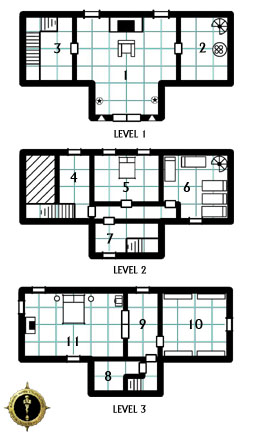
THE MANOR HOUSE - ENTRANCES
 [/center]
DOORS: The outer doors are barred from the inside (Break DC 20). The interior doors are not initially locked, although they can be if the cultists decide they need to barricade themselves (Break DC 16, Thievery DC 20).
ARROW SLITS: The arrow slits on the south wall of area 1 are not large enough to serve as entrances. However, they do allow anyone inside to shoot through without impediment.
WINDOWS – FIRST FLOOR: The windows on the first floor are, in fact, 20 feet above the ground. They are not designed to be opened and lined with lead, but are easily broken (Break DC 5).
WINDOWS – UPPER FLOORS: The windows on the upper floors are locked. (Break DC 5, Thievery DC 15).
CHIMNEYS: There are three chimneys.
- EAST CHIMNEY (KITCHEN): This chimney is too small to climb down.
- WEST CHIMNEY (BEDROOM): This chimney is cramped and difficult to climb down (Athletics DC 20). Stealth checks suffer a -2 circumstance penalty while climbing in this chimney.
- NORTH CHIMNEY (RECEPTION HALL): This is a very large chimney and relatively easy to climb down. (Athletics DC 15).
1. RECEPTION HALL: This is the hall in which Lord Padraig greets petitioners and sits in judgment.
The walls of this formal reception hall are paneled with dark mahogany polished to a gleaming shine. A high-backed wooden chair, its arms carved to look like bear claws and its back in sprigs of mistletoe, sits in a place of honor before a massive fire place.
The statues are of Lord Padraig’s father and grandfather.
2. KITCHEN: An massive iron stove – an unmistakable remnant of the old Empire – fills the eastern wall of the kitchen. A spiral staircase of wrought iron stands in the corner, leading up to the second floor.
3. STAIRS: Broad stairs of worn stone curve up to a landing on the second floor.
4. LANDING: There is a railing along the edge of this landing. It’s a 20 foot drop to the stone floor below.
5. GUEST BEDROOM: Lord Padraig offers this bedroom to visiting dignitaries. It is currently unoccupied. The bed is large and comfortable. There is an empty chest under the bed (where long-term guests can store their clothes and personal items).
6. SERVANT QUARTERS: Lord Padraig’s five servants sleep here.
Five narrow beds fill almost the entirety of this room. Although cramped, everything here appears to be kept in very neat order. There are footlockers beneath each of the beds.
The footlockers contain the possessions of the servants – mostly clothing and a few keepsake items. The footlockers are secured with very simple locks (Thievery DC 10). If the PCs choose to ransack them, there are a few items of value – a ring worth 15 gp; a golden lock with a portrait of a young woman worth 10 gp; a silver necklace worth 5 gp.
7. STAIRS: There is a portrait of Lord Padraig’s father hanging on the wall here.
8. STORAGE CLOSET: This closet contains a variety of common household goods – linens, lamp oil, mothballed clothing, a ladder, blank paper and ink, lanterns and lamps, and the like.
Tall shelves are crammed together in this narrow space, packed full with a wide effluvium of common household goods. There is a trapdoor in the ceiling, although it is partially blocked by one of the shelves.
The trapdoor leads up to the unused attic.
9. HALL: This grand hall leads to the library and lord’s bedchamber.
A thick, luxurious carpet runs the length of this hall. A chandelier of silver and glass hangs from the ceiling. Heavy doors of oak, carved with an Imperial signet of the old Empire, stand to one side with a smaller door to the other.
10. LIBRARY: This modest library offers a +2 bonus to History and Nature checks. Characters searching on particular topics of interest for the adventure may discover:
The True Historie of the Empire’s Keep, which describes the Keep on the Shadowfell (it gives the same information as a DC 25 Streetwise check and the first two paragraphs of Valthrun’s Follow-Up on the same topic).
Observations of Botany, a journal written by Lord Silvius (Lord Padraig’s great-grandfather). Silvius’ name is signed “Lord Silvius, Vassal of the Verdant Lord” and the text makes it clear that Silvius was a member of that druidic order. Near the end of the journal, Silvius mentions finding a cave which “led into what appear to be the ruins of the ancient keep”. He appeared to be fascinated by the unique cave ecology emerging there, but does not precisely give the location of the cave.
Four bookcases of blackoak stand along the walls of this library, their shelves covered in a wide variety of tomes and parchments.
11. LORD’S BEDCHAMBER: This is Lord Padraig’s bedchamber.
Upon the polished stone floor of this bedchamber sits an enormous bearskin rug at least twenty feet in length. A four-poster bed piled high with mattresses stands along one wall, an elegant fireplace is nestled along another. On one of the tables next to the bed there is a silver bust of a maiden’s head. A large chest of oak banded with steel sits in one corner.
CHEST: The chest is locked (Thievery DC 20). It mostly contains Lord Padraig’s clothing, but there is also a leather purse containing 100 gp in a random assortment of coin.
BEARSKIN RUG: Lord Padraig could tell the story of how his grandfather, Lord Patronus, led a hunting party to slay a dire bear that had been plaguing Winterhaven’s farms. The rug is worth 100 gp (although probably not in Winterhaven, where almost everyone would recognize it as belonging to Lord Padraig).
SILVER BUST: This bust is in the image of Padraig’s mother when she was a young woman. It is solid silver and would fetch a price of 225 gp (although probably not in Winterhaven, where almost everyone would recognize it as belonging to Lord Padraig).
A trap door in area 8 leads up to the fourth floor. The fourth floor was gutted decades ago by a fire and was later changed into an attic, which is now empty. There are, however, two windows in the south side.
CULTISTS:
- Ninaran (KOTS pg. 61) (N)
- Human Rabble (x12) (KOTS pg. 30) (R)
- Human Berserker (x2) (MM pg. 163) (B)
HOSTAGES
- Padraig (P)
- Servants (x5) (S)
SITUATION: Ninaran and the cultists break into Padraig’s manor house and take him hostage. In the process, they kill four of the Winterhaven Regulars. Ninaran’s primary goal is to prevent the village from organizing any kind of resistance to Kalarel’s plans.
Padraig and his servants are kept securely bound with rope at the locations indicated on the encounter map.
ESCALATION: Ninaran starts by making an outrageous demand for ransom (25,000 gp). Then she’ll kill one of the servants and throw the body out the window. Next she’ll demand that 10 ritual sacrifices are performed in the courtyard before the manor house.
Ninaran doesn’t actually expect any of these demands to be met.
APPROACHING THE MANOR HOUSE: The only cultists actively keeping a lookout are the human rabble at the arrow slits on the first floor and at the northern window on the second floor. Approaching the manor house without being spotted requires a Stealth check (DC 10).
However, there are blind spots to the east and west. If PCs climb over the outer wall of Winterhaven and approach the manor house from due west or east, there is no chance they will be spotted.
TACTICS: The cultists on the upper levels are specifically there as lookouts. If they detect the presence of PCs, they will run downstairs and alert Ninaran. At that point, the cultists will take all the hostages down to area 1 and fortify themselves there.
[center]FEATURES OF THE AREA[/center]
RUBBLE: With the exception of the cleared path leading to the trapdoor, the ruins are filled with rubble. These squares are difficult terrain.
RUBBLE PILES: Where indicated there are larger piles of rubble. These require Athletics checks (DC 15) to climb at one-half speed.
This ambush is set 1d2 days after the PCs wipe one (but not both) of the kobold barricades. (If they wipe out both barricades, there are no kobolds to perform the ambush with.) The kobolds here are drawn from encounter A1 in Keep on the Shadowfell.
1 kobold skirmisher (K)
3 kobold dragonshields (D)
1 kobold wyrmpriest (W)
TACTICS: The kobolds wait until the PCs reach a point even with the southernmost dragonshields and then attack as described below.
Dragonshields: The dragonshields simply move out from their hiding places, converging on the PCs.
Skirmisher: The skirmisher is hiding just behind the peak of a pile of rubble. He has taken the time to soak the pile with oil, making it slippery and more difficult to climb (Athletics, DC 20). When the ambush is launched, he will stand up and begin making his ranged attacks.
Wyrmpriest: The wyrmpriest is actually perched on the thick wall behind the central tower. He can move along the top of the wall to the wall of the tower itself. While perched up there he grants combat advantage. The walls is 20 feet high at that point.
That's my problem with the web enhancements released by WotC - I like 'em, but I don't want to leave myself having to do lots more work in the long-run (modifying adventures, etc.)
Your amendments are very good, though.
Aren't you concerned that all of these extra encounters will leave your players at a much higher level when it comes to the end of the adventure or moving on to H2?
A good point to raise, and one which made me realize that I left out one piece of information in an earlier post.
(1) The quest reward for finding Sir Caliban's son (the hook I'm using) is actually relatively easy, so I decided to only reward 250 XP for it. (This was before I had the core rulebooks. Using those guidelines I'd actually classify it as a minor 1st level quest, which would only carry a 100 XP reward.)
This is notable because the default hooks in KOTS carry much larger rewards (about +1000 XP for the Douven Stahl hook, for example). So this gives me an excess XP "budget" to put towards these extra encounters. If I was planning to run H1 as the beginning of a full campaign (at the moment that's not my intention), I'd probably have to make up for that by giving a quest reward after they defeat Kalarel -- but that wouldn't have an effect on the balance of H1.
(2) I haven't actually done a full XP count of all the encounters in KOTS, but if I trust the designers than the module is designed so that the PCs hit 3rd level before the Kalarel encounter and should be close enough to 4th level that the final encounter and quest reward should push them over the edge.
The final encounter has a reward of 1175 XP (+2000 XP for a quest reward).
(3) So in order to upset the balance of the adventure, I would need to give the PCs more than 2175 XP from extra encounters. Using all of the bonus encounters gives me:
The Second Guard/Ruined Keep Ambush = 625 XP
Farmer's Jeopardy = 675 XP
The Slyblade Hunter = 575 XP
Cultists in Our Midst = 897 XP
That gives me a total of 2772 XP. So I've slightly exceeded my "budget", so to speak. I'm not overly concerned, however, because in a worst case scenario this only means that the PCs will end up being 4th level for the final encounter instead of 3rd level. Since the final encounter is already designed as a 6th level encounter, this shouldn't be a big deal.
(But you can always add two more Skeleton Warriors to bump that final encounter up to a 7th level encounter.)
(4) My playtesting also indicates that the Kobold Lair is just too deadly. Even with the changes I've made (which make it less deadly), my first playtest group still wiped. Repeatedly. (I'll hopefully be talking about this in more detail later.) So for my second playtest group I've already reduced the number of opponents there, so that will probably ease any XP problems.
(5) In terms of the long-term: Yes. If I were going to continue using the H-series of modules, and if future modules require as much work to make them playable as H1 did, then I'd probably starting running into some problems as my PCs start to gradually outpace the adventures. That's a problem I'd have to tackle as it came up.
How do you make you maps?
Dundjinni with the Classic Dungeon Map Pack.
Possibly the best $50 I've ever spent.
I was never a big believer in mapping programs. After trying a half dozen or so of them, I found all of them to fail in essentially the same manner: You spend a significant amount of time learning the program, and then you spend about 10 times longer working on a map to get something that... doesn't look much better than what you could have drawn by hand on graph paper in 1/10th the time.
But Dundjinni made me a believer. There is a learning curve, but it only lasts for a few hours. And once you've got the basics of the program down, it won't take you much longer to draw a map in Dundjinni than it would take you to draw the same map on graph paper... and the results will be dramatically superior.
Plus -- and this is major -- I can actually design a map in Dundjinni. With so many other mapping programs, the interface would be clunky enough that I would always need to sketch out the map. Using the mapping program was about trying to execute a vision I'd already worked out previously.
With Dundjinni, on the other hand, the interface is simple enough and clear-cut enough that I can effectively "sketch" right in the program itself. (And when the sketch is done, I've got a professional looking map.)
None of the maps in this thread took me more than 30 minutes to execute, and that includes a finishing pass in Photoshop (to add lettering and the like).
PART 11: KALAREL'S RITUAL AND THE DRAGON BURIAL SITE
A4. THE DRAGON BURIAL SITE[/center]
This encounter will largely play out in the same way, but we're going to change the nature of the artifact (to have it tie directly into Kalarel's ritual) and expand the information Douven Stahl has to impart.
THE ARTIFACT: The artifact they’ve dug up is a small stone idol of Orcus. It can recognized on a successful Religion check (DC 15).
DOUVEN STAHL: Douven Stahl can tell them everything on pg. 210 of the Monster Manual regarding the cults of Orcus. Then he will continue with a description of local cult activity:
“Two hundred years ago, this entire region south of the Cairngorms was a stronghold of the cult. The cult deliberately created a gap between this world and another realm – the Shadowfell. Although not inherently evil, the Shadowfell is fraught with dangers, and through the gap between worlds the cult brought forth skeletons, zombies, and even fouler creatures.
In those days, fortunately, the Empire of Nerath was still strong. A legion was dispatched to quell the threat. They destroyed the undead, sealed the rift, and built a keep to keep watch over the location and contain the threat. Today, however, that keep lies in ruins.
I came here merely to study history. But now I fear that the cult has returned, and seeks to open that gap between worlds once again. If that were to happen… without the Empire to respond…” He shudders.
If asked, Stahl can also tell them about the ritual:
“The worship or Orcus revolves around the practice of human sacrifice. But these sacrifices are not merely about death, they about the collection and distribution of a victim’s blood. Cult rituals often revolve around filling a skull with blood, drinking it, and then filling it again for Orcus and pouring it over his idol.
If these cultists are trying to reopen a portal to the Shadowfell, then they must be attempting to tap into the ancient magic that first created the gap between worlds. There will be a sacrifice of blood and an idol of Orcus.”
If Stahl is shown the Orcus idol:
“This is an ancient idol, but you can see by the markings along its base that it is merely part of a larger set. When brought together, these multiple idols intensify each other’s power. By capturing this idol, you will have delayed whatever ritual they’re preparing for… but not prevented it.”
FOLLOW-UP: Douven Stahl will return to Winterhaven and lodge up with Valthrun. He can be found in Valthrun’s tower if the PCs need to ask him further questions.
CRUCIFIED ANGEL: Hanging above the altar in this area is an angel of protection (Monster Manual, pg. 14). It has been pinioned to the wall with multiple adamantine spears. A wall of arcane magic surrounds the angel and can only be penetrated if the ritual in Area 19 is disrupted.
ANGEL'S BLOOD: Blood flows from the angel's wounds, over the Orcus-pledged altar, through the wall of arcane magic, and down into the pit below. Corrupted by the mystic energies of the altar, it is serving as a crucial material component for Kalarel's Ritual.
THE FANE OF ORCUS: The pit in the center of this room is, in fact, 60 feet deep. Standing in this pit is a 60' tall statue of Orcus the Demon Prince. This is the Fane of Orcus. Through the fane, Orcus is able to manifest some portion of his will upon this world. It is an important part of Kalarel's Ritual.
THE IDOLS OF ORCUS: The four grates depicted on the map are, instead, sunken depressions in the floor. In two of them, the Idols of Orcus have been placed. (If the PCs failed to disrupt the activities at the Dragon Burial Site, three of them will be occupied.) Blood flows up out of the pit and towards these depressions. (See Kalarel's Ritual.)
Level: 25
Category: Travel
Time: 120 days
Duration: Permanent
Component Cost: Special
Market Price: n/a
Key Skill: Religion
Kalarel’s ritual will open a permanent connection between this world and the Shadowfell. Once the ritual is one-quarter completed, the Thing in the Portal manifests (see module).
Special: Kalarel is able to perform a ritual so far above his normal level because this specific ritual is bound to the Fane of Orcus.
The smaller Idols of Orcus are also being used to help focus the ritual, reducing the amount of time necessary. Each idol added to the ritual reduces the remaining time of the ritual by half.
[center]TIMELINE[/center]
When the PCs first arrive in the valley, 30 days have passed since Kalarel started his ritual. Kalarel had also already recovered two of the Idols of Orcus, reducing the remaining time for the ritual to be completed to 45 days.
If the PCs don’t interfere with Kalarel retrieving the Idol of Orcus from the Dragon Burial Site, it will be installed and whatever time remains will be further reduced by half.
Kalarel is working from a reconstructed and partially translated text known as the Scrolls of Hamasatra. This text is located atop the altar in Area 19 of the keep. The skill challenge for reversing the ritual is based, in part, on an article available at WotC's website.
Level: 6th
Complexity: 3 (8 successes before 4 failures)
Primary Skills:
Arcana (DC 22): As a standard action, you can call upon your knowledge of magical effects and rituals to study the ritual book and determine the next step in unbinding the ritual. The first successful Arcana check also allows the character to figure out how a Heal check can contribute to undoing the ritual. A failed check indicates that the energy of the ritual attacks you: +10 vs. Will; 1d6 + 4 necrotic damage.
Endurance (DC 18): As an opportunity action, triggered when an adjacent ally has just failed an Arcana or Religion check to reverse the ritual, you can allow the necrotic energy flowing through the ritual to damage you instead of your ally. Success at this skill use aids the party, but does not count as a success toward completion of the challenge.
Heal (DC 18): As a standard action, you can make a Heal check and spend a healing surge to send positive life energy into the necrotic ritual in order to help disrupt it. In doing so, you automatically expose yourself to the energy of the ritual, which attacks you: +10 vs. Will; 1d6 + 4 necrotic damage. This approach to undoing the ritual can be determined on any successful Arcana, Religion, or Insight check.
Insight (DC 18): A character succeeding at an Insight check as a free action, triggered by observing the ritual, can figure out how a Heal check can contribute to undoing the ritual. Success at this skill use aids the party, but does not count as a success toward completion of the challenge.
Religion (DC 22): As per the Arcana check.
Success: The ritual is undone. The angel in area 18 is freed, but collapses into unconsciousness. (However, nothing stops Kalarel from starting the ritual afresh. If the Scrolls of Hamasatra are destroyed or the angel escapes or Kalarel is killed, however, the threat has passed. In that case, reward the adventurers a major quest reward of 750 XP.)
Failure: If the skill challenge is failed, the magical energy of the Shadow Rift stabilizes. Necrotic energy surges through the ritual book and the altar, striking all of the characters attempting this skill challenge. Each of these characters loses a healing surge and is attacked by the necrotic energy: +10 vs. Will; 1d6 + 4 necrotic energy.
The ritual isn’t complete, but the partially opened rift remains as such until either Kalarel is killed or the ritual is completed.
The ones I use I will let you know about, ok?
Cheers,
Rusty
-M.
Thanks for putting all these ideas up for me to steal from Justin!
The ones I use I will let you know about, ok?
That would be awesome, Rusty. I'd love to hear feedback and war stories from anyone who uses this stuff in actual play.
Thanks to everybody for the kind words. And I apologize for the delay in getting the next installment posted. I had a computer meltdown over the weekend that I still haven't fully recovered from, so I've been digitally discombobulated for a bit.
THE THREE CLUE RULE[/center]
At the beginning of May I wrote a lengthy essay on the subject of scenario design and the Three Clue Rule:
Basically, the idea is that every chokepoint in your adventure design (the points where the PCs must do X or be unable to proceed) are all potential points of failure: If the PCs fail to do X at any one of those points, the adventure will grind to a frustrated halt.
There are two ways to deal with such chokepoints: Either you can railroad your PCs through them (a "solution" that I find drastically unappealing) or you can design alternative paths through the adventure. And in my experience, designing three alternatives results in a sufficiently robust design so that the players will never find themselves clueless.
Probably the most common problem with published adventures are their chokepoints -- they're usually riddled with them, creating countless pitfalls for the DM to overcome. So the first thing I typically do when looking at a published adventure is to track the flow of the adventure: How do the PCs get from one point in the adventure to the next? Once I've identified the chokepoints, I'll start designing alternative paths until I've satisfied the Three Clue Rule.
The flow of Keep on the Shadowfell was particularly baffling for me. For example, as the name of the adventure might suggest, the PCs are supposed to eventually go to the Keep. But there are only three ways that will happen:
(1) You can use the adventure hook which basically tells the PCs "you're coming to Winterhaven in order to investigate the Keep". But, if you do that, it's very likely that the PCs might decide to ignore the kobold threat and go directly to the Keep... which is designed for higher level play and will prove rather deadly for 1st level characters.
(2) The PCs can succeed at a Religion check to identify a holy symbol of Orcus, conclude there's a cult active in the area above and beyond the kobold tribe, and then... rewrite the adventure so that the PCs can learn that the Keep was once a site of Orcus worship without first asking a specific character about the Keep separate from the Orcus worship.
(3) The players read the title of the module and conclude that they should find out about this Keep.
Similarly, there's encounter A4: Dragon Burial Site. As far as I can tell, the only way the PCs will ever go to the dragon burial site is if you use the "Missing Mentor" adventure hook. If you don't use that specific hook, the PCs will never have any reason to look for Douven Stahl -- which is the only reason they would ever go looking for the dragon burial site. (Which isn't much of a loss, admittedly, since in the original adventure there is no useful information to be gained at the site.)
So these problems needed to be fixed. In addition, I had a desire to remove the CRPG-like quest-givers in Winterhaven, which meant that I would need a more robust Three Clue Rule design for the kobold sections of the adventure, too.
[center]REVELATIONS[/center]
Although this is one of the last remix essays I'm writing for Keep on the Shadowfell, it's actually describing the first steps I took in revising the module. And the very first step I took was to identify and list the revelations the players would need in order to move through the adventure.
First, there are three location-based revelations. The adventure basically takes place in three locations: The kobold lair; the dragon burial site; and the Keep on the Shadowfell. The PCs need to (a) identify these as places they should go; and (b) go there.
Second, there are two revelations which allow the PCs to figure out what's going on: They need to know what the cult of Orcus is and they also need to discover the existence and purpose of Kalarel's ritual. These revelations are less important because the adventure can continue even if the PCs aren't entirely sure what's going on -- in other words, these aren't actual chokepoints -- but my players get a big kick out of discovering hidden lore. And, also, knowing these facts will help raise the stakes of the adventure.
Keep on the Shadowfell begins with a kobold ambush. The entire village of Winterhaven is suffering under the effects of the kobold attacks. And Lord Padraig is offering bounties on both dead kobolds and the location of the kobold lair. So how will the PCs actually find the kobold lair?
CLUE 1: TRACKING. The PCs can track the kobolds back to their lair, starting at the location of any of their attacks or the barricades on the road between Winterhaven and the Keep of the Shadowfell.
Following the trail is a 6/3 skill challenge. The PCs must first succeed at a Perception check (DC 15) to locate the tracks (this counts as a success on the skill challenge), and can then use Nature and Perception checks as primary skills to complete the skill challenge.
CLUE 2: NINARAN. A successful Streetwise check in Winterhaven will put them in touch with Ninaran (see "On the Streets of Winterhaven" and "Winterhaven NPCs").
CLUE 3: INTERROGATION. Any captured kobold can be forced to reveal the location of the kobold lair with an Intimidate check vs. Will defense. The kobold receives a +10 bonus because it's hostile and a +2 bonus because giving up the location of the lair is essentially a betrayal of the entire clan.
Other PCs can use the Aid Another action with either Interrogation or Diplomacy (good cop/bad cop).
The PCs need to become aware of the dragon burial site and motivated to check it out.
CLUE 1: DRUIDIC SPIRIT. The druidic spirit in area 6 of the kobold lair is aware of the dragon burial site and of its importance to Kalarel's ritual (see "Kobold Lair").
CLUE 2: VALTHRUN. If asked about the Cult of Orcus, Valthrun will have some information but will also refer the PCs to Douven Stahl -- "the true expert on the cult". Valthrun knows that Stahl was researching the burial site and can tell the PCs where it is. (See "On the Streets of Winterhaven" and "Winterhaven NPCs".)
CLUE 3: KALAREL'S LETTER TO BALGRON. We'll put a letter in area 4 of the keep, written by Kalarel with instructions for Balgron.
Balgron—
One of the villagers has stumbled onto the dig site south of the village. I’ve ordered Datok and his men to reinforce Agrid. You should send some of your goblins to the surface and keep an eye on the ruins. It is important that our work not be disturbed.
Kalarel
Pretty much anyone in Winterhaven can tell the PCs where the Keep is, and many people can give them even more information about it (see the relevant Streetwise check in "On the Streets of Winterhaven"). However, the following clues will make the players aware of its importance:
CLUE 1: DOUVEN STAHL. When the PCs speak with Douven Stahl at the dragon burial site, he'll be able to tell them about the Keep. (See "Dragon Burial Site".)
CLUE 2: KALAREL'S RITUAL LETTER. The note Kalarel writes to Ninaran can be recovered after the "Dead Walk" interlude. It mentions the keep.
CLUE 3: SIR CALIBAN. Perrien's father, the banished knight Sir Caliban, journeyed to the keep and was killed there. (Bairwin Wildarson can tell them this.)
Once the PCs become aware of the cult's potential involvement in the area (either through identifying a holy symbol; an Orcus idol; or learning of the keep's true history), they may want to find out more about Orcus and his cult.
CLUE 1: ARCANA/RELIGION CHECK. See the Monster Manual, pg. 206, for Orcus Lore.
CLUE 2: STREETWISE CHECK/VALTHRUN. See "On the Streets of Winterhaven".
CLUE 3: DOUVEN STAHL. Douven Stahl can tell them everything on pgs. 206 and 210 of the Monster Manual regarding Orcus and his cults. See, also, "Dragon Burial Site".
[/b]
The PCs don't need to know about Kalarel's ritual before stumbling into area 19 of the keep, but they're likely to be interested in learning what the cult is planning.
CLUE 1: KALAREL'S RITUAL LETTER. The note Kalarel writes to Ninaran can be recovered after the "Dead Walk" interlude. It mentions the keep (see below).
CLUE 2: DOUVEN STAHL. Douven Stahl can make several informed guesses regarding the ritual (see "Dragon Burial Site").
CLUE 3: SIR KEEGAN. Sir Keegan, in area 8 of the keep, can tell them of the Fane of Orcus which lay beneath the keep (see "Kalarel's Ritual"). He knows that the cultists have gathered there.
I received your report on the runebearers. Next time you see them, but an end to their meddling. Mix the blood of ten people with the elixir my messenger brings. Then trace the following pattern on the ground of the graveyard and pour the liquid into the lines:
With the thinning of the veil here at the keep, this circle will create a sympathetic connection to the Shadowfell.
My work here is very near completion. It will not be long now. If you come to the keep, the pass phrase for the second level is “from the ground, some magic was found”.
- Kalarel
Basically, there are three steps to my use of the revelation list for an adventure:
First, I determine the chokepoints of the adventure and list the necessary revelations.
Second, for each revelation I make a list of at least three clues and then incorporate these clues into the design of the adventure.
Third, while actually running the adventure, I keep the revelation-and-clue list handy as a quick-reference tool. I treat it as a literal checklist: If the PCs find a clue, I check it off. If the PCs have missed a clue (by failing to search a room, for example), I'll circle it. If the PCs have definitely reached a particular conclusion (not just considered it as a possibility, but definitively concluded that "this is what's happening"), I'll cross the entire revelation off my list.
Using this approach allows me to spot potential trouble spots as they're developing: If, for example, the PCs have discovered all the clues I've designed for a particular revelation but, for whatever reason, still haven't draw the proper conclusion then I know I need to introduce new clues. Similarly, if they've been missing a lot of clues for a particular revelation, I can start anticipating the need for new clues.
My original Three Clue Rule essay had a lengthier discussion of how to deal with these types of issues as they emerge, but here's an example: If the PCs have missed or ignored all of the clues suggesting that they should really check out the Keep of the Shadowfell and see what's going on there, I might decide to trigger Ninaran's assault on Lord Padraig's manor house with the intention that either Ninaran or one of the other cultists will willingly surrender when the encounter turns against them and spill their guts regarding Kalarel's plans.
Similarly, if the PCs haven't found the kobold lair yet, I might trigger one of the kobold encounters -- either the "Slyblade Hunter" or "Farmer's Jeopardy" encounters can be used without the PCs taking any action themselves -- and use it as a way of introducing a new clue. (Or, if nothing else, give the players something to do while I try to figure out another way of getting them back on track.)
The good news is that, when you use the Three Clue Rule, you generally won't run into these problems in the first place, so you'll be able to spend more time playing the game and less time trying to fix the game.
Are you going to do the same analysis of the Thunderspire adventure? I hope so
With the first encounter, I too saw the problem with the kobolds' positioning and fixed it. I also thought it was dumb that the kobolds get the drop on the PCs pretty much automatically so I gave my players a chance to make Perception checks. One of them rolled really high so the encounter began with the PCs still some way away from the ambush, which worked well in their favor, resulting in a positive initial experience with 4e.
In Winterhaven, I pretty much went with the dialogue that was in the module, but I had made each NPC unique and ended up doing some improv as the PCs pursued lines of inquiry not covered in the module (one of my new players, who hasn't played D&D in 10 years, said he was pleasantly surprised by the amount of roleplaying we did. He was evidently expecting it to be all combat -- which is pretty much how session #2 turned out :rolleyes
. I did add a bit to Ninaran. The PC cleric is an elf and I gave him a dream in which a town that looked a lot like Winterhaven was overrrun by undead being led by some evil-looking cultists (one of whom looked directly at the cleric before he woke up in a cold sweat). THe next morning, Ninaran talked to him and told him she'd had the same dream and gave him the "The cultists are real and they're in league with the kobolds who live behind the waterfall ..." thing.With the second kobold ambush, I again gave them the opportunity to foil it (this time I told the PC with the highest passive Perception that he noticed that the birds had gone all quiet). None of them rolled well enough to beat the seemingly random DC 25 provided with this encounter, though, so the ambush went as planned. The way I dealt with the ambush being on the road again was by explaining that the burial site was best reached by traveling down the southwest road for a mile or so first. No one seemed to mind the repetition (this part of the adventure is about dealing with the kobolds plaguing the town, after all) but, conceptually, the idea that these kobolds were specifically ambushing the PCs to avenge their fallen comrades bothered me a bit. Fortunately that detail eluded my players. As far as they were concerned, this second ambush just drove home the point that the town has a kobold problem.
The burial site encounter was a bit awkward. I had the gnome invite them down but only one player accepted and I made the mistake of getting the map out and placing the minis despite the fact that everyone failed their Insight checks. So there was a bit of a stand-off with the gnome desperately trying to think of something that would convince the PCs to come down into the crater while the PCs all just stood up on the cliffs and waited for something to happen. Eventually something clicked (I'm not sure what it was that did it) and another PC agreed to come down. The guard drakes were nasty, taking the cleric out in one round (and he stayed down for most of the encounter, much to the dismay of his player). The wizard went down twice and the fighter once, but no one died. They found the mirror but didn't really know what to make of it or why it was buried with the dragon's bones (I threw in the story of Vendar and the dragon from the Fallcrest town fluff in the DMG - these were the dragon's bones and Staul had gone to find them). This is where we stopped but Staul is still with them, so I might get him to contribute a bit more before heading off back to Fallcrest to be with his wife again.
As for your other comments -- it hadn't occured to me until I read your issues with the trap room that it really has some pretty serious ones (and I totally agree with your assessment of 4e's traps. They're probably the most disappointing part of 4e for me.). What's even sillier is that kobolds are all about traps (although the KotS kobolds don't have their Trap Sense ability) and yet the KotS kobold lair doesn't have any! WTF?! I don't have the spare time to alter the encounter too much, but I'm planning on getting rid of one of the skirmishers and a number of minions and replacing them with two needlefang drake swarms (I'm really hoping one of my players will yell out "Get 'em off me! Get 'em off me!") as a kind of "living trap" that the PCs will trigger once they go through the waterfall.
I also think the whole thing with Keegan is a bit dumb. I too questioned his presence in a proper crypt and the "skill challenge" is anything but (and, of course, the most recent errata has completely changed skill challenges anyway, so KotS is now even more full of errors than it was before).
The adventure assumes that the PCs will return to Winterhaven after exploring the first level of the Keep's dungeon but before they explore the second level ... but it does not provide any reason for them to do so (and, if they find the hidden armory and clear it of the zombies, the adventure indicates that they can safely rest here, so in this instance they would not even need to go back to town just to rest). Have you considered this? What are you planning on doing? Any hooks that might make them go, "Oh crap?! We need to get back to town right now!"
I feel sorry that my players are about to enter the last room of the adventure, because now I don't have the chance to apply all your great changes...
I also saw a lot of trouble when we played through the adventure, but I thought most was because I didn't DM it right, I'm glad you proved me wrong
Hope you'll be doing the same thing for more adventures!
BTW, your version of the Sir Keegan conversation is the most funny thing I've read in a while :D
I LOVE your change having Ninaran take over the manor house and hold him hostage. I will be doing this, I just have one question. I see no way to resolve the standoff... all the hostages go to area 1 and have a standoff. The PC's sneak all the way down to level 1, but even if they don't activate anything Ninaran still has lord padgrin and can just use him as a hostage to get the PC's to back off. If nothing else he'll kill him. How do you resolve this?
I have read all your stuff on the webpage and I think you're brilliant, especially the thing on the fighters mark removing the paladin's mark. (Check out the flavor text for the swordmage's mark and imagine the fighter removing that) Keep this stuff comming!
A deathlock wight however is a much better option and is at the right level of power for it's level and experience.
Don't forget that the PCs will be facing off against a deathlock wight in the final fight with Kalarel. If you don't mind having them fight one twice in this adventure, then go ahead ... perhaps you could have it be the same one. I rather liked the idea of some undead human mage as a "lesser lich" though. I suppose you could use the mechanics for the deathlock wight but call it a lesser lich or something.
I'm the DM of sort who gives different descriptions for the same badguys.
I'll probably start doing this with 4e. It just seems easier to "file off the serial numbers", as the WotC guys like to say.
I've come across another problematic part of the adventure. It's the first encounter with the hobgoblins. It's pretty obvious what happens if the PCs don't give the right pass phrase (or if they use the false one in Ninaran's note from Kalarel), but it isn't obvious how to proceed if they use the right one. All it gives is one phrase: "What business have you got with Kalarel that you know the pass phrase?" or something.
I'm not really how to proceed. Skill challenge? Would the hobgoblins tell the PCs to wait while the Warchief was summoned? Would they let the PCs pass unharmed? If not, and the result is supposed to be that the hobgoblins attack the PCs no matter what, then what purpose does the pass phrase serve?
For many, covers coming off would be preferable to ink smudging
Happily, KotS's production values being what they are, we don't have to choose between these problems.