Elements of the weird conspiracy:
A Solipsist- Directly inspired by The Melancholy of Haruhi Suzumiya, an otherwise ordinary human with a weird hermetic consciousness that can unwittingly alter, create, and destroy reality. For the safety of everyone else in the universe, the Solipsist must never be allowed to know of his or her own power. There is one major difference- nobody knows who the Solipsist is.
Reality Leaks- A source for monsters and weird powers in the game. The Solipsist's power inadvertently stretches the boundaries of reality, allowing one-dimensional cracks to form. Bits of unreality can escape through the cracks and take the form of imaginary creatures, or cause bizarre events that don't necessarily follow logic or physics as we know it.
The Syndicate- A secret organization of rich and powerful individuals who first learned of the Solipsist. They determined certain paranormal activity was actually caused leaks within the structure of reality. Fearing that the Solipsist may also come to the same conclusion if faced with a reality leak, they built an organization devoted to the suppression of all paranormal phenomenon. They insure that reality leaks remain out of public memory, operating like the Men in Black. Of course the Syndicate has an ulterior motive known only to its highest members- world domination. They are constantly trying to discover the identity of the Solipsist because controlling him or her would be the means to world domination. Therefore it is very important that each level of Syndicate hierarchy remains alienated from its own work. Purposes aren't given, just orders and the assurance that something weird will happen. Higher level members are assigned to keep subordinates under constant surveillance, K.G.B. style. There is no member who is not being spied upon by another member.
Inbo- N.B.O. or "Inbo" is the supercomputer in charge of all Syndicate operations. It not only stores and analyzes all recorded reality leaks, but gives orders to all members, and stores their personality data. That way, it can reconstitute lost members that prove valuable to its weird plans. It believes this is also a final safeguard in case a member of the Syndicate turns out to be the Solipsist. It can use that brain pattern to construct a second Solipsist, knowing reality would be ripped in half if two Solipsists were to exist at once, which is the equivalent of mutually assured destruction.
Weird Experiments- Naturally, you can't have a weird conspiracy without someone going around experimenting on people. In this case, the Syndicate is kidnapping civilians, preferably involved with reality leaks, as they look for the Solipsist. Inbo determined the Solipsist must be between the ages of 15 and 25, making high school and college students a prime target.
Other Considerations:
Comedy- There is just no way I am going to do this straight. It has to be off the deep end crazy if it's going to work. I just want to take the humor from events and characters, not the setting.
Reconstitution- One idea I had was to have Inbo reconstitute dead PCs and important NPCs so they can come right back into play in the next episode and act like nothing went wrong. I need to impose some penalty to discourage abuse, but I want to be less severe than the usual -1 level penalty for the Resurrection spell. I'm also thinking about using some kind of glitch so there is no guarantee you come back in the same body, or maybe a head or a leg is put on backwards. Oops.
Hikikomori as Syndicate victims- Ever seen Welcome to the NHK? Who's going to notice if a few unemployed shut-ins disappear forever? Could be Syndicate members posing a rehab group, and the government voluntarily looks the other way because of its "success" rate.
The Solipsist as a PC- I like this idea but it gives me a headache if I think about pulling it off. I'd prefer to have my players go crazy paranoid and accuse each other rather than have it known from the start. Suppose another player found out and started playing his character differently until it got really obvious. Or it was just too obvious from the start.
So what if the last thing you remember is falling into the whirling blades of the world's largest food processor? You might feel better when you wake up as a Martial Artist. No more failing gym class...
I'm using base classes presented in BESM d20 as well as a few from d20 Modern. The idea here is that Inbo can encode sets of genetic tendencies into a stored agent before construction, and that certain talents are tailor made to fit the character archetypes. A character's life before working for the Syndicate might not reflect his current specialty or abilities. That way characters who were kidnapped students aren't forced to take at least one level of Student.
BESM base classes:
Adventurer- works best for secret agents and investigators.
Giant Robot- for Yuki inspired androids.
Martial Artist- in case of a character that randomly drop kicks people.
Shapechanger- genes subjected to reality distortion for too long may develop certain interesting side effects.
Student- represents a superior student, smarter and more popular than usual. Average students have an NPC class instead.
Tech Genius- the internet black belt who is in Computer Science III.
A self-proclaimed magic boy or weird psychic agent (sometimes both). Espers are otherwise ordinary humans who were inadvertently empowered by the Solipsist to repair reality leaks into closed space. Most are valued Syndicate agents, and those who aren't typically maintain contact with outer Syndicate ops, anticipating reality leaks.
Reconstitution- One idea I had was to have Inbo reconstitute dead PCs and important NPCs so they can come right back into play in the next episode and act like nothing went wrong. I need to impose some penalty to discourage abuse, but I want to be less severe than the usual -1 level penalty for the Resurrection spell. I'm also thinking about using some kind of glitch so there is no guarantee you come back in the same body, or maybe a head or a leg is put on backwards.
This part sounds like Read or Die.
This part sounds like Read or Die.
Actually I was thinking of Call of Cthulhu. It's a cliche that the investigators die too easily, so I wanted a way they can come back like Kenny from South Park. Does Read or Die handle body part mix-ups? I haven't seen much of the series and I don't remember anything like that.
Actually I was thinking of Call of Cthulhu. It's a cliche that the investigators die too easily, so I wanted a way they can come back like Kenny from South Park. Does Read or Die handle body part mix-ups? I haven't seen much of the series and I don't remember anything like that.
A couple of the resurrectees came out messed up. But I was just thinking that in R.O.D. most of the bad guys are famous historical figures, cloned/reborn with super powers.
01-02 2chan
03 Alcohol
04 American film
05 Anime
06 Apples
07 Ashes
08 Baseball
09 Bells, chimes, or gongs
10-11 Books by Dan Simmons
12-13 Buddhist chants, sutras, or ofuda
14 Bunnies
15 Calligraphy
16 Camera flash
17 Candy or snacks
18-19 Cats
20 Cell phone ringtones
21 Chinese cuisine
22 Chocolate
23 Cigarettes
24 Classical music
25 Clowns
26 Cocaine
27-28 Cosplay
29 Desserts
30 Dogs
31 Drills
32-33 Fast food
34 Firecrackers
35-36 Fluorescent lights
37 Fugu
38 Game shows
39 Getomono cuisine
40 Gold
41 Goldfish ponds
42-43 Green onions
44 Heavy metal
45 Hentai
46 Holy symbols
47 Holy water
48-49 Hospitals
50 Hot springs or mineral water
51 Ice cream
52 Insect repellant
53-54 Internet
55 Keys
56 Kobe beef
57 Korean cuisine
58-59 Korean culture
60 Laundry detergent
61 Lanterns
62-63 Mahjong
64 Manga
65 Mathematical equations
66 Mirrors
67 MMORPGs
68-69 Morphine
70 Natto
71 Nerve gas
72 Nitrous oxide
73 Novocaine
74 Number 9
75 Pachinko
76-77 Panties
78 Plastic
79 Plutonium
80 Pocari Sweat
81-82 Ponytails
83 Pulsing strobe lights
84 Radiation
85 Radio waves
86 Rap music or hip hop
87 Rubber
88 Running water
89 Salt
90 Sand
91 Sashimi or sushi
92 Shrine maidens
93 Soccer
94 Specific phrase or gesture
95 Specific song, band, or singer
96 Starcraft
97 Stuffed animals
98 Tinfoil
99 Television
00 Volcanoes
Gargantuan Ooze (Extraplanar)
HP: 15d10+255 (337)
Init: +4
Speed: 60’
AC: -4
Armor: 9 (Natural)
Def: +5 Unarmed
Base Atk: +12/+7/+2
Grapple: +17
Attack: Slam +17 melee (1d8+12)
Full Attack: Slam +17/+12/+7 (1d8+12)
Space/Reach: 20’/20’
Special Attack: Demolition Slam +17 melee (20d8+12), requires 1 full round to power up
Special Qualities: Blindsight 60’, blind, no int, immunity: sleep, paralysis, mind affecting
F/R/W: +17/+7/+12
Abilities: Str 34, Dex 10, Con 44, Int --, Wis 12, Cha: 8
Combat Skills: Unarmed Attack +5, Unarmed Defense +5
Skills: Jump +12, Listen +6, Spot +11, Powerlifting +21
Feats: Cleave, Great Cleave, Lightning Reflexes, Improved Initiative, Iron Will, Power Attack
Attributes: Immunity 2, Special Attack 19 (Melee, Muscle Powered), Mindless
Defects: Activation Time: 1 full round- Demolition Slam (1 BP), Confined Movement: closed space (4 BP), Maximum Force: Special Attack (18 BP)
Environment: Closed space
Organization: Solitary
CR: 16
Alignment: Neutral
Advancement: 16-23 HD (Gargantuan), 24-36 HD (Colossal); 4 HD = 10 CP
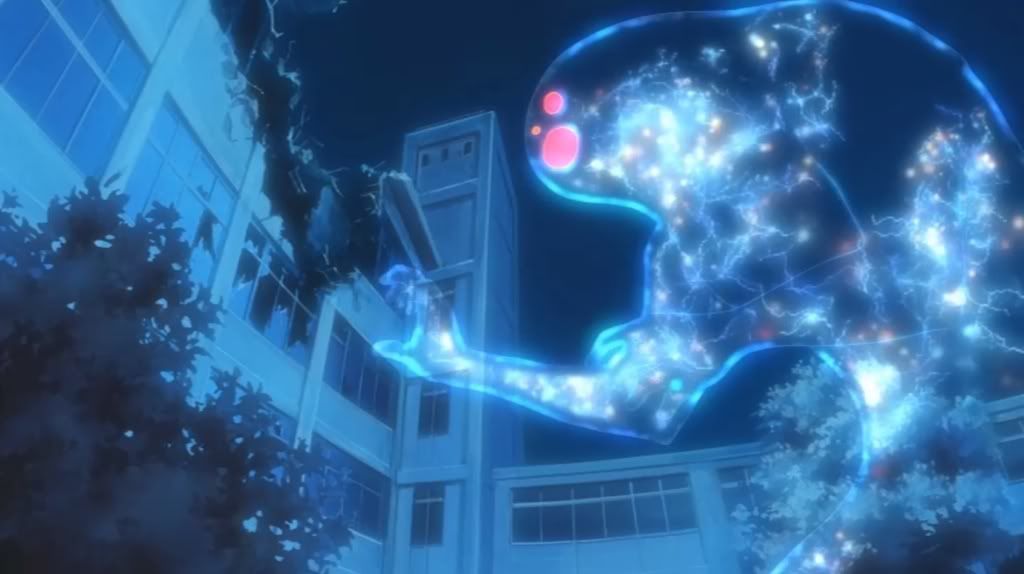
The gargantuan shinjin are dangerous native inhabitants of closed space, mindlessly destroying everything in their way. The beings are made of an unknown energy or force, since under the normal laws of physics, creatures the size and shape of shinjin would not even be able to support their own weight.
A shinjin appears to be a towering, vaguely humanoid shape made of sparkling electrified gel the consistency of toothpaste. They are, however, tough and leathery to the touch, and lack the ability to form extra pseudopods or alter their original shape. Although a shinjin has no identifiable anatomy, glowing red structures near the top of the creature are analogous to vital and sensory organs. Its fist-like pseudopods can crush structures with more force than the creature's size and shape would normally allow, indicating an entire shinjin’s anatomy and structure may extend beyond the portions which are in the visible dimensions of closed space.
Investigation:
Shinjin are always in closed space. If one is not immediately present, or is somehow not visible (if the PCs are inside a building or behind a large wall), a shinjin attacks in 1d4 minutes.
Info: made with a Knowledge: Biological Science or Knowledge: Occult check, or use of the Research skill
DC 19: That tremendous glowing wrecking ball of a creature is called a Shinjin.
DC 29: It is classified as an Ooze in spite of its humanoid shape. (Ooze traits)
DC 34: Shinjin are quite tough, possessing strong natural armor because of a closed space membrane. They can strike down entire buildings with their powerful Demolition Slam attacks, and as they destroy more buildings, closed space expands. Destroying all shinjin in a bubble of closed space will break the space apart and return all visitors to reality without any harm.
DC 39: Shinjin possess no defense against projectile attacks aside from their strong natural armor. (Biological Science: The tiny points of light on the creatures belong to oversized organelles approximating nervous systems, and their bodily fluids experience weak circulation from an undulating membrane. In other words, they can bleed and die like any complex organism.) Shinjin lack Ooze type immunity to critical hits and flanking because of their delicate structures, but they will continue to fight even if they lose arms or legs. (Occult: The presence of shinjin indicates the Solipsist is displeased.) (Research: Roll to determine specific weakness.)
Judge Opponent: The glowing red structure inside the top of the creature houses vital and sensory organs. (Called shots to this area are critical hits.)
Interaction:
Shinjin are designed for encounter levels much lower than their challenge rating. Direct combat would be suicide. Instead, staying alive during a shinjin attack, and hiding from them while completing other objectives, are the real challenges in closed space. At higher levels the characters can start exterminating them to counter closed space activity. Escaping from a collapsing building under shinjin attack has a CR or 10-8.
Combat:
Shinjin typically attack buildings and landmarks, expanding their closed space habitat. If any living things happen to get in the way, shinjin will happily smash them, too.
Demolition Slam (ex): A shinjin may briefly increase the mass of its body and strike with the force of a wrecking ball. This attack may even be combined with bonuses from Power Attack and other feats, though it may not be used more than once per turn. It takes a shinjin 1 full action to prepare this attack because of the creature’s size and slow backswing.
Cleanup Procedure:
Much to the relief of the Syndicate, shinjin are self-cleaning, vanishing without leaving evidence behind, and taking entire bubbles of closed space with them. It helps to know the size of these bubbles, and to reach their overlapping areas in reality to pick up any accidental witnesses released from the space once it shatters.
Medium Aberration
HD: 1d8+1 (5 hp)
Init: +6
Speed: 30’
AC: 2
Armor: 2 (Natural)
Def: +1 Unarmed, +1 Ranged
BA/Grapple: +0/+2
Attack: Bite +2 melee (1d8), Slam +2 melee (1d3)
Full Attack: Bite +2 melee (1d8), or Slam +2 melee (1d3)
Space/Reach: 5’/5’
Special Attack: Devour Head (ex), Psychic Poison (ex)
Special Qualities: Darkvision 60’, Detectable (Sixth Sense: Closed Space; linked to Pocket Dimension attribute)
F/R/W: +1/+2/+2
Abilities: Str 11, Dex 14, Con 12, Int 12, Wis 10, Cha: 10
Combat Skills: Unarmed Attack +2, Unarmed Defense +1, Ranged Defense +1
Skills: Hide +4, Spot +1, Listen +1
Feats: Dodge, Improved Initiative
Attributes: Armor 2, Highly Skilled 1, Natural Weapon 1, Pocket Dimension (fixed to closed space anomaly) 1, Special Attack 1
Defects: Detectable (Sixth Sense: Closed Space; linked to Pocket Dimension attribute)
Environment: Closed space, any
Organization: Solitary, Squad (2-4), Gang (8-11 and 1 3rd lvl NPC leader), Mob (apply Mob template from DMG2)
CR: 1
Alignment: Chaotic Evil
Advancement: By character class
Build adjustment: -19 CP (ECL +1)
Though it is rare for anyone without the proper senses to enter closed space, accidents can happen, and unwitting bystanders can wander in by mistake. A human who enters a pocket of closed space and remains trapped for too long eventually undergoes Partial Existence Failure, where his body and mind simultaneously implode, leaving a human-shaped hole in the fabric of reality.
Pseudo-ningen are the victims of these catastrophic failures in closed space who have somehow escaped into reality. At first glance they appear to be well dressed strangers, except they have no faces. Closer inspection reveals the appearance of clothing is actually the product of colored skin flaps. Eyeballs disguised as buttons hide in skin folds along the chest. The faceless head can split open vertically into a gaping mouth lined with multiple rows of teeth.
Investigation:
Sightings of psuedo-ningen are often confused with noppera-bo, or faceless ghosts, because of their appearance. Ghost stories and urban legends about noppera-bo may provide leads to pseudo-ningen encounters, and ultimately, closed space anomalies. Knowledge checks pertaining to noppera-bo stories, sightings, and urban legend, are made with Knowledge: Cultural Arts, whereas knowledge about the powers and qualities of noppera-bo are made with Knowledge: Occult.
Info: made with a Knowledge: Occult check or Research skill
DC 15: This is not a human or a ghost, but a creature called a pseudo-ningen. It is one of several paranormal life forms classified as “Aberrations.” Aberrations have little in common except bizarre anatomy and the ability to see infrared light.
DC 20: Pseudo-ningen are the remains of humans who were trapped in closed space for too long. They can eat their own heads to deliver an infectious Psychic Poison attack that spreads the closed space anomaly which spawned them.
DC 25: Pseudo-ningen are notoriously bad humored and socially inept. They would rather taunt than fight. A single successful Intimidation can weaken a whole mob. (Research: roll for weaknesses.)
Judge Opponent: Your foe is cowardly and will fall before intimidation. (A successful Intimidation check during combat, lasting only 1 round, will cause a pseudo-ningen target to become Shaken for 1d4 rounds.)
Interaction:
Pseudo-ningen NPC attitudes are initially Unfriendly towards most other characters. They would rather taunt than risk their lives attacking targets who might defend themselves. If there are characters present with any ranks of –Ism, Physical Impairment, or Not So Tough, the attitudes become Hostile towards those characters.
Combat:
Devour Head (ex): At any time, as a free action, a pseudo-ningen may eat its own head. Once the head is swallowed, the creature secretes enough extradimensional residue to make a single Psychic Poison attack with its hands. When the attack is finished, it instantly regurgitates its swallowed head. It may use this ability up to 3 times a day.
Psychic Poison (ex): By coating its hands in dimensional residue, a pseudo-ningen can punch a living target at an angle perpendicular to reality with a successful Slam attack, infecting the soul with poisonous residue. The attack deals no physical damage, though its effects can be traumatizing. Treat this as a poison attack with the following properties: Will DC 16, initial and secondary dmg: 2 Wis; secondary dmg occurs every hour instead of every minute. The Will DC is equal to 15 + the ranks of special attack the pseudo-ningen possesses. If the poison reduces the target’s Wis to 0 or less, the target becomes a pseudo-ningen. A pseudo-ningen must eat its own head before using this attack.
Cleanup Procedure:
Because of the pseudo-ningen’s ability to infect others, effectively tripling their numbers several hours after an attack, witnesses have to be quarantined and psychologically evaluated by Syndicate personnel for inconveniently long periods of time. These gatherings of Syndicate agents posing as the local police force are good opportunities for the player characters to rest at the end of an investigation, and get a feel for the organization’s paranoid ways.
Show
???-2003: The Timequake
A great timequake prevents temporal translocation before 2003. It is widely accepted that there was no history before this point. Evidence such as fossil records, the speed of light, microwave background radiation, all of archeology, legitimate archives dating before 2003, etc… fails to account for this phenomenon. Nothing but boring teleology can come of this, so it’s best to pretend like history actually happened and get on with life.
2003: Last Thursday
Everything in the universe is fabricated at this point, along with an entire history indicating that it was not fabricated in 2003.
A tremendous surge of data on Earth acts as an enormous beacon, attracting a community of Data Integration Entities riding dark matter currents only 1.5 light years away.
Psychically talented “Espers” suddenly appear on Earth. They form a cult-like organization around the Prime Solipsist and work to contain closed space anomalies.
A great timequake prevents temporal translocation before 2003. It is widely accepted that there was no history before this point. Evidence such as fossil records, the speed of light, microwave background radiation, all of archeology, legitimate archives dating before 2003, etc… fails to account for this phenomenon. Nothing but boring teleology can come of this, so it’s best to pretend like history actually happened and get on with life.
2003: Last Thursday
Everything in the universe is fabricated at this point, along with an entire history indicating that it was not fabricated in 2003.
A tremendous surge of data on Earth acts as an enormous beacon, attracting a community of Data Integration Entities riding dark matter currents only 1.5 light years away.
Psychically talented “Espers” suddenly appear on Earth. They form a cult-like organization around the Prime Solipsist and work to contain closed space anomalies.
I've made this attribute more specific, since it is a whole lot more relevant to a conspiracy campaign. Reputation and Wealth abilities don't appear normally in BESM, but they're still important in this kind of setting. In a School Days setting, Reputation is everything, and Wealth takes a backseat to its role in d20 Modern.
Organizational Ties offers 3 possible kinds of resources: contacts, licenses, and reputation points, depending on the organization. Contacts represent an organization’s ability to perform favors for the character, providing skills or services he normally wouldn’t have access to, as well as miniature offsite flunkies who can perform boring legwork. Licenses allow ease of use for items that would otherwise be illegal (such as major items bought with ranks of Personal Gear). Reputation points are used for special Reputation checks, which NPCs can make against player characters. (The DC is normally 25, and the NPC’s check is 1d20+target’s rep+NPC’s int modifier.) NPCs that successfully recognize characters are more likely to respond favorably (or unfavorably), and are more susceptible to the PCs’ charisma linked skills and attributes.
Calling in favors:
If you have 1 or more ranks in Organizational Ties, you can request services from this organization with a Favor check. The check is 1d20 + ranks of OT + cha modifier + circumstantial bonuses (if any). You must have some kind of direct communication with members of your organization, usually through e-mail or a cell phone (or Telepathy). Obviously you can’t just call in favors from talking to walls. Unless those walls are members.
Favors DCs:
This list includes examples, and the length of time it takes to complete the favor. The time delay is not always necessary and depends on the action.
DC 10: Minor requests- 1d4 minutes; Borrow extra standard equipment; pass a note to someone through a third party
DC 15: Basic requests- 1d4 hours; Have others Research or Investigate a topic, or use Knowledge skills to answer your questions
DC 20: Important requests- 1d4 hours; Access the organization’s important database files; add or remove information from the club’s website, get contact information for unlisted members
DC 25: Major requests- 1d4 hours; Obtain major resources or influence/exercise authority; Borrow the company helicopter, get someone fired from your organization; take the club’s computer home, kick a student out of your club
DC 30: Authoritarian requests- 2d6 hours; Make an important decision requiring maximum resources; Initiate a 3 year plan, change the fundamental goals of your organization (the DC drops by 5 if you are the leader of your organization); coordinate any major club activity, organize a tremendous prank guaranteed to disrupt school for an hour
DC 35 or more: Impossible requests- 1d4 days; Use the full resources of your organization beyond their realistic limits; construct a new classroom specifically for your club meetings, petition an angry drunken Asashoryu Akinori to visit your school and body slam the president of the rival computer club
Circumstantial Bonuses
+6 The majority of your organization is under the influence of your Mind Control
+4 The majority of your organization is under the influence of your Art of Distraction
+2 You have already convinced an important member of this organization with Bluff or Diplomacy that this is a good idea
+1 You are using Aura of Command
+1 You have 1 or more Flunkies in the organization
+1 Your contact recognizes you with a Reputation check
-1 You have an –Ism or some other social defect (including Famous or Girl Magnet)
-1 You’ve lost or misused equipment with the Conditional Ownership defect belonging to this organization (cumulative)
-1 to -3 You have the Red Tape defect
-2 Your contact is your Nemesis
-4 You are Owned by this organization
Contact NPCs
Contacts are NPCs that grant minor favors. Contacts usually specialize in Int based skills, but some are professionals who can be requested to perform onsite tasks, such as a chauffeur or a locksmith. Contacts are constructed as Regulars, often taking generic classes from d20 Modern (weaker than BESM classes), and receive half the normal amount of skill points. They are more skilled than Flunkies, but less reliable, and cannot fight. A Contact making a skill roll as a favor for a character adds that character’s ranks of Organizational Ties to the result. A Contact's level is equal to 1/2 the character's.
Wealth Attribute Ranks
This is for converting the Wealth attribute into the equivalent of a Wealth ability score.
Rank 1 = 15 Wealth
Rank 2 = 20 Wealth
Rank 3 = 30 Wealth
Rank 4 = 40 Wealth
Rank 5 = 50 Wealth
Rank 6 = 60 Wealth
A character may make a Purchase DC less than or equal to his current Wealth ability score without decreasing his score. Even a depleted Wealth ability score will rise to the number indicated by ranks of the Wealth attribute if the character purchases another rank. Characters with 6 Ranks of the Wealth attribute can expend 3 Character Points to restore themselves to an ability score of 60 Wealth instead of gaining another rank.
Favors from these organizations can reach anywhere, including other planets and closed space. (Other organizations are restricted by area. Global organizations can’t reach closed space, for example.) Because of their power, organizations of this size include a Rank 0 which has no benefits (but still costs BP), and a Rank 7 which exceeds the authority of other organizations. For characters that receive ranks in Organizational Ties as a class progression bonus, the bonus is equal to 1 CP, so it would only advance the attribute by 1/3.
Data Integration Entity Argos
Cost: 3 BP/rank (intergalactic)
Prereq: Can’t have any ranks of Organizational Ties with Tantalus
Alignment: Lawful Neutral
“Argos” is the code name for a bodiless Data Integration Entity observing Earth from lunar orbit. The name is taken from a vigilant hundred-eyed guardian in Greek mythology. Argos took up residence in the Sol system around the year 2010, following the disappearance of the original Solipsist. Since then, it has built a worldwide network of Data Agents on Earth with the intent of dominating the local datasphere. Its goal is to establish Earth as a neutral territory for other Entities, preventing any extraterrestrial data manipulation from interfering with ongoing study projects, at least not without its approval. Its rival, code named “Tantalus,” wants the exact opposite, which would interfere with the development of the human race, ruin eons’ worth of valuable data, and contaminate the flow of time with unrestricted data surges. If Tantalus succeeds, Earth will become the equivalent of an interstellar truck stop, and the fate of the human race will be ruined by cultural assimilation. Currently, the two entities are hell bent on destroying one another in a covert war of Data Agents.
Rank 0 – Emergency backup unit
Rank 1 – Surveyor, basic request for 0 lvl spell
Rank 2 – Collector
Rank 3 – Data supervisor, important request for 1st lvl spell
Rank 4 – Passive field operative
Rank 5 – Active field operative, major request for 2nd lvl spell
Rank 6 – Controller
Rank 7 – Avatar of Argos, authoritarian request for 3rd lvl spell
Time delay for spell requests is reduced to one full round action, or the spell’s casting time if it is longer.
Spell database:
Llv 0: Dancing Lights, Mending, Resistance
Lvl 1: Command, Detect Chaos, Protection from Chaos
Lvl 2: Align Weapon, Calm Emotions, Zone of Truth
Lvl 3: Major Image, Magic Circle against Chaos
Data Agent contact (Smart Hero)
HP: 1d3+1 (3) (HD 1d6)
SP: (9+int)/2
Abilities: Str 8, Dex 10, Con 12, Int 15, Wis 14, Cha 13
Attributes: Telepathy 1 (only with Argos’s other Data Agents)
SQ: Construct traits
Knowledge Skills: Arcane +5, Biological Sciences +5, Electronics +5, Foreign Culture +5, Mechanics +5, Nature +5, Physical Sciences +5
Data Integration Entity Tantalus
Cost: 3 BP/rank (intergalactic)
Prereq: Can’t have any ranks of Organizational Ties with Argos
Alignment: Chaotic Neutral
“Tantalus” is the code name for a bodiless Data Integration Entity observing Earth from Mars orbit. The being is named after a mortal character in Greek mythology who dined with the gods (and paid for it). Tantalus arrived shortly after Argos, following the disappearance of the original Solipsist. Like the other Data Entity, Tantalus has built a worldwide network of Data Agents on Earth with the intent of dominating the local datasphere. Its goal is to use the Earth as an intergalactic data hub, making it a free zone with no restrictions on data manipulation, commerce, or temporal interference. Its rival, code named “Argos,” wants to seize control of the datasphere and lock out all potential change, and is taking steps to remove Tantalus’s Data Agents. If Argos succeeds, mankind will never reach a Data Integration Entity state, reducing the Earth to another passing curiosity of no lasting significance.
Rank 0 – Emergency backup unit
Rank 1 – Surveyor, basic request for 0 lvl spell
Rank 2 – Collector
Rank 3 – Data supervisor, important request for 1st lvl spell
Rank 4 – Passive field operative
Rank 5 – Active field operative, major request for 2nd lvl spell
Rank 6 – Controller
Rank 7 – Avatar of Tantalus, authoritarian request for 3rd lvl spell
Time delay for spell requests is reduced to one full round action, or the spell’s casting time if it is longer.
Spell database:
Llv 0: Dancing Lights, Mending, Resistance
Lvl 1: Detect Law, Entropic Shield, Protection from Law
Lvl 2: Align Weapon, Shatter, Status
Lvl 3: Major Image, Magic Circle against Law
Data Agent contact (Dedicated Hero)
HP: 1d3+1 (3) (HD 1d6)
SP: (5+int)/2
Abilities: Str 8, Dex 10, Con 12, Int 14, Wis 15, Cha 13
Attributes: Telepathy 1 (only with Tantalus’s other Data Agents)
SQ: Construct traits
Skills: Computer Use +5, Investigate +4, Medical +5, Sense Motive +5, Survival (Tracking) +6
GATT (Global Administration of Temporal Translocation)
Cost: 2 BP/rank (worldwide)
Prereq: Victim of Censorship
The GATT is a victim of its own paradoxical creation. The organization was founded by its own members from the future, who taught the first Grand Marshal the secret of time travel. Therefore, on “Ultraviolet Thursday” (an undisclosed date in the distant future, not necessarily a Thursday), volunteers are sent back in time to start the GATT all over again. Due to the chaotic nature of the Unified Field (it seems that travelling back in time instantly changes history and triggers a chain reaction of chaotic variables), it is impossible to duplicate circumstances exactly, so Ultraviolet Thursday creates an alternate timeline slightly different from before. That means every time, the GATT uses different volunteers to recreate itself, because the originals are almost never available twice, and the GATT’s membership and structure are slightly altered.
If certain variables are properly controlled, the new GATT is close enough to the old one to merge timelines. The organization is rapidly gaining new members from slightly different timelines with each incarnation. Current GATT membership is over 600% of what it was intended to be and is expanding exponentially.
The cycle has the GATT operating in an expanding time spiral of its own, almost perpendicular to linear history. Along this path, the organization grows more distant from the main timeline, fearing it will eventually be cut off from all time travel. If it is cut off, it would be under the same effect as too many variations, and the organization would negate its own existence.
Rank 0 – Cadet, TT learner’s permit
Rank 1 – Petty Officer, TT license and standard gear
Rank 2 – Captain, archaic weapons license
Rank 3 – Commodore, futuristic gear license
Rank 4 – Vice Marshal, alternate universe gear license
Rank 5 – Chief Marshal, futuristic weapons license
Rank 6 – Grand Marshal, time disruption weapons license
Licenses:
TT Learner’s permit: The owner can legally travel through time accompanied by a superior.
TT License: The owner is allowed to travel through time on his own and access GATT headquarters.
Archaic weapons: Replica weapons from the unreachable past up to modern times. Includes archaic armor, but this is rarely used because of its concealment difficulty. However, local laws may still restrict ownership of guns and other modern weapons.
Futuristic gear: Miscellaneous gadgets considered minor items at tech level 5 and up. This includes futuristic modifications for modern weaponry and vehicles.
Alternate universe gear: Miscellaneous gadgets from worlds parallel to the current time frame, including variations of archaic weapons (like steam powered crossbows, or swords that can be disassembled and placed in a carrying case).
Futuristic weapons: Weapons and armor at a tech level of 5 or more. Must be concealable.
Time disruption weapons: Weapons with spell-like effects or powerful special attacks, purchased with the Item of Power attribute. The item’s attributes must be time related.
Standard Gear (2 ranks of Personal Gear):
Standard gear is provided for free at rank 1. A basic request is required to replace lost gear.
Autosynchronous Wristwatch: A seemingly ordinary digital wristwatch that also displays the date, month, and year. It is synchronized with HQ to automatically adjust to new time frames. Counts as 1 minor item.
Chrono-Camo: Clothing able to mimic most civilian clothing, including public school uniforms, that adjusts its size according to the wearer to imitate a custom fit. Provides a +1 bonus to Disguise. Counts as 1 minor item.
Comlink: A communication device in the form of a cell phone, with the added capability of contacting HQ. Counts as 1 minor item.
GATT Uniform: Similar to the British RAF uniform, but with a lot of extra cargo pockets. The undershirt has a reactive gel layer providing +1 Armor to the torso. Counts as 1 minor item.
Headscrew: An invasive neural implant designed to absorb dangerous input from N-space, installed in all GATT officers. It is shaped like a three inch long screw for ease of installation. It may be illegally purchased (but not installed) as a major item of Personal Gear. Installation requires mild anesthetic, a power drill or automatic screwdriver, and a successful DC 20 Medical (Neurosurgery) check.
TPDD: A time portal device for travel between 2 destinations, with one as the present time frame. The default setting on the other destination is GATT headquarters. It may be changed to another time frame with permission from HQ, or hacked for unlawful use with Computer Scanning (DC 35). It may be illegally purchased with 1 rank of Personal Gear, adding 3 ranks of the Wanted defect.
GATT headquarters:
GATT headquarters exists in a protective bubble around N-space where the Grand Marshals can safely observe the flow of the largest timelines. They direct the activities of registered time travelers, preventing accidents like an airport control tower, as well as maintain communication links between different timelines. If the need arises, GATT sends its police forces to deal with abuses of time travel.
Treat the HQ as an inner plane with the following traits:
No Gravity, Flowing Time (static), Finite Size (borders N-space), Static Morphic, Limited Magic (time effects only), no elemental or alignment traits
It is possible to reach the HQ with one or more ranks of Temporal Meditation, or a planar spell like Gate or Plane Shift. Reaching HQ directly from N-space is not possible because of the barrier. However, it is possible to view N-space from HQ without being subjected to its maddening effects.
N-space and time travel:
N-space is the biggest danger of time travel. It is where every single possibility and impossibility collide in shifting timelines along a membrane of at least 12 dimensions. To a human observer, it would be a pile of incomprehensible chaos, or a feeling similar to being struck dead by lightning. Perceiving oneself spliced apart along infinite timelines is too much information for the brain to handle, resulting in a lethal seizure.
Time travel is similar to extraplanar travel in D&D. If other timelines were other planes, N-space would take the place of the Astral Plane, only with physical properties similar to the Far Realm. Treat it as a transitional plane with the following traits:
No Gravity, Flowing Time (time appears to flow normally within N-space, but it is static), Infinite Size, Highly Morphic, Limited Magic (time effects only), Maddening (special, see below), no elemental or alignment traits
The maddening effects of N-space exposure are not immediately harmful. Creatures that briefly travel through N-space with destinations in their native time frames, such as through a Teleport effect, do not perceive it long enough. For creatures travelling to other time frames (such as the past, future, or alternate universe), perception of N-space has a way of catching up to the brain, even after reaching the destination. Existence in another time frame counts as residual exposure. For each hour, the effects intensify:
Hour 1: N-space appears as a pitch black void with sporadic arcs of electricity. The brain increases its thresholds to block extra information. Beyond this stage, closing the eyes will not prevent N-space perception.
Hour 2: Major timelines become visible as glowing white tubes, branching out like veins and weaving around one another. Creatures in their non-native time frames begin to see slight overlay, requiring a DC20 Will save. Failure results in insanity, and the next save will fail automatically.
Hour 3: 4th and 5th dimensions are perceptible, as timelines appear to cross through each other without actually touching. Smaller timelines, down to a few millimeters thick, become visible. A DC20 Will save is required to prevent a lethal seizure.
Hour 4: Perception of multiple, disjointed, paradoxical existences makes coherent thought difficult. A DC20 Will save is required every minute, +1 for each minute beyond the first, to prevent a lethal seizure.
Hour 5: Total sensory overload. If an exposed creature has anything analogous to a brain it will die instantly. Only massless beings like Data Integration Entities can survive more than 4 hours of unprotected N-space exposure.
Returning a creature to its native time frame will only suspend the effects of N-space. (If the creature went insane, the insanity remains, though it can be cured through psychotherapy.) Once the creature travels through time again, the maddening effects immediately resume where they left off (even insanity, if it has been cured). Extensive therapy at a GATT facility is required to fully repair the damage.
There are three ways to protect time travelers from the harmful effects of N-space
1. Casting Time Stop before shifting, known as a “Data Freeze,” reduces exposure time to zero and prevents residual perception from breaking through to the destination time frame. This is the preferred method of Data Agents.
2. Unconsciousness during time travel stops all sensory input, acting as a Data Freeze, but makes navigation impossible for very obvious reasons. Unconsciousness does not prevent the residual effects of N-space exposure. Cadets on short term excursions use this method (accompanied by a superior, always).
3. The most efficient method requires a Headscrew (officially, a TDC or Temporal Dissociation Countermeasure), a bioware implant in the head that acts as a shock absorber for unnecessary information. A Headscrew is part of standard gear, acquired at Rank 1 of Organizational Ties: GATT. It may also be obtained illegally as a major item of Personal Gear, adding 1 rank of the Wanted defect.
Temporal Meditation:
Time travel abilities can be represented by purchasing spells with time effects, including some Divinations, using the Magic attribute (rules for purchasing spells are in BESM d20: Advanced Magic). Casting requires a technique called Temporal Meditation, the equivalent of 3 ranks in the Concentration defect.
Time Traveler contact (Smart Hero, Professional)
HP: 1d3-1 (1) (HD 1d6)
SP: (9+int)/2
Abilities: Str 10, Dex 12, Con 8, Int 14, Wis 16, Cha 14
Defects: Victim of Censorship 1 (25% knowledge failure)
Skills: 22 SP, max ranks of Profession (3 at lvl ½)
Cost: 5 BP/rank (worldwide), 3 BP for rank 0
Prereq: None
Special: PCs start with rank 0, and 2 BP of the defect Owned plus an extra free point
The Syndicate is the primary organization for players. It occupies a position similar to Department 7 in d20 Modern. It gives players something to do, somewhere to stay, a good idea of what to do next, and a healthy dose of paranoia. Unlike other Global organizations, there is no starting gear at Rank 1. Bonus clones are far more valuable.
Rank 0 – Omega level access, no extra clones per session
Rank 1 – Zeta level access, +1 clone
Rank 2 – Epsilon level access, +1 clone
Rank 3 – Delta level access, +1 clone
Rank 4 – Gamma level access, +1 clone
Rank 5 – Beta level access, +1 clone
Rank 6 – Alpha level access, +1 clone
The Syndicate Compound:
The Syndicate’s primary compound is an unassuming 2 story cabin somewhere in Kyushu on the side of a mountain. There are no roads nearby, no power or phone lines, water mains, broadcasting towers, or other utilities leading to the building. Even paths for construction equipment have been removed. There are no defenses surrounding the structure, nor is there a need for them. The cabin’s doors are false, and its windows are unbreakable and built into the wall.
The main facility is underground, powered by geothermal activity in Kyushu. The first few levels, including the cabin, are living quarters. The floors beneath are restricted according to rank. Six major sections labeled Zeta through Alpha contain the Syndicate’s most important equipment. Real entrances are well guarded and scattered across the island.
Syndicate ranks:
Omega- Pronounced “awmega.” The Syndicate treats Omegas like cannon fodder, sending them on suicidal missions and only bothering to reconstitute them weeks later when it is cost effective. Areas with Omega access are only the most basic facilities: living quarters, cafeterias, showers, briefing rooms, and lavatories. Everything else, including most recreational facilities, is off limits to Omegas. (You’ve got to be at least Zeta to use the vending machines or the gym.)
Zeta- Although there are many ranks below Zeta, most are for minor positions like the Syndicate janitor or assistant electrician, and nobody cares about people like that. Zetas are Omega agents who have distinguished themselves in field operations, demonstrating basic competence. Zeta access is not much better than Omega. It includes training grounds, weapons lockers, and some recreational facilities, like the lounge and the water fountains. Anything below ground level is still off limits.
Licenses: Concealed weapons and armor
Epsilon- Epsilons are Zetas who have “gone pro,” consistently outperforming the others in skill and dedication. Most Zetas don’t make it to Epsilon before they get wiped out in a purge. Epsilons have access to the first two underground levels of the Syndicate compound. This includes the Skunkworks, allowing Epsilons to borrow some equipment prototypes with the Conditional Ownership defect.
Licenses: Rifles, basic cyberware
Delta- Delta agents are not elite Epsilons. They are specialists who have become irreplaceable in their fields. The only reason Delta is higher on the list than Epsilon is that specialists need access to more equipment and resources. This includes the use of bioware implants, medlab equipment, advanced cosmetic surgery, computer hacking software, surveillance vehicles, and other costly tools. Access usually depends on specialization, enhancing strengths instead of covering weaknesses. For example, Shapeshifers can use bioware and advanced cosmetics to enhance their abilities, whereas Tech Geniuses can use hacking software and surveillance gear.
Licenses: Spy tech, power mods, vehicles
Gamma- Gamma agents are the equivalent of commando units. They work in small teams of about 4 or 5 members, and take missions too extreme for Omegas. Gammas usually have more respect for their teammates than anyone else, so rivalry is common among them. Most would rather stay dead than face the humiliation of defeat, so it is normal for Gammas to leap headfirst into danger with no regard for personal safety, hoping to burn off a excess clones before the situation can turn against them (returning defeated with a leftover clone is disgraceful). Gammas have access to deep underground levels, including heavy weapon storage, and other military grade equipment such as body armor and armored vehicles. This kind of equipment is a last resort because it draws so much attention.
Licenses: Heavy weapons, military vehicles
Beta- If Gammas are commandos, Betas are somewhere between James Bond and samurai. As a major favor, Betas can request access to the most sophisticated equipment: armored limousines with hidden gun ports, augmented reality smart sunglasses, motorcycles that teleport in and out of closed space- all the ridiculously sophisticated technology secret agents need. Betas also enjoy full access to the Syndicate’s archives, and do not have to go through waiting periods to obtain records or research files. Betas have the privilege of forgoing reconstitution, eliminating the problem of returning with leftover clones in case of a failed mission. Each is issued a Kill Switch, a bioware gland that can instantly flush all the user’s oxygen out of the brain and stop the heart with a single mental command. Once the Kill Switch is activated, the Beta will not reconstitute from a clone.
Licenses: Supergadgets, advanced cyberware
Alpha- Alphas are the true power of the Syndicate, the stereotypical suit and glasses types who stand back and throw pawns into a bonfire- not literally, anyway. Alphas take orders directly from Inbo and no one else, occupying the only stable positions within the entire organization. Every scrap of classified information is available to them, but many deliberately withhold important information anyway. Information among Alphas is on the level of international secrets, the kind that can overthrow governments, kill millions, make billions, and maybe save a life or two. To defend their private hordes from sycophants, most Alphas are cold blooded, uncompromising, and poker faced, but there are always a few exceptions. A rare sympathetic Alpha on your side could be the next best thing to a personal Data Integration Entity… or a trap.
Licenses: Superweapons
Agent identification:
Syndicate agents are nameless and use registry codes to identify each other. The code is a random 3 digit number (3d10) followed by the agent’s level of access. For 2 and 1 digit agent numbers, ignore the first zero or two. It’s really not as complicated as it looks.
Unlucky idents:
The number 4 is considered unlucky in many Asian cultures, kind of like number 13 in Western societies. Minor NPC agents with idents containing a 4 tend to die in the background like red shirts. 444 is a death wish number, so there is no Agent 444. (However, there can always be an Agent 666. It’s a lucky number that says “everything’s going to be fine!”) An important NPC or PC with an unlucky ident can take a rank of the Marked defect to represent group superstitions.
Licenses:
Advanced cyberware: Performance enhancing cyberware which counts as 2 or more Major Items, or Items of Power
Basic cyberware: Replacement limbs and Features
Concealed weapons: Handguns, pistols, and concealable armor.
Heavy weapons: Military grade assault rifles, light machine guns, heavy weapons and launch weapons.
Military vehicles: Armored military transports, including modded civilian vehicles like bulletproof limousines.
Power mods: Legally install 1 rank of Item of Power into any non-vehicle mundane or minor item. It may not include Dynamic Sorcery, Magic, or Special Attack.
Rifles: Also includes shotguns.
Spy tech: Legally disguise a weapon as a minor or mundane item, or install 1 or more ranks of Item of Power into any vehicle
Supergadgets: As power mods, but without restrictions, and may be applied to any vehicle type.
Superweapons: Futuristic weapons such as military lasers and particle beam cannons.
Vehicles: An omni-license to operate civilian vehicles. Includes boats, airplanes, helicopters, and construction equipment.
Bonus clones
Activation: Character death
Backlash: Random defect or mutation (character receives no bonus points for either)
Cost: As Organizational Ties: Syndicate
Time: 2d4 hours (1d4 hours to make the clone or 1 minute per hp, +1d4 hours for delivery), or until next session (alternative: 1d12 weeks) at Rank 0
Uses: 1 per bonus clone, per session (or per 1d12 weeks)
Save: Fort DC 14, failure results in backlash
Effect: The dead character is reconstituted from organic matter in Inbo’s cloning vats. The process takes 1d4 hours to complete, or 1 minute per character hp if it is longer. Once the character’s clone returns to full health, it is clothed, wrapped in bubble packing, placed in a metal box, and delivered to a safehouse or post office near the location of its owner’s death. When the box is opened, the clone receives memories from its owner and is awakened with a small injection of caffeine. Express delivery is 1d4 hours to anywhere in the world.
Special: Upon attaining the next rank of Organizational Ties: Syndicate, instead of gaining an extra clone, a character may spend 1 extra CP to speed up the reconstitution process instead. The first bonus reduces cloning and delivery time to a single hour, a second will reduce it to 1d4 minutes. A clone still builds at the rate of 1 hp per minute, but spending another 1 CP will speed this up to a rate of 1 hp per round (10 per minute). A character can’t take more clones or speed bonuses once he reaches 6 ranks of Organizational Ties: Syndicate.
Conditions:
1. Clones are for Syndicate use only. Not for recreational stunts, creative suicides, or other private use.
2. Only one clone at a time per deceased agent. No doubles!
3. The clones must not compromise the secrecy of the Syndicate. If an agent’s death is witnessed by non-Syndicate alibi, cosmetic modifications and change of cover ident is mandatory during reconstruction.
4. An authorized delivery team will return the deceased agent’s corpse to the vats. Do not interfere, handle the corpse, or wait for the delivery team.
5. All agents using clones are required to upload their memories to secure databanks during R.E.M. sleep and periods of unconsciousness. The necessary bioware implant for memory upload is already in place. DO NOT TAMPER WITH, DISABLE, OR REMOVE THIS DEVICE. Unsanctioned neurosurgery is strictly forbidden.
6. Cycling through unwanted clones is a waste of resources. Suicide (assisted or otherwise) because of a defective clone is prohibited without special permission. The Syndicate is not responsible for faulty or mutated clones.
7. H.Q. reserves the right to change the above conditions at any time.
Penalty: Agents who fail to adhere to these conditions will receive the death penalty.
A bonus clone is equal to 4 ranks of the Reincarnation attribute, 1 rank of Regeneration, and the following defects:
Reincarnation:
Backlash (+3 BP)
Conditional Ownership: Severe (+3 BP)
Limited Use: Instantaneous (+9 BP)
Unreliable Power (+1 BP)
Regeneration:
Dependent: Reincarnation (+1 BP)
Limited Use: Ongoing (+1 BP)
Special Requirement: Cloning Vats (+1 BP)
Backlash mutations (d100):
01-05 Ability Decay
06-10 Brittle Bones
11-15 Combat Fear
16-20 Extra Digits
21-25 Forked Tongue
26-30 Heat/Cold Susceptibility
31-35 Lethargy
36-40 Light Sensitivity
41-45 Lost Arm
46-50 Mindslave
51-55 Pheromone Repulsion
56-60 Rapid Aging
61-65 Reduced Speed
66-70 Thin Skin
71-75 Ultraviolet Allergy
76-80 Unnatural Eyes
81-85 Unnatural Hair
86-90 Unnatural Skin
91-95 Unnatural Voice
96-99 Weak Immune System
100 Roll twice
All mutations add 1 rank of the Marked defect. For mutation effects, refer to the section on mutations in d20 Future SRD (p. 202 in the book). Characters do not gain mutation points or bonus points for receiving a mutation. Cybernetic technology for replacement limbs is available from the Skunkworks, requiring Epsilon level access and up (3 or more ranks of OT: S).
There are also alternative Global Organizations so characters do not have to give up their bonus clones to turn against the Syndicate. For example, the GATT can use spatial translocation to build quantum doubles which act as clones, and the Organization can psionically transfer a dead agent’s mind into a voluntary body double. Giving this ability to other organizations adds 3 CP to the price of each rank (but only 2 for rank 0).
Omega contact (Charismatic Hero)
HP: 1d3+1 (3) (HD 1d6)
SP: (7+int)/2
Abilities: Str 8, Dex 10, Con 12, Int 14, Wis 13, Cha 15
Skills: Bluff +5, Disguise +5, Forgery +5, Knowledge: Military Sciences +5, Knowledge: Police Sciences +5, Research +5
Constructs do not benefit from bonus clones, but they still have to pay full price for ranks in Organizational Ties: Syndicate. This is a disability, already paid for in the racial price for Construct. A dead Construct might be rebuilt by some other means. If it is posing as a human Syndicate Agent, it would have to supply a false reconstitution record with the Forgery skill, or find another way of avoiding suspicion.
Early playtesting showed the Esper class was slightly weak, because it could only acquire 10 MP every 2 levels. The options were one huge energy draining attack improving with every level, or multiple useless attributes with each level. I have since introduced a conversion system for Psionics based on the BESM Advanced d20 Magic rulebook. The class is now much more potent, but not overpowered (I hope). It is still possible to purchase attributes as before.
Magic
Magic can represent a Data Agent’s ability to hack reality, a time traveler’s Temporal Meditation techniques, the Solipsist’s power to control closed space, or other general weirdness. Magic points may be used to purchase spells as well as attributes. These rules are in BESM d20 Advanced Magic.
An Esper or other psychic character may use Magic to purchase psionics. Psionics do not have to be silenced or stilled to count as psychic abilities, whereas attributes like Telekinesis require it. Using a Psionic Power consumes EP equal to the purchase price, not the PP cost indicated in the Power’s description. The price of acquiring a Psionic Power is equal to the Casting DC/5, rounded down. Each rank of Magic has a limit to the maximum DC of a Power that is purchased, indicated below. At 10 ranks, the price of available Powers may exceed the 10 MP gained with each new rank, so leftover MP from previous levels may still be useful.
Manifester Level = Magic rank x2
Rank limits:
Cost: 2 BP/rank (worldwide)
Prereq: Ability to cast 1 or more silenced or stilled spells, or manifest a psionic power
In 2003, a few thousand individuals across the world suddenly manifested psychic abilities. These people called themselves Espers, and somehow understood that the Prime Solipsist was responsible for their origins. The Organization dedicated itself to the preservation of a sane reality, and found it necessary to combat the threat of closed space wherever it occurred.
Organization HQ
For a secret worldwide power, the Organization runs on surprisingly little budget. Their HQ consists of a single office in Matsue, Japan. Most of the Organization’s resources are either stored on the office’s one and only PC, or in a file cabinet. Much of the organization’s psionic equipment is manufactured on an old lathe in the back room.
Psychically, the HQ is extremely well defended. A psionic field surrounding the office dulls the minds of visitors and those who perceive it. This is not quite the same as invisibility. People can clearly see it, watch others enter and exit the office, even walk right by the Organization’s door on the way to another office, and not even notice. Non-Espers who enter the office behave as though affected by a Psionic power (Will negates, DC 28, mind affecting, compulsion). While this has no perceptible effect, it puts visitors in a state of mind (similar to Cloud Mind, but without invisibility effects) so that they don’t pay attention to important details, and prevents them from taking hostile actions against Organization members. Unauthorized Espers who enter HQ feel the effects far more strongly. In addition to the office’s charm effects, they are also subject to the effects of a lethal Psychic Crush (CL 15, partial Will DC 15, 18d6 dmg). A polite warning is posted on the door, but it does not mention the Crush or mind effects.
Goals
The Organization’s original purpose was to defend the Prime Solipsist against threats of its own creation. Members developed cultish tendencies and zealously risked their lives in closed space combat. They had even gone far enough to infiltrate the Prime Solipsist’s school and assign a bodyguard. The Solipsist’s school became an early warning system for closed space activity.
In 2010, the system failed when the Prime Solipsist disappeared. When the world did not disappear along with it, the Organization came to the illogical conclusion that the Prime Solipsist was still somehow present. They compared the situation to the death of Osiris in Egyptian mythology, believing that the Solipsist had been symbolically dismembered, and it would return if its pieces were reunited.
It was rumored that the Solipsist left behind certain relics containing a fraction of its power. When new closed space activity erupted, the Organization believed that someone else had found some of these relics, and was manifesting the Prime Solipsist’s abilities to a lesser extent because of it. The Organization’s new goals became to find this person, locate all relics in existence, and reassemble the Prime Solipsist.
Resources
The Organization’s personal computer is its most obvious resource. It contains the names and personal information of all Espers in the world since 2003, the most comprehensive studies of closed space activity, and international secrets that can only be obtained through telepathy. The computer’s operator, who goes by the name “Mr. Yamazaki,” is the Organization’s best defense (lvl. 20 Data Agent). Since he appeared in 2003, he has never spoken a word or left his seat, not even to eat, sleep, or go to the bathroom. Yamazaki sends assignments and requested information to Espers around the world via e-mail.
Rank 0 – Initiate
Rank 1 – First Degree, standard gear
Rank 2 – Master
Rank 3 – Templar, psionic gear
Rank 4 – Grand Templar
Rank 5 – Patriarch, reliquary gear
Rank 6 – Inspector General
Bonuses
Ranks 1, 3, and 5 have gear bonuses instead of licenses. These are equipment packages issued to all members of the appropriate rank. Gear can also be purchased with character points, as 1 rank of Personal Gear with the Conditional Ownership defect attached.
Standard gear:
Telepathic Cell Phone (major item) – An otherwise ordinary disposable cell phone with text messaging and e-mail. It is able to call someone telepathically, as though using 1 Rank of the Telepathy attribute. The target is chosen either from line of sight, or if their phone number is stored in the cell phone’s memory. Doing so overloads the battery and melts the innards, but the connection remains for 1d4 rounds. Replacing a broken phone is a major request.
Far Hand Gloves (4 pairs) – These disposable latex gloves allow the wearer 1 use of Far Hand (EPH 106, CL 2), which can be augmented up to 2 times at the cost of 4 EP per augmentation. Once the ability has been used, the latex disintegrates. Replacing a pair of Far Hand Gloves is a minor request.
Psionic gear:
Psychic I.D. (major item) – A blank, laminated plastic card that appears to be a valid I.D. of the appropriate kind when it is displayed. Provides a +10 bonus to Bluff or Forgery where an I.D. or license is required.
Crusher Cards (4) – These appear to be ordinary business cards. When crushed in the hand, the card duplicates the effect of Ego Whip (EPH 98, CL 2), doing 1d4 Charisma damage to a target, and stunning the target for 1 round (DC 11, Will halves and ignores stun). A telepathic connection with the target is required for this ability to work. Replacing a 4 pack of Crusher Cards is a major request.
Reliquary gear:
Gleaming Trench Coat (major item) – A brown, black, or white trench coat that grants the wearer concealment when active, as though affected by the Gleaming armor enhancement (EPH 162).
Light Undercover Shirt (as SRD, 2 minor items)
Night Vision Goggles (as SRD, 2 minor items)
Kudos.
These organizations cost only 1 CP, making them ideal for Organizational Ties bonuses obtained from character classes like the Student. These are mostly North High school clubs, offering few bonuses other than favors. While it may seem like there is an enormous power gap between local and international organizations, locals have the ability to work openly, without layers of secrecy and security. They also cost less than half as much, making it easier to successfully request favors for less CP.
Reputation bonuses: Some organizations provide a cumulative bonus to the character’s Reputation ability score. The bonus is circumstantial, and only applies where the organization has power (usually that means North High).
Skill bonuses: A few organizations offer skill bonuses, either from membership experience or group effort. These may apply to the character’s skill checks, as well as checks made by that organization’s contacts, or the character’s servants and flunkies.
Other clubs: North High has many clubs and organizations not listed here (for example, student council). They offer no bonuses other than standard resources. Ranking is as follows:
Rank 1 – Member
Rank 2 – Vice Secretary
Rank 3 – Secretary
Rank 4 – Treasurer
Rank 5 – Vice President
Rank 6 – President
North High Sports Teams (by specialization)
Cost: 1BP/rank (local)
Resources: Relevant Sport specialization bonuses
Each team has one specialization in the Sport skill, so belonging to more than one team will not boost the others. Like the Profession skill, taking ranks of the Sports skill requires specialization.
Rank 1 – Bench warmer, relevant sport skill taken as a class skill
Rank 2 – Passable athlete, +2 relevant sport skill
Rank 3 – Plays a favored position or has a nickname, +2 relevant sport skill
Rank 4 – Above average athlete, +2 relevant sport skill
Rank 5 – Popular teammate, +2 relevant sport skill
Rank 6 – Captain, coach, or MVP, +2 relevant sport skill
Sport skill synergies: (5 or more ranks, these bonuses do not stack w/ other synergies, combat skill bonuses aid specializations only)
Sports: Archery = Archery: Bow +1
Sports: Baseball = Thrown Weapons: Ball +1
Sports: Basketball = Jump +2
Sports: Boxing = Unarmed Attack/Defense: Brawl +1
Sports: Golf = Concentration +2
Sports: Handball = Balance +2
Sports: Hockey = Balance +2
Sports: Kendo = Melee Attack/Defense: Sword +1
Sports: Martial Arts = Unarmed Attack/Defense: Strikes +1
Sports: Rugby = Unarmed Attack/Defense: Bull Rush +1
Sports: Soccer = Tumble +2
Sports: Swimming = Swim +2
Sports: Tennis = Balance or Bluff +2
Sports: Track & Field = Controlled Breathing +2
Sports: Volleyball = Bluff or Tumble +2
Sports: Wrestling = Unarmed Attack/Defense: Grapple +1
Athlete Contact
Strong Hero
HP: 1d4 + 2 (4) (HD 1d8)
SP: (3+int)/2
Abilities: Str 15, Dex 14, Con 13, Int 10, Wis 8, Cha 12
Skills: (Select one: Balance, Climb, Controlled Breathing, Jump, Powerlift, Ride, Swim, or Tumble) +5, Sports: Any +6
The Calligraphy Club
Cost: 1bp/rank (local)
Resources: Forgery: Handwriting skill
Japanese calligraphy is focused on aesthetics and brush strokes. Familiarity with good handwriting techniques and an eye for copying the works of master calligraphers can translate into more practical skills. With the right experience, it is not a great step to make other characters in the style of a great master, or in the case of the North High calligraphy club, somebody’s parents. And if those stylized characters happen to fall on something like a permission slip the parents did not sign, consider the aesthetic appeal. Not that the club deliberately attempts forgery. Instead it is an unpleasant byproduct, maybe one or two delinquents at most, but there is always someone willing to use calligraphy skills unscrupulously.
Rank 1 – Member, Forgery: Handwriting taken as class skill
Rank 2 – Vice Secretary, Forgery: Handwriting +2
Rank 3 – Secretary, Forgery: Handwriting +2
Rank 4 – Treasurer, Forgery: Handwriting +2
Rank 5 – Vice President, Forgery: Handwriting +2
Rank 6 – President, Forgery: Handwriting +2
Calligrapher Contact (Charismatic Hero)
HP: 1d3+1 (3) (HD 1d6)
SP: (7+int)/2
Abilities: Str 8, Dex 10, Con 12, Int 14, Wis 13, Cha 15
Skills: Craft: Artwork +5, Diplomacy +5, Forgery: Handwriting +6, Gather Information +5, Knowledge: Cultural Arts +5, Knowledge: Domestic Arts +5
The Computer Club
Cost: 1bp/rank (local)
Resources: Computer Use skill
Rank 1 – Member, Computer Use taken as class skill
Rank 2 – Vice Secretary, Computer Use +2
Rank 3 – Secretary, Computer Use +2
Rank 4 – Treasurer, Computer Use +2
Rank 5 – Vice President, Computer Use +2
Rank 6 – President, Computer Use +2
Computer Geek Contact (Smart Hero)
HP: 1d3+1 (3) (HD 1d6)
SP: (9+int)/2
Abilities: Str 10, Dex 14, Con 12, Int 15, Wis 13, Cha 8
Skills: Computer Use +5, Craft: Electronics +5, Disable Device +5, Knowledge: Electronics +5, Knowledge: Physical Science +5, Repair: Computerized +6, Repair: Electronics +4, Research +5
The Fashion Club
Cost: 1bp/rank (local)
Resources: Flunkies attribute bonus (non-combat only)
Rank 1 – Member, Bluff as class skill
Rank 2 – Vice Secretary, Flunkies +1
Rank 3 – Secretary
Rank 4 – Treasurer, Flunkies +1
Rank 5 – Vice President
Rank 6 – President, Flunkies +1
Ganguro Contact (Charismatic Hero)
HP: 1d3+2 (4) (HD 1d6)
SP: (7+int)/2
Abilities: Str 10, Dex 13, Con 14, Int 12, Wis 8, Cha 15
Skills: Bluff +5, Craft: Tailoring +4, Disguise +5, Knowledge: Cultural Arts (Fashion) +5, Seduction +5
Local Police Department
Cost: 1bp/rank (local)
Resources: Police (includes firearms, vehicles, body armor, special access, permits, etc; must be acquired through ranks of Personal Gear)
Prerequisite: Law enforcement training (costs 2 CP, character age at least 20)
Variant: Represents a family member in law enforcement; prereq. conditions are lifted but character does not receive a permit (favors are still permissible)
Japanese law enforcement is mostly divided by prefecture, functioning like state police in the United States. Most police activities are the same as in the U.S. and other countries, and do not need a detailed explanation. All departments in Japan answer to the National Police Agency and the National Public Safety Commission, not included in the ranks. Police officers are typically Dedicated/Strong Ordinaries, although important Police NPCs may be Adventurers, Gunbunnies, or Hot Rods.
Rank 1 – Officer
Rank 2 – Sergeant
Rank 3 – Lieutenant
Rank 4 – Inspector
Rank 5 – Superintendent
Rank 6 – Chief Superintendent
Law Enforcement Kit (Personal Gear 2)
Light Pistol
Undercover Vest
Flashlight (doubles as club)
Handcuffs (steel)
Zip-Ties (6)
Cell phone
Pepper Spray or Taser
Metal Baton
Multitool
Latex gloves (12)
Citation Book
Bumbling Cop Contact (Dedicated Hero)
HP: 1d3+1 (3) (HD 1d6)
SP: (5+int)/2 (+8 at lvl 0)
Abilities: Str 13, Dex 8, Con 12, Int 14, Wis 15, Cha 10
Attributes: Highly Skilled 2, Personal Gear 2 (Policeman’s kit)
Defects: Inept Attack 2 (BA -2)
Skills: Drive +2/+5, Intimidate +3, Investigate +5, Knowledge: Law +3, Knowledge: Police Sciences +5, Knowledge: Streetwise +3
Combat Skills: Unarmed Combat +0, Gun Combat +0
Gear: Law Enforcement Kit
The Mystery Club
Cost: 1bp/rank (local)
Resources: Investigation
Rank 1 – Member, Investigate taken as class skill
Rank 2 – Vice Secretary, Investigate +2
Rank 3 – Secretary, Investigate +2
Rank 4 – Treasurer, Investigate +2
Rank 5 – Vice President, Investigate +2
Rank 6 – President, Investigate +2
Jr. Detective Contact (Charismatic Hero)
HP: 1d3+1 (3) (HD 1d6)
SP: (7+int)/2
Abilities: Str 8, Dex 10, Con 12, Int 14, Wis 13, Cha 15
Skills: Investigate +5, Knowledge: Cultural Arts (mystery genre) +5, Knowledge: Law +5, Knowledge: Police Sciences +5, Search +5, Sense Motive +4
The Paranormal Investigation Club
Cost: 1bp/rank (local)
Resources: Knowledge: Cultural Arts (Urban Legend)
Like most real paranormal investigators, North High’s club lacks the ability to actually investigate anything, but they do know a lot of ghost stories. They don’t have the special EM detection equipment needed to mistake wires in the walls for ghosts, but the club president Aiko does a fine job dowsing for UFOs with a stolen Scientology e-meter. Sometimes the batteries die and she spooks everyone.
Rank 1 – Member, Knowledge: Cultural Arts (Urban Legend) taken as class skill
Rank 2 – Vice Secretary, Knowledge: Cultural Arts (Urban Legend) +2
Rank 3 – Secretary, Knowledge: Cultural Arts (Urban Legend) +2
Rank 4 – Treasurer, Knowledge: Cultural Arts (Urban Legend) +2
Rank 5 – Vice President, Knowledge: Cultural Arts (Urban Legend) +2
Rank 6 – President, Forgery: Knowledge: Cultural Arts (Urban Legend) +2
Generic Angsty Goth Contact (Dedicated Hero)
HP: 1d3+1 (3) (HD 1d6)
SP: (5+int)/2
Abilities: Str 10, Dex 12, Con 8, Int 13, Wis 15, Cha 14
Skills: Craft: Literary +3, Decipher Script +4, Knowledge: Cultural Arts (Urban Legend) +5, Knowledge: Cultural Arts (Music) +5, Research (Paranormal) +5
The Rock and Roll Club
Cost: 1bp/rank (local)
Resources: Perform skill (Dance, Keyboard, Percussion, Stringed Instruments, or Sing)
North High’s Rock and Roll club was originally intended as a way to earn extra music credits while having a little fun, which students quickly misunderstood as a way to get music credits just for going to rock concerts. In less than a semester after it started, the club’s faculty sponsor, also the band teacher, threatened to cut the club if members did not take up instruments and practice according to extremely strict conditions. Membership went from about 100 members to 5 almost overnight, but the remaining students were serious. They managed to do an almost professional performance at the end of the year for their official club project. Over time, every project set the bar a little higher, until the club gained a reputation for launching real careers in music (among misinformed students, anyway). Only one successful band started out in the Rock and Roll club, and it appears to be a fluke, since just one of the members was present for the final project. Current membership consists of average students who are serious about rock music but have nothing to contribute, and talented students who aren’t serious at all and think the club is some kind of magic ticket to easy success.
Rank 1 – Member, Perform (Dance, Keyboard, Percussion, Stringed Instruments, or Sing) as class skill
Rank 2 – Vice Secretary, Perform +2
Rank 3 – Secretary, Perform +2
Rank 4 – Treasurer, Perform +2
Rank 5 – Vice President, Perform +2
Rank 6 – President, Perform +2
Rocker Contact (Charismatic Hero)
HP: 1d3+1 (3) (HD 1d6)
SP: (7+int)/2
Abilities: Str 8, Dex 13, Con 12, Int 14, Wis 10, Cha 15
Skills: Bluff +5, Disguise +5, Perform (Dance) +5, Perform (Sing) +5, Perform (Stringed Instrument) +5, Knowledge: Cultural Arts (Music) +6
The S.O.S. Brigade
Cost: 1 BP/rank (local)
Resources: Reputation bonus
From the Brigade's original manifesto:
We, the SOS Brigade, are seeking all sorts of paranormal events in this world. We welcome anyone who has experienced, is experiencing, or senses that they will experience any kind of supernatural or mysterious events to come to us for consultation. We will do our best to answer your questions. Please note, however, that we do not handle normal paranormal events; it must be a paranormal event that we deem to be very shocking.
Currently, the Brigade has a reputation for being a paranormal event rather than finding them. The club has a history of bizarre pranks, including setting off fireworks indoors, dumping gasoline on the soccer field, and disrupting class with claims of an alien invasion. Faculty has long since written them off as a bunch of delinquents, whose only reason for not disbanding the Brigade is the fear that its members will immediately drop out of high school and become starving NEETs for life (although a few cynical teachers would really, really like to see that).
Rank 1 – Flunky, +1 Rep (North High)
Rank 2 – Lieutenant, +1 Rep (North High)
Rank 3 – Captain, +1 Rep (North High)
Rank 4 – Commander, +1 Rep (North High)
Rank 5 – Colonel, +1 Rep (North High)
Rank 6 – Brigadier General, +1 Rep (North High)
S.O.S. Brigadier Contact (Student)
HP: 1d2+1 (2) (HD 1d4)
SP: (8 + int)/2
Abilities: Str 8, Dex 10, Con 12, Int 15, Wis 13, Cha 14, Rep 1
Skills: Diplomacy +5, Knowledge: Area +5, Knowledge: Architecture +5, Knowledge: Cultural Arts +5, Knowledge: Foreign Culture +4, Knowledge: Nature +5, Research +5
Esper class progression:
Mamono
Medium Monstrous Humanoid (Shapechanger)
HP: 6d8+24 (51)
Init: +3
Speed: 30’
AC: 3
Armor: 15 (5/--, 10/SA 2)
Attacks: Arm Blades +8/+8, dmg (1d6+4 melee, slashing); Bite +3 dmg (1d8+2 melee, piercing)
Special Attack: Reality Taint
Energy: 6d2 (9)
F/R/W: +9/+8/+9
Abilities: Str 18, Dex 17, Con 18, Int 11, Wis 18, Cha 21
Attributes: Alternate Form: Cosmetic Changes (Adult Human), Alternate Form: Cosmetic Changes (Child Human, size = Small), Armor 2, Armor 3 (weakness: Special Attack 2), Extra Attack, Heightened Senses II: Darkvision 60’, Highly Skilled 5, Invisibility 2, Massive Damage: Bite 2, Reincarnation 4, Special Attack 1: Arm Blades (Flurry, Muscle-Powered, Melee), Special Attack 1: Bite (melee), Special Attack 5: Reality Taint (Drain Body, Drain Soul, Incurable, Linked: Arm Blades, Linked: Bite, Melee, No damage, Toxic; Secondary)
Defects: Bane: Sunlight, Restriction: Reincarnation (night only)
Skills: Bluff +18, Disguise +18, Listen +6, Sense Motive +13, Spot +6
Combat skills: Unarmed Attack +2
Feats: Dodge
Climate/Terrain: Closed space, any
Organization: Solitary
CR: 6
Alignment: Neutral Evil
Advancement: 7-18 HD, or by Character Class
Mamonos (Oriental Adventures, 117) are shapeshifters spawned by reality leaks, who embody misery and evil desires. Their true forms are practically unknown. Espers and Syndicate containment squads have noticed partial transformation characteristics such as bladed arms, and a large mouth in the torso, which the creatures use to attack if caught without defenses.
Examination of Mamono victims reveals the creatures prefer to deflesh their victims and consume the internal organs, particularly the intestines, kidneys, and liver. This has led to speculation that Mamonos gather around yakitori bars which serve the same kinds of meat.
Mamono NPCs take class levels in Shapeshifter, using transformation abilities to improve their power. A Mamono form is the equivalent of 10 ranks of Full-Powered Form.
Interaction:
One of the few Mamonos ever captured, responsible for the murder of ten police officers, said its only wish was to be left alone so it could kill people without useless distractions like the police. It then convinced its interrogator to let it go free, and ate him.
Mamono encounters often arise from police investigation. Their distinctive killing methods, high charisma, and shapeshifting abilities work well in murder mysteries and similar situations. The Investigation skill can be useful here, as well as Spot and Sense Motive.
Alternate Form (sp): A Mamono uses an alternate human form to infiltrate society and commit murder, behaving like a serial killer. Disguised as humans, they either live apart from society altogether, or take on unassuming roles like janitors or clerks with no friends and very few acquaintances. It is rare, but some of the creatures take on the exact opposite behavior, being extremely friendly and cheerful, though it is often too cheerful for most people to tolerate. Because of their vulnerability to sunlight, most Mamonos either work night shifts or wear a lot of strong sunblock.
Alternate Form: Child Human
Small Human
HP: 6d8+21 (48)
Abilities: Str 14, Dex 19, Con 16, Int 11, Wis 18, Cha 21
AC: 2
BA: +7/+2
F/R/W: +8/+11/+9
Investigation
Info: Made with Knowledge: Cultural Arts (Urban Legend), Knowledge: Arcane, or Research.
DC 20
Arcane: The creature is a class 3 pseudobiological entity with the traits of a Monstrous Humanoid, otherwise known as a Mamono. It carries the Shapeshifter subtype, which has no extraordinary traits beyond the obvious.
Cultural Arts: You remember an old TV show about a monster just like this. The creature was called a “Mamono,” and it was played by someone in a rubber suit. If the Mamono were real, it would definitely be a Monstrous Humanoid of some kind.
Research: There are police records of a creature like this, called a “Mamono.” It appears to be a Monstrous Humanoid. Monstrous Humanoids excel at direct combat, but not much else.
DC 25
Arcane: The creature originated from a reality leak. Its inherent instability gives it limited transformation ability, allowing it to disguise itself as a human, and bend visible spectrum light around its surface to achieve temporary invisibility. A stronger, harmful instability may be carried along its blades and teeth, behaving as contact poison if it touches living tissue.
Cultural Arts: In the show, the Mamono was a shape shifting monster from ancient legend. It spent most of the time disguised as a shrine girl, reverting to its monster form only to kill. When it wounded one of the characters, it smeared him with black tar that made him go crazy.
Research: One eyewitness report shows the Mamono has the ability to transform its arms into sharp blades made of bone, and bite victims with a gigantic mouth in its chest. It is able to evade capture by making itself invisible.
DC 30
Arcane: The Mamono is surrounded anomalous energy currents capable of stopping most physical attacks. Reality altering attacks, rank 2 special attacks, and psionics can bypass most of the energy. However, it can reassemble itself from dead tissue in a matter of hours if it is destroyed. Small doses of ultraviolet radiation from exposure to natural daylight can disrupt this process. Cutting the organism into three pieces and burying them apart may also prevent recorporation.
Cultural Arts: Near the end of an episode, Mamono turned out to be bulletproof and ate half the JSDF before the main characters defeated it. They combined magic swords into one big laser cannon and shot the monster, but it came back two hours later. Turned out the Mamono could only be killed by sunlight, but they had to stop it before the night was over. So the genius character hacked satellites and used them to reflect sunlight from the other side of the Earth right onto the Mamono. When the light hit it, it turned to dust.
Research: The captured Mamono burned to death when it was exposed to sunlight for one half hour. (Roll to determine its weakness.)
Judge Opponent: The monster is tough, but relies too heavily on its armor for defense. If only there was some way to break it… (combined attacks ignore DR 5/--)
Combat:
A Mamono prefers surprise attacks, using its Invisibility to hide from victims and stalk them, then attacking from the shadows with its powerful Arm Blades and Bite. It never fully abandons its alternate form to use these attacks, only forming blades and teeth when it is absolutely necessary.
Bane: A Mamono takes 1d6 damage every 10 rounds it is exposed to sunlight. Heavy application of sunblock may prevent this damage for up to 6 hours.
Invisibility (sp): While invisible, a Mamono is detectible by sound, scent, and other means, as though it were the target of an Invisibility spell.
Reality Taint (ex): If a Mamono successfully damages a creature with its Arm Blades or Bite, the creature must succeed at a DC 17 Fort save or take 2 Con and 2 Wis damage as though it were poisoned. This damage cannot be healed normally. Using 1 rank of the Healing Attribute, casting Remove Disease, or Remove Curse on the creature, restores up to 6 damage to both attributes. A humanoid creature that takes a total of 10 or more damage to either Cha or Wis from this attack becomes a Pseudo-Ningen.
Reincarnation (su): A Mamono that is destroyed at night reincarnates two hours later, fully healed, unless its body is cut into three pieces, which are then buried separately. A Mamono killed in natural daylight will not reincarnate.
Cleanup procedure: The Mamono’s ability to infiltrate society and commit murders is cause for public alarm, but not necessarily indicative of paranormal activity. This works to the Syndicate’s advantage, since police are more than willing not to publicly disclose the information, or blame the crimes on foreigners and the Yakuza (anything to keep the crime rates looking small). The greatest problems come from killing Mamonos, which do not always stay in human form after death, and tend to reincarnate at night. Cleanup crews often treat witnesses with injections of Mem-Away, whether it is necessary or not.
Syndicate Mastermind
Lvl BA F/R/W Special
1 +0 +0/+2/+0 Org Ties: Syndicate +1
2 +1 +0/+3/+0 Syndicate Gear +1
3 +2 +1/+3/+1 Org Ties: Syndicate +1, Highly Skilled +1
4 +3 +1/+4/+1 Syndicate Gear +1
5 +3 +1/+4/+1 Org Ties: Syndicate +1, Wealth +1
6 +4 +2/+5/+2 Syndicate Gear +1
7 +5 +2/+5/+2 Org Ties: Syndicate +1, Wealth +1
8 +6/+1 +2/+6/+2 Syndicate Gear +1
9 +6/+1 +3/+6/+3 Org Ties: Syndicate +1, Wealth +1
10 +7/+2 +3/+7/+3 Syndicate Gear +1
HD: d6
Skills: 8+int
Class Skills: Balance, Bluff, Computer Use, Diplomacy, Disable Device, Disguise, Drive, Electronics, Gather Information, Hide, Investigate, Jump, Knowledge: Any, Listen, Move Silently, Navigate, Open Lock, Perform, Pilot Vehicle, Poison, Profession, Read Lips, Repair, Research, Search, Seduction, Sleight of Hand, Speak Language, Spot, Survival, Swim, Tumble, Use Rope, Gun Combat
Prereq: 8 ranks Bluff, 2 ranks Gun Combat, Double Tap feat, Organizational Ties: Syndicate 1;
Special prereq: Character must complete special training
Unique attribute – Syndicate Gear (special item availability)
Syndicate Gear 1:
Select 1 gear pack from the list
Any armor as long as it is concealable, and up to 2 armor mods. Mods provide Equipment bonuses, and do not stack except with the original armor. For available mods, see below:
Custom Fit – Relaxes the armor’s Dex penalty by 1
EM Dampeners – Armor gains a +5 bonus vs. Electricity
Integrated Disguise – -4 penalty to Spot this concealed armor, can only be used with 1 specific outfit (such as a school uniform)
Integrated Equipment – integrates mundane item as 1 rank of the Features attribute, some items may interfere with concealability
Interior Pockets- 1 Medium item, or up to 4 Small items get concealment
Kevlar Padding - +1 Armor
PBM Weave – Armor gains a +5 bonus vs. Fire
Any pistol or rifle (excluding assault rifles) in the d20 Anime SRD, +4 accessories/features or special ammo, as long as it is concealable. Includes Trigger Lock (mundane feature), and one of the accessories must be a silencer. These are integrated into the gun design. A concealed carry holster (mundane item, see d20 Modern SRD) is included with the weapon at no cost.
Burglary Pack: Boltcutters, Circular Glass-Cutters, Contact Microphone, Comlink, Disguise Kit, Lockpick Set, Lock Release Gun, Microphone Headset, Multi-Tool
Syndicate Gear 2:
Select 1 gear pack from this list, or any previous
Cat Burglar Pack: Night Vision Goggles, Lock Release Gun, Stimpacks (4), Stealth Suit
Flash Pack: Flare Comp Shades, Flash Grenades (4), Light Undercover Shirt, Stimpacks (2)
Hacking Pack (May trade Laptop for 4 additional Disposable Hacks): Disposable Hack (4), Wireless Laptop (hacking interface)
Smuggler’s Car: Passenger Car (ECM, Engine Rebuild, Hidden Cargo Space, Rotating License Plate)
Surveillance Van: Van (Surveillance Electronics), Laser Microphone, Line Tap, Wireless Tap
Syndicate Gear 3:
Select 1 gadget, or 2 packs from rank 1-2
Any Heavy Weapon (LMG and Launch Weapons included) or Assault Rifle in d20 Anime SRD, +4 accessories/features or special ammo if applicable. Includes an integrated Trigger Lock (mundane feature). Accessories and features listed here must be acquired separately.
Bioware (Only 4 from the list, Bioware provides equipment bonuses, which do not stack with existing attributes; not available for constructs): Advanced Neurostimulants (Initiative +2), Augmented Metasynaptics (+2 Dex), Circadian Overdrive (Immunity to sleep effects, double item), Endocrine Synthglands (+2 Str), Endoskeletal Plating (+2 Con), Expanded CRH (Heightened Senses +1), Geneboosted Antibodies (+2 Fort save vs. poison and disease), Hypermetabolic Glands (+10 EP, double item), Infrared Photoreceptors (Darkvision 60’, double item), Lucidum Eyes (Low-light vision), Myelin Reinforcement (Mind Shield +1)
Disguised Gun: Any gun which is normally concealable (pistols, carbine rifles, sawn-off shotguns, etc…) takes Miniaturization and a disguise. See Suggested Weapon Disguises.
Disguised Weapon: Non-gun weapon (such as a crossbow or pepper spray) gains a major concealment bonus. See Suggested Weapon Disguises.
Kinetic Field: Armor adds +1 Enhancement bonus to AC (not damage reduction), armor feature (may be taken up to 4 times for a +4 Enhancement bonus, Cost: 4 CP per +1 bonus; this would normally cost 8 CP)
Energized Weapon: Weapon gains a +1 Enhancement bonus, weapon feature (may be taken up to 4 times, Cost: 4 CP per +1 bonus; this would normally cost 8 CP)
Miniaturization (gun feature)- size and damage are reduced by 1 category. A normally large weapon becomes concealable with this feature.
Mem-Away: 4 syringes (or 4 doses) target injected with Mem-Away experiences the effects of Modify Memory (PH 255, CL 8, Will Negates, DC 15). This is enough to erase 1 paranormal encounter from memory, even if it lasted more than 5 minutes, and automatically creates a plausible alternative experience. Mem-Away is expensive to produce and must be used as a last resort. Replacing a syringe is a major favor, or requires a DC 35 Wealth check.
Recoil Electrokinetic Boost: +3 damage, -1 attack, gun accessory
Recoil Negation Hammer: +2 attack, -1 damage, gun accessory
Solid State Firing System: Pistol, rifle, or shotgun gains an extra attack and the Automatic special attack ability, -4 attack, gun feature; guns with limited shots disability include a Speed Loader accessory to represent expanded ammo capacity
Suggested Weapon Disguises: these items incur a -20 penalty on a target’s spot check vs. concealment, but are still vulnerable to other forms of detection (metal detectors, x-rays, etc…). Any minor or mundane item of the same size or larger may be used as a disguise, (even another weapon, although it may not be functional except as a bludgeoning instrument) and works as normal (some disguises may make no sense, so it’s up to the GM what’s admissible and not). Complex folding or assembly from different components decreases the item size requirement by 1, but requires a full action to assemble into a weapon, and may not be used while disguised.
For example, a light pistol (Medium object) is Small if it is disguised. It could be integrated into a baseball bat (Medium object) or fitted with a palm squeeze trigger and sewn into a glove (Small object). It can also be assembled from components disguised as highlighter pens (Tiny objects).
Knife/Dagger – Cell phone, deck of playing cards, mp3 player, mini-notebook, ruler
Crossbow* – Crutch, baseball bat, juice carton (1-2 liters), stringed instrument
Pistol – Barbell, cell phone, glue stick tube, highlighter marker, paperweight
Syndicate Gear 4 – One Rank 2 Item of Power (or any two Rank 1 items of power, or any 2 SG3 items, or 4 SG2 items, etc…). CP provided by the Item(s) of Power may be used to improve existing equipment instead, without the use of Mechanical Genius.
Syndicate Gear 5 – 1 Rank 4 Item of Power (or any 2 Rank 2 items of power, 4 rank 1 Items of Power, or a combination) with 1 rank of the Conditional Ownership disability. CP spent on these items may be used to improve existing equipment instead, without the use of Mechanical Genius. These CP may also be used to add 1 Psionic power up to 6th level, no more than 1 power per item, at the cost of 3 CP per level. The item must also have its own energy reserve, purchased with ranks of Bonus Energy, and its maximum augmentation cannot cost more than its level x2. A psionic attack from the item is treated as a Special Attack with a rank equal to its Power level, and it is not affected by effects that interfere with psionics (such as Dispel Psionics, or Power Resistance), nor is a telepathic connection required to make telepathic attacks (as with Esper abilities).