I've been poring his skill points into Knowledge: Tactics (a relative statement he's a strong hero after all.) I was just getting to the point where he would start using it when I realized after I read the skill that it seemingly has no discernable use.
By this I mean that you would roll Knowledge: Streetwise to see if you know some bit of information. But what do you roll tactics for. It just says that you know stuff about squad movement in combat etc. But it gives no mechanics with this. Do you get a bonus if you figure some thing out? Is it like the plan talent for smart heros, but only for combat situations?
How do you guys work the mechanics in this?
As a GM, I typically look over the areas the characters are going to enter, and think about similar questions to the ones below (from the most pertinent to least pertinent):
"Where is the best place to set up an ambush?"
"Where is the best place for a machine gun emplacement?"
"How can the use of explosives turn the tide of a battle?"
"Will elevation play a significant role in any engagements?"
"How can we stop down the motorcade that's passing by?"
"What are the optimal places a sniper would fire from?"
"At what points will cover come into play the most?"
and so forth. When the player(s) make a roll, I am better prepared to inform them. DC15 would net them the basics, and DC 25 and above would have me go into specific details, perhaps including information based on equipment and even character abilities (where Jack the Fast Hero's speed, or Morgan the Tough Hero's concentration would best fit, for example)
Also, I sometimes use it as an opposing check to identifty aspects of the other side's strategy (if high enough) and to plan a counter-attack.
The key difference between plain Knowledge (Tactics) and an ability, like say, Coordinate or Leadership is that one tells you what to do, but the other makes you better at it.
---
Don't be afraid to call upon knowledge sources of your own (documentaries, military texts, Google, etc) to fill in the blanks.
It also depends on what complimentary skills he has - in general, a combat pilot has a different focus on Knowledge (Tactics) if most of his time is in the air, compared to say, a Navy SEAL.
But, as I said, if it becomes central to your games, dedicating effort to brush up on intermediate tactics, and a few advanced tactics will be time well spent.
I wasn't a tactician myself when I started GMing. After learning a bit, though, I can say that combat has become more interesting.
A more complicated form would be to figure out what the bonuses would be for gaining elevation, cover, or ambush etc, and then state that they get that if they make the rolls. Again not as fun or dramatic as getting sound tactical advice and then bonuses. But useful for those who don't have the time to invest in John Woo movies. Wait thats for how to use action points, never mind that last bit.
I don't know myself either and I'm not the best when it comes down to tactics, but this is static information that the players could then use to their own advantage. Knowing someone is a tough hero means you know his weaknesses are in reflex and will.
Blood and guts has a cool rule and feat for this.
With a successfull DC 15 check when setting up an Ambush, the GM might give you a +2 circomstance bonus on your suprise round attack roll.
If you have time to set things up ahead of time, a successfull Knowledge (tactics) roll could give you a +2 Circomstance bonus on some skill checks (such as intimidate)
If your GM allowed it, you could use Knowledge[tactics] to predict enemy movements, figuring out where to strike next or what the enemy would be most likely to do.
A few ranks in Knowledge[tactics] could provide a +2 Competence bonus to an Investigate check for figuring out what happened at a battle (Like Prince Humperdink in The Princess Bride.)
Those are some things just off the top of my head.
A successful Aid Another can increase the AC of the 'Aide-ed' by 2
Also, it wouldn't be out of line to do things like increase the damage on roll by two or increase the recipient's initiative in one pass by 2.
Not true.
it really is that simple
the ` best ` plan is the one posited by the character who makes the highest DC skill check on their knowledge : tactics skill check
it does not matter if another player is a 20 year vetran NCO who now teaches tactics and field craft to recruits - if thier character fails a skill check or does not even have tactics skill - then thier plan is inferiore to one formiulated bt a player who does not know what ` pincer movement ` is but whos charac succeded on a DC 25 check agains tactics
obviously a degree of common sense is required to avoid silly situations and the game disolving into farce
this approach works for any gaming situation where player and character experience and education are poles apart
http://www.giantitp.com/articles/paBcfg1YaEccDMQACfu.html
If your GM is not as good of a tactician as you are, then he should do something as follows: You make a skill check to find "good offensive terrain" or "good defensive terrain." If you succeed, he picks some terrain for you, and then gives you and your team a bonus on attack rolls while on/in offensive terrain, and a bonus to defense rolls while in/on defensive terrain.
I've houseruled that you can use the Knowledge (Tactics) skill instead of an attack roll when using the Aid Another action in combat, with particualry high rolls imparting a greater bonus. Also, along the same lines where the Tumble skill provides a bonus when fighting defensively when you possess 5 or more ranks, possessing 5 or more ranks provides a +2 competence bonus on Initative checks in situations where you are not suprised.
I like that.
In my games, the skill normally comes up when the PCs are preparing to attack someone or some place and are trying to figure out the best way to do it. The DC might be 15 or 30 if the target also knows tactics. If they succeed, I tell them where the weakest points in the target are and/or how to best exploit them. The players might figure this out on their own, but this is what the character with Knowledge (tactics) would already know by making the check.
Pete
"Go for the eyes, Boo!"
Knowledge (Tactics) (Int) Trained Only
This skill encompasses Techniques and strategies for disposing and maneuvering forces in combat. In addition to the standard uses of a Knowledge skill, Knowledge (Tactics) can be used to perform the Aid Another action in combat instead of making an attack roll.
Check: A character makes a Knowledge (Tactics) check to perform the Aid Another action in combat as a Full-round action.
Tactical Aid (DC 15): The character selects one ally that is within line of sight and can clearly see and/or hear the character, as well as one specific opponent. If the character is successful in his skill check, the Aided ally gains a +2 Insight bonus on either attack rolls, damage rolls, or defense (chosen by the aiding character) against that opponent until just before the Aiding character’s next turn. For every 5 points by which the Aiding character succeeds on his skill check, the bonus granted increases by +1.
Special: A character that possesses 5 or more ranks in Knowledge (Tactics) gains a +2 bonus on Initiative checks made whenever he is not surprised.
figured i'd go ahead and post the actuall rule I use here
Knowledge (Tactics) (Int) Trained Only
This skill encompasses Techniques and strategies for disposing and maneuvering forces in combat. In addition to the standard uses of a Knowledge skill, Knowledge (Tactics) can be used to perform the Aid Another action in combat instead of making an attack roll.
Check: A character makes a Knowledge (Tactics) check to perform the Aid Another action in combat as a Full-round action.
Tactical Aid (DC 15): The character selects one ally that is within line of sight and can clearly see and/or hear the character, as well as one specific opponent. If the character is successful in his skill check, the Aided ally gains a +2 Insight bonus on either attack rolls, damage rolls, or defense (chosen by the aiding character) against that opponent until just before the Aiding character’s next turn. For every 5 points by which the Aiding character succeeds on his skill check, the bonus granted increases by +1.
Special: A character that possesses 5 or more ranks in Knowledge (Tactics) gains a +2 bonus on Initiative checks made whenever he is not surprised.
Basicly, he was using it as a PC Stupidty Enforcement Mechanic.
The player cannot do smart things with a dumb PC, to include staying out of ambushes.
"Well, it is almost certain they have set up defenses in that warehouse, and we will get chewed up bad if we just run in there. Lets set the place on fire, when the BadGuys come running out we cut them down in our own ambush covering the door from behind cars with highbeams blinding them."
Wow... uh... that is just.... Oh, Roll Tactics to see if you come up with that campaign killing plan. I dont want you guys killing off my recurring villian so easy.
Ohhhh, tooooo bad. Nope, you dont devise your own ambush, now just go in the warehouse & take what you got coming.
When the DM is not tactical in his own knowledge, help him out but let him decide the details. One good way is to ask "I would like to use my tactical skill. I would like knowledge of 3 tactically significant areas in this vicinity. You can define them with fluff if you want, like the best sniper spot, but are there any areas that give bonuses to iniative, spot, hide, AC, hit, etc? If so I would like to roll tactics to see if my character can recongnize them and attempt to utilize them"
Another aspect would be using tactics to place booby traps, claymore mines, etc. It is easy for a DM to subconsiously move enemy units safely past such threats. By asking him where a tactical minded character would think the enemy is going to be, the DM is going to decide what path they are going to take, and then roll to see if you can put your traps there, a much more safe suggestion. He may also later roll to see if the enemy spots the traps in time, but that is still in general better for the PC team than to have never mentioned it. Also, if your DM lets the enemy walk into a trap and then the enemy gets to roll spot, tactics, or somethign to detect it, you should be entitled to do the same later on when walking into DM laid mines.
Otherwise rolling tactics to get some small predefined bonus (+1 AC because you are smart enough to belly crawl or hunch over when you move) that applies to everyone on your character's team. Opposed rolls work here. Define the bonus in game terms, fluff out why it exists, and then both sides roll for who gets it.
Oh, and when no one has any tactics skill I prevent the characters from using stuff I come up with when I am DMing. I also prevent them from buying more magazines for their gun.
Player "I want to buy an M-16 and 5 clips for it, can I find a shop or a gangsta to sell me that stuff?" DM "Are you applying your real-world knowledge or do you think your character has enough tactical sense to come up with that idea on his own? what is his tactical?" (on a high roll I say 'okay, you can, and in fact you think maybe 10 is better, and encourage your teammates to buy a few extra mags too)
When your players are about to try something really dumb due to lack of player knowledge, tell them to roll tactics, then either tweak their plan to improve it, tell them their character thinks the idea may be flawed for reason X, etc" they fail, go ahead and let em do the dumb stuff. (example had a gunfight, heroes were pinned down in the garage of a house. Player A says he takes a shovel, snaps off the handle, and puts the shovel blade in his shirt to deflect bullets. I figure his next move is to rush the opposition. I then ask, what is your character's intelligence and tactics and wisdom scores again? roll any of those to allow your character to realize in this DM's world, that will be a bad idea)
"

(the ammo in the magazine is loaded back wards
this lady cop failed her roll on knowledge: tactics
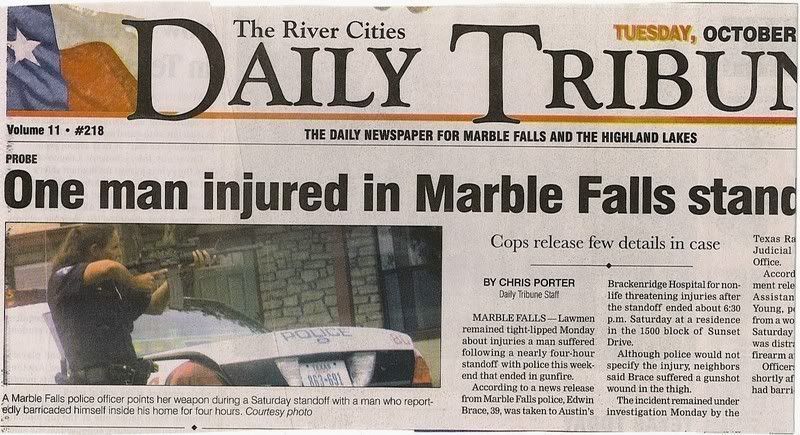
p.s the running joke with this one is 'her elbow is obscuring her lieutenant bars"
Another might be +2 synergy bonus to spotting an ambush: character would go, hmmmm...looks like a good place for an ambush, that's where I'd put one, better look a little more carefully, hey, what's that....
Along that route, a character with five plus ranks in tactical knowledge who sets up an ambush creates a -2 penalty for any NPC trying to spot the characters set up in an ambuscade...
Yet another would be a +2 bonus to any smart character or charismatic character with 5+ ranks when he/she uses those plan/inspire type abilities (ones that give bonuses to other characters) in combat situations.
One last one: five plus ranks gives you a bonus to initiative. This, I believe, is how Traveller did it. This one might be a bit strong, actually. Perhaps at best a +1.
I would hesitate to use it to help players plan their actions or point out flaws in their plans. As Traveller put it, "...strategy is the realm of players...". I understand their is a distinction between Strategy and Tactics (that is often somewhat grey), but I am looking at this from a roleplaying point of view, not a military one.
Besides History is replete with otherwise brilliant tacticians making stupid mistakes. Napoleon in Russia and at Waterloo, Hannibal in the 2nd Punic War by winning Cannae and losing the war, Lee at Gettysburg come to mind. If players make mistakes, let them.
Allowing a knowledge/tactics skill for planning attacks invades player decisions, IMHO, and encourages players to take a skill instead of learning to problem solve for themselves.
Ok, I'll get off my soapbox now.:D
Second, I developed a number of skill synergies for Knowledge (tactics) and the other Knowledge skills.
I'd be careful about using Knowledge (tactics) for too many things outside of simple Knowledge checks - you don't want to step on talents (like Plan) or class abilities (like Tactical Aid).
(Excerpts From Wikipedia)
"The United States Army Field Manual 3-0 offers the following definition of tactics: "Tactics – (Department Of Defense) 1. The employment of units in combat. 2. The ordered arrangement and maneuver of units in relation to each other and/or to the enemy in order to use their full potentialities. (Army) The employment of units in combat. It includes the ordered arrangement and maneuver of units in relation to each other, the terrain, and the enemy in order to translate potential combat power into victorious battles and engagements. (FM 3-0)."
"Some practices have not changed since the dawn of warfare: Ambushes, seeking and turning flanks, maintaining reconnaissance, creating and using obstacles and defences, ad infinitum. Using ground to best advantage has not changed much either; heights, rivers and swamps, passes and choke points, natural cover, all of these can be used in multiple ways."
With this in mind I would say that a tactics skill roll could produce the following advantages:
A free (additional) 5ft adjust move if you can suceed in a Tactics skill roll vs. opponents Sense Motive roll.
(DC 10) A +1 skill bonus to AC when using cover (you make better use of it).
(DC:15) +2 bonus to Hide skill when laying an Ambush.
(DC: 20) a +2 bonus to Initiative.
Synergy for the following skills If Knowledge( tactics) is 5 or greater :
+2 to Spot checks when Detecting ambushes or locating a hidden sniper.
+1 to Driving or Pilot skill checks when in combat.
+2 bonus to any combat related Sense Motive checks (like resisting a feint).