I'll be copying any starship equipment I've posted in weapons and Chuck's Emporium.
To start off.. PL5 starship armour.
Aircraft Grade Aluminum (PL5)
Cheap and light aircraft grade aluminum was used to skin many societies' early space craft, saving on weight and costs. Ships equipped with Aircraft grade aluminum superstructures gain a bonus of +250 ft to its base speed due to the light weight.
Hardness: 5
Speed Bonus: +250 ft
Base Purchase Modifier: 10 + one-quarter base purchase DC of starship.
Carbon Composite (PL5)
Based on low-observability/stealth materials design carbon composite armour is an early form of stealth armour for PL5 ship designs. The material makes the ship difficult to detect at long range with conventional radar and MAD sensors. Opposing units trying to detect a ship with carbon composite superstructure take a -5 penalty on their computer use checks if they are using Class I or II sensor suites. Class III and higher are unaffected.
Hardness: 2
Speed Bonus: +250 ft
Base Purchase Modifier: 10 + one-half base purchase DC of the starship.
Titanium Alloy (PL5)
Titanium alloy is some of the strongest materials available to a PL5 military. It makes a great material for building starships but is rare and expensive, and used only on warships or important exploration ships in PL5.
Hardness: 12
Base Purchase Modifier: 12 + one-half base purchase DC of the starship
Here's a quick, simple little cheap fighter. Think TIE fighter only not a TIE.
King Fisher

The King Fisher is a small, fairly inexpensive defense fighter, meant to be used in large numbers launched from ships or stations. Its small size reduces the armaments it can carry, and the amount of armour it can support, but it does have enhanced speed and maneuverability and small size makes it a difficult target. The king fisher is pretty much a cockpit stuffed between two engines with a pair of lasers, with minimum sensors and other systems, including limited life support, requiring pilots to wear at least a rebreather as it only has about an hour of stored air. Use of rebreathers will extend this supply by 30 minutes, although an additional air supply, with a sealable flight suit is suggested in the event of needing to eject from the craft. The king fisher does have two external mounts on the bottom to allow it to carry two missiles to give it a little extra punch.
The small size and low price allows more king fishers to be purchased and stored in hangers. About two, sometimes three king fishers will fit in the same space as other fighters, easily doubling the number of fighters available for defense, which in some cases, having more ships in the air is better, no matter how weak they are.
King fishers are not atmospheric ships, and should avoid them. Although planets with not atmosphere, and especially those with lower gravity don't seem to affect them as much, which makes these small craft a favourite defense fighters on moon bases or small barren planetoids.
King Fisher (PL6)
Type: Ultralight
Subtype: Fighter
Size: Huge (-2)
Tactical Speed: 3250
Defense: 8 (10 base -2 size)
Flat-Footed Defense: 8 (10 base -2 size)
Autopilot Defense: none
Hardness: 12
Hit Dice: 6d20 (120 hp)
Initiative Modifier:
Pilot's Class Bonus:
Pilot's Dex Modifier:
Gunner's Attack Bonus:
Length: 23 ft
Weight: 10,000
Targeting System Bonus:
Crew: 1
Passenger Capacity: 0
Cargo Capacity:
Grapple Modifier:
Base PDC: 38
Restriction: Lic (+1)
Attack:
2 fire linked lasers 9d8, 20, fire, 3000 ft, s/a
Up to two missiles externally.
Attack of Opportunity:
none
Bonuses:
Due to the small size and design, the King fisher enjoys a +2 bonus to Pilot checks for stunt maneuvers.
Standard PL(6) Design Spec:
Engines: Thrusters, ion engine, twin engine
Armour: Titanium Alloy
Defense Systems: none
Sensors: Class II, Missile Lock Alert
Communications: Radio transceiver
Weapons: 2 fire-linked laser, 2 missile hard points (carry 2 missiles externally)
Grappling Systems: none
Improved Thrust engines
Limited Fuel
Simple Construction
Limited Fuel
The king fisher has a smaller than normal fuel tank, requiring it to refuel after every battle. Reduce the cost of refueling by half, and reduce base purchase DC of the ship by 3.
Simple Construction
The king fisher is designed to be as simple as possible, using many off the shelf components, and the most simplest construction methods. A king fisher can actually be assembled in many workshops that have enough space and average tools and all the components, with a 10 man crew in about 1 day. The king fisher has its repair costs lowered by 3.
Shields
In d20 Future Tech, shields were introduced. Shields provide 20 hp per HD of starship with a maximum of one quarter of the ship's HD.
Each shield except for the Deflector Shields at PL9 only protect against one type of weapon, kinetic weapons or energy. The same for fields only provide a penalty to attacking weapons of a specific type except for the Solid Defense Field.
Enhanced Shields
Enhanced shields provide some of the benefits of fields combined with shields. Although overall weaker than full shields or fields, enhanced shields are used on ships that have limited space for defensive systems.
Enhanced Magnetic Shields (Late PL7)
Enhanced magnetic shields provide 15 hp per HD of the ship (one quarter rounding down). Absorbs damage from missiles and ballistic weapons. Missiles and weapons that deal ballistic damage fired at the ship suffer a -2 to attack roll. Mines can be equipped with enhanced magnetic shield.
Purchase DC: 17 + one half base purchase DC of the ship.
Res: Res (+2)
Enhanced Particle Shields (Late PL8)
Enhanced particle shields provide 15 hp per HD of the ship (one quarter rounding down). Absorbs damage from weapons that deal concussion, electricity, fire, or nonspecific energy damage. Such weapons suffer a -2 to attack rolls. Mines can be equipped with enhanced magnetic shields.
Purchase DC: 22 + one half base purchase DC of the ship.
Res: Res (+2)
Enhanced Deflector Shield (Late PL9)
Enhanced deflector shields provide 15 hp per HD of the ship (one quarter rounding down). Absorbs damage from any type of weapon. Weapons suffer -2 to attack rolls.
Purchase DC: 24 + one half base purchase DC of the ship.
Res: Res (+2)
Advanced Shields
Advanced shields are just more powerful versions of the basic shields. These shields add bonus hp of half the HD of the ship, rounding down. So normal shields add 20 hp per HD for half the total HD of the ship. While advanced enhanced shields add 15 hp per HD for half the total HD of the ship.
For example, a standard destroyer with 80 HD equipped with advanced version of standard shields (magnetic, particle or deflector) now gains an extra 20 hp for 40 HD instead of only 20 HD.
Enhanced shields can receive the same benefit, providing 15 hp for half. In the same example of the destroyer using advanced versions of enhanced shields gain 15 hp for 40 HD instead of 20 HD.
PDC: Shield type has PDC increased by +5.
Res: Mil (+3)
Redundant Shield Generator.
A redundant shield generator is a backup shield generator that kicks in the round after the primary shields are depleted. Redundant generators take up a defense system slot just like any other system and must be of the same type as already installed.
PDC: Cost of shield system to be installed +5.
Res: Mil (+3)
New Defensive System
Shield Energy Sink System
Shield energy sink system are designed with a special 'self-sacrifice' capacity in the event that shields should take too much damage and overload, acting like a circuit breaker. In the event the ship's shields take catastrophic damage and failing, the energy sink system absorbs the damage and burns out. The burnt out capacitor-fuse is ejected and allows the shield to continue as normal.
This system functions in two conditions. The first is if the ship is subjected to a critical hit, which normally bypasses shields, it has a 50% chance of the shields absorbing the damage instead. The second condition is if the shields would suffer a massive amount of damage, equal to the number of HD the ship has, the system will negate the damage equal to the number of HD it has. If a ship has 200 HD and suffers 215 points of damage, the system will engage and negate 200 points of damage. This makes the energy sink system only attractive on larger ships, especially since the capacitor-fuse takes up a fair bit of space, and several are mounted on a ship in the system. One capacitor is used when either condition is met. They do not do both. If a critical hit would do 300 points of damage, one capacitor-fuse would blow attempting to absorb the critical hit to the shield (makes the 50% chance), then a second one would blow if the ship had less than 300 HD.
Ships are equipped with 10 capacitor-fuses. Minimum ship type is upper range of Light (destroyer) or mediumweight ships. Up to two shield energy sink systems can be installed on a ship, each one taking up 1 available defensive system.
PDC: 15 + one half ship base Purchase DC of the ship for the system. Capacitor-fuses have a PDC of 25 each.
Res: Mil (+3)
Defensive System
Graviton Refractive Hull (PL 8)
Starships with this modification have had the hulls of their vessels treated to emit a low powered graviton scattering field making it more difficult for starships with any type of tractor beam to lock on to them.
Starships or star bases with this modification can make a Pilot check (DC 20) to avoid being effected by the tractor beam. If the roll fails, the starship or star base is affected as normal by the tractor beam.
Purchase DC: 5 + one-eighth the base purchase DC of the starship
Restriction: None
COMBAT WINGS (PL 6)
These advanced wings are structurally reinforced, enabling each wing to carry one additional beam, projectile, or missile weapon over the starship’s standard limit (see the future SRD). The standard design for a starship includes only two wings, though some unusual configurations sport four wings. The exact cost – and number of extra weapons the ship can carry – of this special system depends entirely on the ship’s design.
Maximum Ship Size: Gargantuan.
Purchase DC: 10 + one-quarter the base purchase DC of the starship (two wing designs); 18 + one-quarter the base purchase DC of the starship (four wing designs).
Restriction: Military (+3)
TWIN ENGINE SYSTEM (PL 6)
During the Fusion Age starship engineers expand upon experimental starcraft and prototype twin engine technology,designing a command and control system capable of taking two identical engine types and slaving them together, boosting the overall tactical speed of a starship.
A starship equipped with a twin-engine system must mount two identical starship engines – at the loss of 25% of the ship’s cargo capacity and one weapon slot – in order for the system to operate.
This device increases the tactical speed bonus of one of the engines by 50% (round down up the nearest 500 ft.) – the pair provides a tactical speed bonus of 150% of a single engine design.If the system or one of the engines in damaged in combat (most likely due to a critical hit), the remaining engine provides a tactical speed bonus equal to one-half (round up) the bonus a single engine design would normally provide.
Example: A starship equipped with this device and two induction engines would have a total tactical speed bonus of +1,500 ft. If one of the engines is damaged or destroyed the bonus drops to +500 ft. A starship equipped with this device and two gravitic redirectors would have a total tactical speed bonus of +2,500 ft. If one of the engines is damaged or destroyed the bonus drops to +1,000 ft.
Minimum Ship Size: Gargantuan.
Tactical Speed Bonus: See text.
Purchase DC: 15.
ADVANCED SENSOR JAMMER (PL 7)
This upgraded sensor jammer is identical to the Information Age sensor jammer (see the future SRD) except that it works against Class I through Class IV sensor systems. Sensor checks made against a ship equipped with an advanced sensor jammer by Class I or Class II systems suffer a –8 penalty while checks made by Class III or Class IV systems suffer a –5 penalty.
Purchase DC: 6 + one-half the base purchase DC of the starship.
Restriction: Military (+3).
PROXIMITY SENSORS (PL 6)
This specialized sensor system monitors the space surrounding the starship and, if an object enters the immediate area, sets of an alarm that instantly notifies the pilot and crew of the potential hazard. A starship equipped with proximity sensors may withdraw or jump to cruising speed– if the pilot makes a successful Pilot check (DC 15 + the opposing pilot’s number of ranks in Pilot) – without provoking an attack of opportunity (see Provoking an Attack of Opportunity in the starship section of the future SRD). Other actions that may provoke an attack of opportunity are unaffected by proximity sensors.
Purchase DC: 22 (Huge), 27 (Gargantuan), 32 (Colossal).
Restriction: Restricted (+2).
MAGRAM (PL 7)
This Gravity Age weapon is an electromagnetic beam projector that is used during starship ram actions (see Move Actions in the starship section of the future SRD). Triggered the instant the weapon impacts with another item (MagRams are mounted in the forward section of a starship), the MagRam increases the die multiplier of the damage caused to the opposing starship to x12 while reducing the die multiplier of the damage caused to the MagRam-equipped starship to x6. Example: A gargantuan starship equipped with a MagRam rams a colossal starship. The rammed starship suffers 6d6x12 damage while the MagRam equipped starship suffers 6d6x6 damage.
If two MagRams are involved in the same collision they cancel each other out and the starships suffer standard damage from the collision (as detailed under Move Actions in the starship section of the future SRD).
Damage: Special, see text.
Critical: –.
Damage Type: Special, see text.
Range Increment: –.
Rate of Fire: See text
Minimum Ship Size: Gargantuan.
Purchase DC: 30.
Restriction: Military (+3).
IMPROVED MANEUVERING FOILS (PL 6)
These computer-assisted wings, each equipped with a small thruster that ties into the ship’s engines, provide the starship with a greater degree of maneuverability. This device grants the pilot a +4 equipment bonus on all Pilot checks.
Minimum Ship Size: Huge.
Purchase DC: 15 + one-quarter the base purchase DC of the starship.
Restriction: Licensed (+1).
Auxiliary Engine
The engine features secondary, backup components that effectively make it its own backup drive system. In any instance that the engine is disabled it automatically comes back online, as a free action, in 1d4-1 rounds (minimum of 1).
A starship may be equipped with this gadget multiple times, each time increasing the total number of times that the engine can be reactivated after it would normally be damaged or destroyed by 1.
For each auxiliary engine gadget a starship engine is equipped with the DC to repairs is increased by +2.
Restrictions: Starship engines only.
Purchase DC: +2.
Improved Thrust
Computer system and machinery changes to the engine core grant the starship more power, enabling it to propel the starship at an increased rate of speed. The starship gains a +500 ft. bonus to speed.
NOTE: A starship may be equipped with multiple improved thrust gadgets, with each increase past the first granting an additional +250 ft. bonus to speed. (Tactical speed, in squares, is rounded down to the nearest 500 ft. increment.)
Restrictions: Starship engines only.
Purchase DC: +2.
Accuracy Enhancement
A combination of calibrated mechanical systems, advanced targeting software, and overall superior engineering combine to increase the weapon’s accuracy. This gadget grants the modified weapon a +2 equipment bonus to attack rolls.
Restrictions: Starship non-missile weapons only.
Purchase DC: +3.
HEAVY-LOAD BODY (PL 6)
Not so much a “system” as a basic body configuration option, the heavy-load body must be selected when a starship is first created. The heavy-load body actually comes in two versions, a cargo option or a combat option, that must be selected during starship creation. A starship may not use this “device” twice.
Cargo Option: Increase the starship’s cargo load by 50%.The starship is otherwise unaffected.
Combat Option: Increase the total number of allowed defense systems by one and the total number of allowed weapons by two. The starship is otherwise unaffected.
Purchase DC: Increase the starship’s base purchase DC by 10 (this is done before any other systems are installed; this change affects the cost of any other systems that are based on the ship’s base purchase DC).
Restriction: Cargo – Licensed (+1), Combat – Military (+3).
MOLECULARLY-BONDED MILITARY-GRADE CERAMETAL/ NEUTRONITE (PL 7)
This military-constructed armor blends neutronite and cerametal into overlapping sheets. The two materials are bonded together at the molecular level and reinforced with vanadium struts that are run crosswise through the individual armor plates.
Hardness: 50
Tactical Speed Penalty: -500 ft. (-1 sq.)
Weight: One-quarter the weight of the starship (rounded down).
Purchase DC: 20 + one-half the base purchase DC of the starship.
Restriction: Military (+3)
HSSSM-12 (PL 6)
The High Speed Ship-to-Ship Missile is the culmination of years of research. The missile casing is hardened and due to its higher velocity can penetrate a ship’s plating partially prior to detonating its warhead, thus causing greater damage than a conventional missile that detonates on the exterior of a ship’s hull. The missile itself is rather small having been developed with the intent of being delivered by a single man fighter.
Damage: 8d12, Critical: (19-20)
Damage Type: Ballistic
Range Increment: -
Rate of Fire: Single
Minimum Ship Size: Gargantuan
Purchase DC: 27
Restriction: Mil (+3)
Class IIISR Sensor (PL 6)
As per the Class III sensor array, but can see through a decoy drone’s false electromagnetic (but not thermal) signature. This sensor package is highly classified and thus is restricted to military purchases. The system itself is removed from the fighter after each mission and kept under tight security.
Purchase DC: 35
Restriction: (Mil +3)
Mantis Strike Particle Beam (PL 7)
The Mantis strike particle beam is experimental particle beam weapons that were taken from a top secret civilian research station first installed on the test ship Black Mantis. Christened the “Mantis Strike” by the Black Mantis’ crew, these beams feature an advanced charging system that allows the beams to be recharged more quickly and thus to be fired in semiautomatic mode, a fact taken full advantage of by the Black Mantis’ crew.
Name: Mantis Strike (experimental particle beam)
Weapon Damage: 12d8 (54)
Critical: 20
Damage Type: Energy
Range Increment: 4,000 ft.
Rate of Fire: Semi-Automatic
Minimum Ship Size: Gargantuan
Purchase DC: 41
Restriction: Illegal (+4)
Cobra Air-to-Air Missile (PL 5)
A light air-to-air missile similar to sidewinders and ARAAMs produced in late PL5.
Name: Cobra (air-to-air missile)
Weapon Damage: 4d12 (26)
Critical: 19-20
Damage Type: Ballistic
Range Increment: -
Rate of Fire: Single
Minimum Ship Size: Huge
Purchase DC: 21
Restriction: Mil (+3)
Nuclear Pumped X-Ray Laser Missile (NPXL Missile)
The idea of nuclear pumped lasers is an old idea, and quickly fell out of use once more reliable power sources and laser technology was available, as such weapons were expensive, and needed constant replacement, similar to a missile. The NPXL missile uses more advanced methods, and cheaper materials to create a disposable x-ray laser of starship scale for fighters to carry, giving them great anti-ship capabilities. The NPXL uses a nuclear detonation to power an x-ray laser emitter, but the explosion also powers a short lived force field which contains the explosion for a short while. The x-ray laser punches a whole in the hull of a ship with its great penetration capabilities, then the force field starts to break down at the front where the laser emitter is, destroying it, and forcing the explosion forward like a shaped charge into the breached hull before the rest of the force field collapses. This further damages the ship, and also has the side effect of hitting the ship's crew with high levels of radiation. This does make the weapon some what illegal in many areas, but critics can not deny its effectiveness.
Nuclear Pumped X-Ray Laser Missile
Damage: 10d8 ignoring 50 points of DR/hardness (x-ray laser) + 14d8 (nuclear explosion) ignores hardness
Critical: 19-20x3
Damage Type: Fire (laser) + energy (nuclear explosion)
Range Increment: -
Rate of Fire: Single
Minimum Ship Size: Huge
Purchase DC: 34
Restriction: Military (+3) to Illegal (+5)
Note: The critical is only for the x-ray laser, the nuclear explosion ignores hardness as it is being directed right into the breach the x-ray laser just made milliseconds before. Also 30% of the crew will be severely irradiated with an exposure time of 1 round, see page 80-81 d20 Future. Most fighters will carry only one or two of these missiles on an external weapon mount.
A bit on Point Defense Systems (page 135 d20 Future)
While doing the Anti-Aircraft platforms I posted earlier, I looked back on the Point Defense Systems for starships. I noticed it only deals ballistic damage. Now.. why couldn't you have a system that uses lasers instead to save on cargo space needed to feed this defensive systems? or Plasma? what about particle beam weapons, ion or electrical based weapons?
And ships can only make one attack of opportunity, does that mean it can only stop missiles once a round, but can't make an attack against any ship getting close? or attack a ship getting close but not any missiles?
So I was thinking.. Allow the system to make as many as the pilot's Dex modifier? or maybe, since they can't be controlled by anyone and are automatic, give them certain amount of attacks per round as if they were a person?
So, first changes I'd make is damage type. The Point Defense System will use the main weapon type of the PL that the ship was made in, or what the designer thought was most efficient, or cost effective. So now the system isn't PL6, but more PL dependent for damage type. So PL5 would be ballistic, while PL6 could be ballistic or fire, or a combination of the two, so half the batteries are ballistic weapons and half lasers, so the damage dealt would be half and half ballistic and fire. While PL7 could be lasers or plasma, or maybe ballistic for rail/gravity guns if you so desire. PL8 can add in electricity based weapons, or 'energy'. Or it can have any of the previous damage types.
Or, if the race that built the ship favours electrical based or particle beam weapons at an earlier PL, can put it on those ships as well, but only on that race's ships.
This option allows the ships to have a little more flavour, which can make some unique. Like if Race A is PL5 and uses the basic ballistic weapons, while Race B uses lasers, and race A has armour designed to fight ballistic weapons, they are at a disadvantage against race B's laser point defense weapons.
PDC won't be changed using this rule, it's more for flavour and some diversity amongst different races and ship designs for the point defense systems.
Let's also say the basic system has one attack of opportunity. More attacks can be made with upgrades. Here's a few possible upgrades or enhancements to the point defense system.
Heavy Point Defense System
This is a heavier version of the point defense system uses larger caliber or greater powered weapons.
Increase the damage by 1 die, as if the ship size was larger than it is.
Increase PDC of the system by +2
Light Point Defense System
This is a lighter point defense system, using smaller weapons or a few less emplacements.
Decrease damage by 1 die, as if the ship was one size smaller. In the case of an ultralight, which normally has 1d12x10 damage for the point defense system, reduce the multiplier to only x6, so it becomes 1d12x6.
Use the PDC of the next size smaller ship, or reduce it by 1 in the case of Ultralight.
Enhanced Point Defensive System
This version has more weapon emplacements to allow greater coverage to bring more weapons to bare.
This version has the multiplier increased to x12 from the normal x10.
Increased PDC by +2
Extended Range
The point defense system has greater range than previous versions. This is done by longer barrels, more powerful propellant, extra focusing chambers, etc. The range that the system works at is now 1000 feet, or two 500 foot squares around the ship.
Enhanced Computer Control
The control system has better computer control and programming, even up to powerful AIs to direct the point defense systems.
Mk1 has 2 attacks per opportunity PDC +3; Mk2 has 2 attacks, but has a 30% chance to destroy a missile and also gets a +1 to attack rolls for attacks of opportunities PDC +4; Mk3 has 3 attacks of opportunities, 30% to destroy missiles, and +2 to attack rolls PDC +5; Mk4 has 4 attacks of opportunities, 40% chance to destroy missiles and +3 to attack rolls PDC +6.
Missile Interceptors (PL6)
Missile interceptors is similar to point defense systems, but uses smaller caliber weapons, and targets missiles only. This allows point defense systems to only be dedicated to just attacking ships within range. This system takes up a Defensive System slot. The system can be used against any missile attacks in a round. A barrage of missiles from a single attack requires a roll against the number of missiles to determine how many missiles the system can target. So if a barrage contains 6 missiles, roll a d6 and the result is how many missiles the system can attempt to hit. If the barrage contains an odd number of a missiles, use only the closest round number that is below the number of missiles, except in the case of 3 missiles, then use a d4 and a result of 4 would just allow the system to try against all three missiles.
Mk1 has a 30% chance to destroy missiles PDC 29, Mk2 has a 40% chance to destroy missiles PDC 31, Mk3 has a 50% chance to destroy missiles PDC 34, Mk4 has a 60% chance to destroy missiles PDC 36, Mk5 has a 70% chance to destroy missiles PDC 38.
After much research in laser weapons, and pulse/beam weapons, weapon designers discovered the x-ray variant laser. These types of lasers are slow to fire, and require a large amount of power, and only somewhat more powerful than other lasers, while being quite a bit larger than normal lasers. The main advantage of x-ray lasers is their armour penetrating capabilities, and normal laser defeating means are only half effective.
X-Ray Laser (PL7)
Damage: 11d8, ignore 40 points of DR/hardness
Critical: 19-20x3
Damage Type: Fire
Range Increment: 3000 ft
Rate of Fire: Single
Minimum Ship Size: Gargantuan
Purchase DC: 40
Restriction: Military (+3)
Spinal Mount
This option for ship based weapons allows one to install a large weapon onto a ship smaller than its listed minimum size. The ship can only get this option during construction as the ship is literally built around the weapon system.
A spinal mount weapon can be mounted on a ship one size smaller than its minimum listed size. For example, a rail cannon has a minimum ship size of gargantuan. As a spinal mount, the rail cannon can fit on a huge ship.
Spinal mounts have reduced payloads of weapons with physical ammunition, by half. They have reduced rates of fire for both physical ammunition weapons and energy weapons. So an automatic would now be semi, and semi would be single. You can rule that energy weapons also have reduced amount of ammunition due to power drains, especially if you want to keep a higher rate of fire.
These type of spinal mounts are usually seen on heavy fighters or bombers to give them a heavy, but limited punch against light capital ships or heavy fighters and bombers.
PDC +2 for this type of spinal mount.
For spinal mounts on a ship that meets the minimum ship size, or is bigger, the spinal mount version is considered a heavy version. Weapon has reduced rate of fire and payload and suffer a -2 to attacks on ships of gargantuan or bigger, but gains +50%, rounding up, damage and +100% range and ignore 20 points of DR/hardness. If the weapon already ignores some DR/hardness, add 20 to its rating. These are bigger, more powerful versions, usually mounted on destroyers or cruisers, meant to be ship killers. Can be found on corvettes and above class of ships.
PDC+5
Edit:
To make spinal mounts far more attractive, here's a little edit for larger ships.
For every increase in ship type above light, a spinal mount weapon can be made even bigger to match the size of the ship, by increasing the damage and range by 50% of the ORIGINAL weapon used, and a decrease in rate of fire. So a cruiser, which is a mediumweight ship can use a spinal mount weapon with a total of 100% range and damage increase but has it's rate of fire reduced twice.
OR a ship could have multiple spinal mounts of a weapon at least one ship type smaller than itself equal to ship size minus 1 in difference between its size and light. So a cruiser could have two light sized ship spinal mounts or one mediumweight. While a dreadnought, a super heavy ship, could have two heavy spinal mounts or 3 mediumweight or 4 light spinal mounts.
PLASMA CANNON, LIGHT (PL 7)
This is a smaller version of the standard plasma cannon. Although the smaller size means reduced range and power when compared to a standard plasma cannon, it is still one of the most powerful weapons for a ship of Huge size.
Damage: 10d8 (45)
Critical: 20
Damage Type: Fire
Range Increment: 2,000 ft.
Rate of Fire: Single, S, or A
Minimum Ship Size: Huge
Purchase DC: 33
Restriction: Military (+3)
Beam/Pulse Weapon System
This system combines long range of lasers with faster fire of plasma weaponry for close range combat all from the same barrel. Although more expensive than having just lasers or plasma cannons, the dual beam/pulse system allows most ships to be able to switch between the two systems, creating better flexibility in combat. When several are mounted in turrets on larger vessels, they can be tied into the point defense system, greatly improving it's damage capacity, however it makes the weapons unavailable for normal use by gunners.
Light Beam/Pulse System (Late PL7)
Damage: 6d8 (27) laser, 10d8 (45) plasma
Critical: 20
Damage Type: Fire, fire
Range Increment: 3500 ft laser, 2000 ft. plasma
Rate of Fire: Single laser , S or A plasma
Minimum Ship Size: Gargantuan
Purchase DC: 35
Restriction: Military (+3)
Game Note: Switching from laser or plasma weapons is a free action which can only be switched once per round. When at least four are mounted on a ship and tied into an installed point defense system, increase the damage by 1 die (in effect increasing the damage by one size category) and increases the range of of attacks of opporunity and of the system itself to 1000 ft adjacent squares around the ship's square. Also the damage type of the point defense system changes to half ballistic/half fire for the plasma weaponry enhancement.
Medium Beam/Pulse System (Early PL8)
An upgraded version of the light beam/pulse system using heavier lasers and plasma cannons
Damage: 8d8 (36) laser, 14d8 (63) plasma
Critical: 20
Damage Type: Fire, fire
Range Increment: 4000 ft laser, 3000 ft. plasma
Rate of Fire: Single laser , S or A plasma
Minimum Ship Size: Gargantuan
Purchase DC: 37
Restriction: Military (+3)
Game Note: Switching from laser or plasma weapons is a free action which can only be switched once per round. When at least four are mounted on a ship and tied into an installed point defense system, increase the damage by 1 die (in effect increasing the damage by one size category), and multiplier by x15 instead of x10 and increases the range of of attacks of opporunity and of the system itself to 1000 ft adjacent squares around the ship's square. Also the damage type of the point defense system changes to half ballistic/half fire for the plasma weaponry enhancement.
TARGETING SYSTEM, ADVANCED (PL 8)
A starship equipped with an advanced targeting system gains an equipment bonus on attack rolls depending on the ship’s size: Huge +5, Gargantuan +6, Colossal +7. This system replaces the PL 7 improved targeting system.
The purchase DC of the advanced targeting system depends on the size of the ship.
Purchase DC: 26 (Huge), 31 (Gargantuan), or 36 (Colossal).
Restriction: Military (+3).
RANGE EXTENSION SOFTWARE (PL 6)
This “system” is, in fact, a software upgrade that must be installed in conjunction with a standard targeting system (see the future SRD). A starship equipped with the two systems gains a +1,000 ft. bonus to each of its weapons’ range increments. An advanced version, available during the Gravity Age, extends the range increment an additional 1,000 ft.
Purchase DC: 20.
Restriction: Military (+3).
Miniaturized
By eliminating wasted space and using microscopic components, some engineers are capable of producing weapons vastly smaller than normal. Any weapon that makes use of the miniaturized gadget is counted as one-half a weapon of its type for purposes of the starship’s weapon limits.
Example: A heavy starship is limited to a single beam, projectile, or missile system for every 50 Hit Dice of its size. The starship could mount two miniaturized beam, projectile, or missile systems for every 50 Hit Dice of its size.
Restrictions: Starship weapons only.
Purchase DC Modifier: +8.
CW4 Sonic Missile (PL6/7)
As Crystal Works expanded its weapons research, one team tried an unorthodox line of weapons in space combat: sonic weaponry. Sonic weapons have proven, in the right conditions, to be particularly devastating to armour, particularly when harmonic resonance frequencies can be achieved. The problem with sonic weapons is there is no medium for the sound waves to travel along. To fix this, and taking advantage of various crystals available to them that enhance sonic frequencies, the CW4 sonic missile was unveiled. About the same size as most space fairing missiles, but with just over 50% of the missile consisting of special crystals, which is exposed to the outside. When fired, the exposed crystal glows brightly as the crystal absorbs sonic frequencies from the sonic generator, thus not making it a stealthy weapon. Just before reaching the target, the missile explodes, spreading shards of glowing crystal all over the target. Upon impact, the crystals impart their sonic energy into the hull, causing it to vibrated, ripping the plating apart.
The advantage of sonic weapons is most ships aren't designed to resist their effects, making them vulnerable, plus if one has knowledge of the type of hulls and armour of the ships they are targeting, the missiles can be programmed with the proper frequencies can be more devastating. Normally sonic missiles ignore 10 points of hardness, but when programmed, requiring accurate readings from sensors of armour type, to do one of two effects. This requires a Computer Use check DC 25 and 5+ 1d6 rounds for commonly found armour types plus an additional 3 rounds for unusual armour types. The two effects are: reducing armour capability, which makes the armour far weaker as the sonic frequencies and vibrations weaken, crack and loosen the armour plating; or increase damage by matching the sympathetic harmonic frequencies and causing the ships armour to shake itself apart. The armour reducing capability reduces the armour's hardness rating to 25% (one-quarter) of what it should be for any follow up attacks until repaired. The increased damage multiplies the damage done by triple (damage x3).
These missiles are expensive, plus the time it takes to program them does restrict their use. Some militaries with large budgets, have racks of preprogrammed missiles for various common armours on their larger destroyers and cruisers.
CW4 Sonic Missile (PL6/7)
Damage: 11d8, ignores 10 points of hardness
Critical: 20/x2
Damage Type: Sonic
Range Increment: -
Rate of Fire: Single
Minimum Ship Size: Gargantuan
Purchase DC: 42
Restriction: Mil (+3)
The PDC includes the price of the launcher and 8 missiles. The price of a rack of 8 missiles is 2 lower.
CW5 Sonic Mine (PL 6/7)
The CW5 sonic mine is a mine version of the CW4 sonic missile. The sonic mine has the sonic generator in the center of a ring of crystal, which upon detonation, glows brightly for a second before bursting, spreading a wave of glowing crystal shards that damage all ships in its square and all adjacent squares. The mines can be programmed just like the missiles before being deployed. In its standard configuration, it ignores 15 points of hardness.
CW5 Sonic Mine (PL6/7)
Damage: 8d100, ignores 15 points of hardness
Damage Type: Sonic
Range Increment: --
Rate of Fire: -
Minimum Ship Size: Colossal
Purchase DC: 43
Restriction: Mil (+3)
The starship «New York/New York-01» is the personal property of the Fraal leader code name Sinatra. Although Fraal civilization has reached PL 9, Sinatra loves to tinker around the antic PL7 ship during his time off. The crew quarters, galley and lounge area have been remodeled in a tribute to New York's 1950 architectural and design styles : Dinner style for the galley, Cabaret style for the lounge, Art Deco/Frank LLoyd Wright inspirations for the captain and crew quarters. When not in use the intercom system doubles has a sound system that plays crooner music classics... When he retires from active service Sinatra plans to transform the two cargo holds of the ship into deluxe passenger cabins and accommodations.
STATISTICS
* Type : Ultralight
* Subtype : Civil Freighter
* Constructor : MindHive Engineering
* Galactic Concord Model Code : FRL_MHE_124b
* Size : Colossal
* Length : 160 feet
* Weight : 4000 tons
* Cargo Capacity : 2000 (2x1000)
* Crew : 4 minimum
* Passenger Capacity : 4
SYSTEMS
* Power Core : Antimatter Reactor
* Engines : Induction Engine + Thrusters
* Armor : Cerametal
* Defense Systems : Light Fortification + Particle Shields
* Sensors : Class IV Sensor Array, Improved Targeting
* Communications : Drivesat Comm Array
* Weapons : 2 Mass Cannons (Firelinked), 1 Rail Cannon
* Grappling System : Grapplers

Credits (Atanakar - AKA Shesheyan)
Function
The AFPs are the backbone of Fraal military strategy. Operated by a skeleton crew of 25 Fraals these superheavy FTL starships are literally mobile factories. Whenever the Fraal become involved in a major conflicts they dispatch fully stocked AFPs to «quickly» build ships to replace the destroyed ones. Soon the enemy is winded and the conflict comes to an abrupt end. Then, Fraal diplomats come into play to sign a non-aggression treaty.
The AFPs can produce different ships at the same time because they have multiple production lines.
Sequence of Production (order in which assets are built by the AFP)
Phase 1- Gunships (Escort_Ultra light) x04 • Production : 5 days
Phase 2- Corvette (Light) x02 • Production : 5 days
Phase 3- Cruiser (Mediumweight) x01 • Production : 15 days
Phase 4- Fleet carrier (Heavy) x01 + Assault fighters (Ultralight) x16 • Production : 30 days
Phase 5- Courier (Ultralight) x02 + Fast Freighter (Ultralight) x02 • Production : 5 days
Number Crunching
Ultra light ships (x4) : One line per ship = 5 days
Light ships (x2) : Two lines per ship. One for the frame the other for components = 5 days
Medium ship (x1) : Lines 1, 2 and 3 are used for the frame and line 4 is used for the components. (which slow production considerably: 10 days for one size above light + 5 days for having one line for components = 15 days)
Heavy ships (x1) are built in 3 phases. Phase 1 : All components and fighters are built and stored. In phase 2 all 4 lines are used to build the frame. Phase 3 : Components are added. (very slow production : 20 days for two sizes above light + 10 days for components = 30 days)
Credits (Atanakar - AKA Shesheyan)
Since the destruction of their homeworld the Fraal have developed and perfected Colony Starships. These superstructures are home to an average of 25 000 Fraals. The PL8 design of colony starships is completely modular.
Concord Transport Tube
This gigantic cylindrical tube is used for «very fast» transport around the colony. Freight and passenger shuttles constantly travel in this weightless environment. All shuttle movement is automated and is controlled by the colony AI. One only need board a shuttle and enter the destination. Travel in this tube take one round per tube segment.
The Concord Transport Tube doubles has superstructural support that houses six independent Colony Nodes. In the event of a major catastrophe each Colony Node is self sufficient and has FTL capability. In its center the CTT also supports the Central Command Node, the Colony Powercore and the main FTL engine.
Transport Tubes
Similar in nature to the CTT these smaller structures have gravity and atmosphere. Opentop gliders are used to move from one platform to another. Movement in these tubes is not governed by the colony AI. One can either pilot the glider or let the autopilot take over. Maximum speed is limited to 100feet per round.
Colony Nodes
Acting as main support of Fraal communities, Colony Nodes are a group of six one kilometer long platforms. Each platform supports 7 towers that house an average of 100 Fraals. Platforms have 5 levels used for the production of goods and food for the colony node. The 4 main floors of the towers are used for administrative, leisure and scientific activities. The 10 top levels of the towers are used for housing.
The central tower of the central platform of each CN houses the Colony Node Council. The towers extend below the platform. These four levels are used for storage and have docking facilities. They also house the CN power core and FTL drive. Each CN has its own attack/defense AI system. This AI becomes slave to the CCN's AI when in Colony Starship configuration.
One in three Colony Nodes are modified to serve as spacedocks for heavy freighters and military starships. Refitting and restocking of military vessels take place in these facilities.
Central Command Node
Housing the powercore, central AI and FTL engine of the Colony Starship this node also doubles has Central Command Center. The administrative, military and political bodies of the colony hold court in these small structures. It is also self sufficient for short periods of time.
Attack/Defense capabilities of Fraal Colony Starships
Attacking a Fraals Starship Colony would be equivalent of attacking :
* 7 Superheavy PL8 colony ships
AND currently docked :
* (1d2+1) Superheavy military PL9 starships
* (1d3+2) Heavy military PL9 starships
* (1d4+2) Medium military PL9 starship
Fraal Colony Ship • Conceptual Plans
i244.photobucket.com/albums/gg28/atanaka...
Credits (Atanakar - AKA Shesheyan)
I Can't remember the book or where its from but imagine having access to a mobile fortress ship capable of arming, armoring, maintaining, repairing, salvaging enemy ships, and outfitting the attached fleet with all the needed means without having to traverse back to neutral or friendly territory for such things... of cours to handle a Gargantuan class starship it would have to be larger and include heavily roboticized means
Its a crazy and megalomaniac idea I came up with a few years back. I originaly posted it under my former user name Atankar. It was part of The Rise of the Kinori novelette-campaign I posted on the old forum. To my surprise in the last Ian M. Banks book «Surface Details» he mentions great factory disks capable of building hundreds of ships in very short time. Great minds think alike !
The ship would indeed need to be extremely large and have robotized means. But I was also thinking further. PL9 nanotechnology that auto builds itself when given the proper initiating codes.
The game Homeworld had repair corvettes that use a 'repair' beam to gradually repair damage done to ships. The more repair corvettes, the faster. I assumed it did this through a sort of nanite technology combined with tractor beams to move any stored materials into place.
I've actually got an idea for a vessel that'll be in fleets, basically a large freighter with expandable scaffolding and robotic arms and such that can conduct repairs from stored material in the freighter's hold. Within the hold will also be a factory and smelter. Factory to assemble equipment, hull plating, etc, and the smelter for melting down battle salvage or even rare materials brought to it.
I would also imagine deep space exploration ships would have similar capacity on a much smaller scale, mostly for manufacturing parts for itself, or for any ships that might be part of the exploration fleet.
So such ships could range in size from mid-to large freighters to even dwarf battleships.
Working on an aptly titled MCSY or Mobile Construction Starship Yard starting at the appropriate PL, late PL 5, allowing for any of the aforementioned tasks of arming, armoring, maintaining, repairing, salvaging enemy ships, and outfitting the attached fleet before said squishy NPC's begin the menial task of fixing up those damaged ships and systems
I'd imagine a PL5 one would be pretty big, like something the size of the ship from Alien (the refinery unit), with large expanding scaffolding with robotic arms for doing large repairs. Probably a hanger for fighters to land for repairs. Definitely would be slow to launch the ships in an emergency.
I don't think it would do too much processing raw materials except for common armour plating, ballistic ammunition and fuel. If it does a salvage or mining, going to need large drills. But salvaging ships, that should be much easier to gain materials for it.
This kind of thing would be a hell of a catch for pirates to attack and raid. Sure, they may not take the ship, but raiding the cargo holds of fuel and raw materials or even finished components of military gear. One could make a series of adventures around escorting such a ship that is moving to a debris field in 'safe' territory to collect and process the debris before moving off to meet up with a fleet that'll finish maneuvers (probably engaged in a series of combat situations) before meeting at a rendezvous point with reinforcements/replacements and the mcsy for repairs, refueling and supplies.
use the exterior scaffolding for refits. Also I'd give it extra superb defense systems but no offensive weapons seeing as it usally has a fleet around it. Also I finished stats on the pelican. The magna-lock will prove to be very useful in almost any future setting imagine it deploying mecha on the Feild.
I have to find my binder with the printouts of the WARSHIP and both Blood & Space pdf's to compare a few things but I may have something statted soon
ATLANTIS Class Cruiser
The shovel shaped Atlantis cruisers were a mass produced, fairly simple military cruiser designed for export sales to as many space navies as possible. No one remembers who originally came up with the design, but many ship manufacturers have licenced the design to be able to produce a reliable design quickly, and efficiently.
Atlantis Class Cruisers measure over 500 feet in length and are comprised of 4 levels. The ship itself is divided into three main sections, a forward hull than includes all command areas and engineering, a main hull that includes most living quarters, weapons, defensive and environmental systems, and the rear engine cluster that is made up of three independent engine units. Each standard Atlantis Class Cruiser is equipped with 4 fusion beams in two batteries of two, a battery of two CHE missile launchers (24 missiles each), magnetic defense field emitters, an autopilot system, a chaff launcher, a decoy drone launcher, a point defense system, radiation shielding, a self destruct system, and an improved damage control system. Sensors include a Class III array and targeting system. The outer hull is made of vanadium, and the engines are a combination of fusion torch and thrusters. The ship has a crew of 95, with an additional passenger capacity of 50 in emergencies.
Internally, the Atlantis is fairly spartan, but efficient, including most facilities found on military ships, including an armoury, security station, mess halls, rec/exercise room, 2 small labs (used for electronic and mechanical repairs, computer maintenance and small parts fabrication), a staging and temporary storage room close to the primary airlock under the shovel prow, a data buoy with ship's blackbox that can be jettisoned, sick bay that can accommodate up to 10 patients at once, several cargo areas, including a cold storage room (approx 30 x 30 ft).
Atlantis Class Cruiser (PL6)
Type: Mediumweight
Subtype: Cruiser
Size: Colossal (-8)
Tactical Speed: 3000 ft
Defense: 7
Flat-Footed Defense: 5
Autopilot Defense: 5
Hardness: 30
Hit Dice: 200d20 (4000 hp)
Initiative Modifier: +6
Pilot's Class Bonus: +3
Pilot's Dex Modifier: +2
Gunner's Attack Bonus: +2
Length: 525 ft
Weight: 24000 tons
Targeting System Bonus: +3
Crew: 95 (trained +4)
Passenger Capacity: 50
Cargo Capacity: 4100 tons
Grapple Modifier: +16
Base PDC: 64
Restriction: Military (+3)
Attack:
Battery of 2 fusion beams -2 ranged (10d8/19-20) and battery of 2 fusion beams -7 ranged (10d8/19-20) and battery of 2 CHE missiles -7 ranged (6d12/18-20)
or
Battery of CHE missiles -2 ranged (6d12/18-20) and battery of 2 fusion beams -7 ranged (10d8/19-20) and battery of 2 fusion beams -7 ranged (10d8/19-20)
Attack of Opportunity:
Point Defense System +3 ranged (3d12x10)
Standard PL(6) Design Spec:
Engines: Fusion torch, thrusters
Armour: Vanadium
Defense Systems: Autopilot system, 1 chaff launcher (8 chaff bundles), 1 decoy drone launcher (8 drones), improved damage control (4d10), magnetic field, point-defense system, radiation shielding, self-destruct system
Sensors: Class III sensor array, targeting system
Communications: Laser and radio transceivers
Weapons: 2 batteries of 2 fusion beams each (range incr 3000 ft), 2 CHE missile launchers (24 missiles each), 1 mine layer (36 fusion mines with magnetic fields and stealth screens; 5d10x10 damage)
Grappling Systems: Grapplers
Shrike Class Fighters
The Shrike family of small single pilot fighters was originally born out of the need for an airframe designed around the Lockdyne HSSSM (High Speed Ship to Ship Missile) project. The specifications for the Lockdyne missile required a specialized single pilot ship be constructed for use during the test phase of the missile. The missile was a failure and the contract was awarded to Argonaut Industries. The fighter prototype proved extremely capable and further testing was requested by the military along with funding for three additional prototypes, followed shortly by full scale production. The shrike has a triangular build, with a flattened top, wings angled down slightly. The wings can swing up for storage, but can not hold any missiles (Mk IV only) while in stored position. After years of successful service, newer models were released. The Mk. II was a straight ship-to-ship dogfighter and had a weapons upgrade to lasers. The Mk. III was a two-seat modification to allow for the inclusion of a second crew member to operate the newly developed class IIISR sensor system. The Mk. IV is a slightly modified version of the Mk. II, but carries a larger missile payload.
Shrike Mk I (Late PL5/Early PL6)
Type: Ultralight
Subtype: Fighter
Size: Gargantuan (-4 size)
Tactical Speed: 3500 ft
Defense: 19
Flat-Footed Defense: 13
Autopilot Defense: 6
Hardness: 22
Hit Dice: 8d20 (160 hp)
Initiative Modifier: +8
Pilot's Class Bonus: +7
Pilot's Dex Modifier: +6
Gunner's Attack Bonus: +8/+3
Length: 43 ft
Weight: 41000 lbs
Targeting System Bonus: +2
Crew: 1 (ace +12)
Passenger Capacity: 0
Cargo Capacity: 1000 lbs
Grapple Modifier: +8
Base PDC: 49
Restriction: Military (+3)
Attack:
2 Fire-linked Gatling gun +6 ranged (9d12)
Attack of Opportunity:
None
Standard PL(Late 5/Early 6) Design Spec:
Power Core: Power Cell
Engines: Ion engine, thrusters
Armour: Polymeric
Defense Systems: Sensor jammer
Sensors: Class III sensor array, targeting system
Communications: Laser and radio transceiver
Weapons: 2 fire-linked gatling guns (6d12, range incr 2500 ft)
Grappling Systems: None
The Mk. II Shrike is an upgraded version that removes the twin gatling guns with four fire-linked lasers, making the Shrike less dependent upon physical ammunition and requiring reloading during extensive dogfights. The Mk. II also sees the addition of a mounting of a two shot HSSSM-12 missile launcher to the top of the craft behind the cockpit and damage control system to increase its endurance.
Shrike Mk II (PL6)
Type: Ultralight
Subtype: Fighter
Size: Gargantuan (-4 size)
Tactical Speed: 3500 ft
Defense: 19
Flat-Footed Defense: 13
Autopilot Defense: 6
Hardness: 22
Hit Dice: 8d20 (160 hp)
Initiative Modifier: +8
Pilot's Class Bonus: +7
Pilot's Dex Modifier: +6
Gunner's Attack Bonus: +8/+3
Length: 43 ft
Weight: 41000 lbs
Targeting System Bonus: +2
Crew: 1 (ace +12)
Passenger Capacity: 0
Cargo Capacity: 1000 lbs
Grapple Modifier: +8
Base PDC: 50
Restriction: Military (+3)
Attack:
4 Fire-linked laser +6 ranged (12d8) and 1 HSSSM-12 missiles +1 ranged (8d12/19-20)
Or 1 HSSSM-12 missiles +6 ranged (8d12/19-20) and 4 fire-linked lasers +1 ranged (12d8)
Attack of Opportunity:
None
Standard PL(6) Design Spec:
Power Core: Power Cell
Engines: Ion engine, thrusters
Armour: Polymeric
Defense Systems: Sensor jammer, damage control (1d10)
Sensors: Class III sensor array, targeting system
Communications: Laser and radio transceiver
Weapons: 4 fire-linked lasers (3000 ft) and 2 HSSSM-12 missiles
Grappling Systems: None
The Shrike Mk. III is more of a scout variant, losing the missiles, but gains expanded sensors and an extended cockpit for an Electronic Systems Operator for the Class IIISR sensor array and recording systems.
Shrike Mk III
Type: Ultralight
Subtype: Fighter
Size: Gargantuan (-4 size)
Tactical Speed: 3500 ft
Defense: 19
Flat-Footed Defense: 13
Autopilot Defense: 6
Hardness: 22
Hit Dice: 8d20 (160 hp)
Initiative Modifier: +8
Pilot's Class Bonus: +7
Pilot's Dex Modifier: +6
Gunner's Attack Bonus: +8/+3
Length: 43 ft
Weight: 41000 lbs
Targeting System Bonus: +2
Crew: 1 (ace +12)
Passenger Capacity: 1 (Electronic Systems Operator)
Cargo Capacity: 1000 lbs
Grapple Modifier: +8
Base PDC: 50
Restriction: Military (+3)
Attack:
4 Fire-linked laser +6 ranged (12d8)
Attack of Opportunity:
None
Standard PL(Late 5/Early 6) Design Spec:
Power Core: Power Cell
Engines: Ion engine, thrusters
Armour: Polymeric
Defense Systems: Sensor jammer, damage control (1d10)
Sensors: Class IIISR sensor array, targeting system
Communications: Laser and radio transceiver
Weapons: 4 fire-linked lasers (3000 ft)
Grappling Systems: None
The Mk. IV Shrike is modified to be a heavy strike attack craft, in addition to the HSSSM-12 two shot launcher, are two three shot wing mounted HSSSM-12 missile launchers. A flight of Mk. IV Shrikes can be a serious threat to small capital ships.
Shrike Mk IV (PL6)
Type: Ultralight
Subtype: Fighter
Size: Gargantuan (-4 size)
Tactical Speed: 3500 ft
Defense: 19
Flat-Footed Defense: 13
Autopilot Defense: 6
Hardness: 22
Hit Dice: 8d20 (160 hp)
Initiative Modifier: +8
Pilot's Class Bonus: +7
Pilot's Dex Modifier: +6
Gunner's Attack Bonus: +8/+3
Length: 43 ft
Weight: 41000 lbs
Targeting System Bonus: +2
Crew: 1 (ace +12)
Passenger Capacity: 0
Cargo Capacity: 300 lbs
Grapple Modifier: +8
Base PDC: 50
Restriction: Military (+3)
Attack:
4 Fire-linked lasers +6 ranged (12d8) and 2 HSSSM-12 missiles +1 ranged (8d12/19-20)
Or 1 HSSSM-12 missiles +6 ranged (8d12/19-20) and 4 fire-linked lasers +1 ranged (12d8)
Attack of Opportunity:
None
Standard PL(6) Design Spec:
Power Core: Power Cell
Engines: Ion engine, thrusters
Armour: Polymeric
Defense Systems: Sensor jammer, damage control (1d10)
Sensors: Class III sensor array, targeting system
Communications: Laser and radio transceiver
Weapons: 4 fire-linked lasers (3000 ft) and 8 HSSSM-12 missiles
Grappling Systems: None
Really like the new ships
Also, have you ever watched the anime Crest/Banner of the Stars because in Banner of the Stars the Abh fleet eventually show these huge sections of latticework like structures where each Abh ship is docked and maintained usually near a gaseous nebula
An idea of some shipyards, a multislip shipyard, although it appears to be of the Stargate tech, Atlantian judging from the two ships visible.

This is a two capital ship slip dry dock of star wars make. It also has 8 smaller ship docks (I think these are also ship building/repair slips, but might also be spots to just dock to transfer cargo).

Oh.. If I remember correctly.. there was an episode of DS9 that showed a really good Cardassian/Dominion shipyard near a sun.
EDIT: Found the shipyard I was thinking of, here, but you can see several large ships being made, and smaller ones, almost the docks/slips are connected by the spines
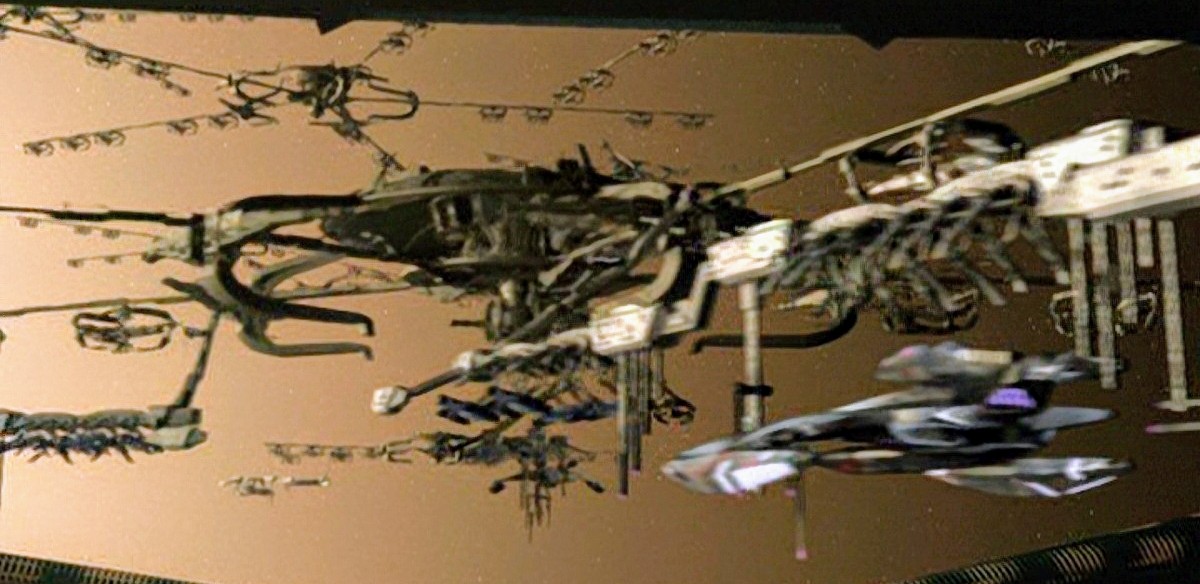
Also, does anyone have any Pirate based tech.... like a Nullifier Web field that when activated and a starship enters it either the ship is shut down or a computer virus ala Cowboy Bebop
A 100,000 ft in length ship, bow to stern, is just shy of 19 miles well 18.9 miles.... and in the Future book I think that there is nothing over 3,000 feet in length.... of course you could dock several 10 mile {52,800 ft} starships in it cradles or internal bays. I am thinking of keeping the ships at even x-miles now 4.5 miles
Also, does anyone have any Pirate based tech.... like a Nullifier Web field that when activated and a starship enters it either the ship is shut down or a computer virus ala Cowboy Bebop
I wouldn't make too many ships over the 2 to 4 mile range, unless it's something like a large refinery ship which goes off on a long term mission for a decade before returning, or colony ships. Space stations and ship yards, I've got no problems making 5 or more. Babylon 5 was just over 5 miles long.
Actually.. ships of that size or larger I would make as plot devices or something for the PCs to explore, but definitely not keep. The logistics alone would be insane.
As for pirate stuff, I'm sure I can make up something. Most military ships are protected against EMP, or resistant, but then there isn't a lot of rules for EMPs. There's mention a few times, but that's it. Urban Arcana has the EMP spell, and Future Tech has the Ion weapon that deals electricity damage.. so.. yeah.. RAW kind of skips over EMPs.
I think I can probably whip a few pirate based things up when I get back home. Maybe even a light pirate carrier or something.
A 100,000 ft in length ship, bow to stern, is just shy of 19 miles well 18.9 miles.... and in the Future book I think that there is nothing over 3,000 feet in length.... of course you could dock several 10 mile {52,800 ft} starships in it cradles or internal bays. I am thinking of keeping the ships at even x-miles now 4.5 miles
Also, does anyone have any Pirate based tech.... like a Nullifier Web field that when activated and a starship enters it either the ship is shut down or a computer virus ala Cowboy Bebop
I wouldn't make too many ships over the 2 to 4 mile range, unless it's something like a large refinery ship which goes off on a long term mission for a decade before returning, or colony ships. Space stations and ship yards, I've got no problems making 5 or more. Babylon 5 was just over 5 miles long.
Actually.. ships of that size or larger I would make as plot devices or something for the PCs to explore, but definitely not keep. The logistics alone would be insane.
As for pirate stuff, I'm sure I can make up something. Most military ships are protected against EMP, or resistant, but then there isn't a lot of rules for EMPs. There's mention a few times, but that's it. Urban Arcana has the EMP spell, and Future Tech has the Ion weapon that deals electricity damage.. so.. yeah.. RAW kind of skips over EMPs.
I think I can probably whip a few pirate based things up when I get back home. Maybe even a light pirate carrier or something.
Initially, the 100,000 feet starship is one that I have been working to act as an independent Marine FIST or First Initial Strike Team complete with needed battalions of aircraft both planetary and space, mecha, artillery, and armor with approximately 5-7 battalions of Infantry to lay siege to the Big Bad Uber Star Empire once the Party found information on who he is... Thsi also includes the needed infrastructure to supply them, factories and whatnot, and their attached fleet
For my Fleet Tenders which so far I have Factory {Ammunition, Armor, Tech},Foundry, Tanker Refinery, Tanker Refueler whic I can agree on being at max 5 miles in length
What size do you feel is appropriate for say a Missile/Gun Boat...
The C-130 Galaxy Spook is a gun boat technically, with the big gun sticking out the side plus a bunch of gatling guns as well, meant to blast tanks and bunkers with the big gun and infantry with the smaller guns. So basically size would range from large bomber to shuttle/small transport.
You could have missile boats the size of frigates or cruisers, but then they would technically be missile frigates or missile cruisers.
Second I have been doing some thinking earlier today.... dangerous thing that can be and here is what hit me so tell me does my reasoning sound off or not
1: At a higher PL such a ship that breaches the 10 to 20+ miles in length or say diameter could be classified as city ship like in Stargate Atlantis thus granting pre-established infrastructure when said group reaches their destination for researching/colonizing the ecosphere of planet P7Y-117
2: Or how about the refurbished Macross with a city built inside and say the half mile to a mile from the exterior hull houses the armor plating and relevant weapons including the munitions stores nearby for easy access while also supporting the smaller attached ships when needed with parts, muntions, or supplies while figuring in the civilian support infrastructure
3a: I mean according to wikipedia the Imperial Super Star Destroyer is 12 miles in length and an Imperial Star Destroyer in just shy of a mile and over a half mile in width... so logically you could have a ship that big with the extra space being allocated to crew housing, barracks, vehicle hangers for At-At/St and still take in an Imperial Star Destroyer in say a dedicated repair hanger with the needed infrastructure to make said repairs while having the dedicated hangers for fighter craft
3b: In Farscape the Peacekeepers supposedly had ships large enough that the housed entire levels that simulated the enviroments of worlds where the troops housed within could train combat simulations to future Peacekeepers...
4:And with advances in tech level or PL Kinetic weapons give way to energy thus no longer needing to carry thousand plus rounds around whereever they go and missile/torpedo explosives yield should increase in destructiveness with smaller warheads thus no longer needing to lug around a soviet cold war era nuclear silo sized missile strapped in a pair along the lower half of your ship...
And then say replicators or whatnot ala Star Trek come into play so there goes having to lug around foodstuffs/storage for said foodstuffs or hydroponic gardnes/fields while no longer needing a foundry/machine shop level to handle the logistics of new armor plating, replacemnet parts throughout the ship, and etcetera.
Sorry if I rambled here
As to your thoughts..
1) Reasonable, as that could be classified as a colony ship, with enough defenses and offensive capabilities to protect civilians (not quite dedicated warship, but definitely better than colonial milia).
2) The Macross I think was a deep space exploration/warship designed to protect itself against almost any conceivable threat. But good idea.
3) The Super Star Destroyer is basically a small fleet rolled into one ship, used as a terror tactic (Emperor seemed to get off on big intimidating designs), so it's got the power of several Imperial class destroyers, plus ground crews, troops, fighters. ISDs also had a prefebricated garrison to deploy on worlds, the SSD had a couple, so they were all designed for planetary subjugation and pacification, plus blow ships out of the sky. I think the SSD could dock a ISD, maybe.. but couldn't perform extensive repairs, probably more useful for doing minor repairs, or for towing if the engines were damaged, or for quick transfers of cargo to/from the SSD and ISD.
3B) those ships I don't think would be dedicates warships, but yeah, I can understand them being quite large to simulate the environments of other worlds, as they don't have holodecks.
4) makes perfect sense. A PL6 high explosive missile should be smaller than a PL5 HE for the same yield (RAW doesn't take this into account really).
As to star trek's replicators, they still have to store raw material for the replicators as they don't create matter out of nothing (they take a raw material block, usually biomass of some sort, re-arrange the molecules into patterns for something else, then transport it to the unit that is requesting something), so they do need some storage, but probably not as much volume-wise as say trying to store food packs of say beef for a crew of 150 people for 6 months.
But in a nutshell, your reasoning is all sound, with good examples, just as we've seen, except for a few exceptions (super star destroyer), they serve another purpose besides war.. the macross.. remove the inner city, and it'll probably be a fair bit smaller.
Atlantis was built as a home that can travel with all their stuff in it, so labs, food, entertainment, plus protection (which was mainly their shield and not much armour. Hell, if they didn't have the shield, no one could breathe as it'll all just escape through a window sill.
This vessel is an old Loggerhead-class hauler designed to pull long trains of unmanned cargo pods. It requires only a single crew and operates exclusively in space – sporting a powerful set of ion engines but no atmospheric thrusters. The Loggerhead has an octagonal sphere shaped bridge, with a wide but low profile main haul, from which four powerful ion engines stick out on two sets of short wings, one above the other. At the rear of the ship is the hookups for connecting to cargo modules, usually the CM01 cube type.
The cockpit is fairly spacious and simple, and the door between the cockpit and main cabin has atmospheric seals so the cockpit or cabin can be independently depressurized. There is an access hatch in the floor of the cockpit behind the pilot's seat to facilitate extra-vehicular access.
The main area of the haul contains a single cabin for the pilot's off-hour use, which has a computer/media terminal in one corner and a food station built into the back wall. A combination toilet/shower in a small chamber on the starboard side, a storage closet is on the port side opposite. There are exit hatches down a few stairs on either side, but no dedicated airlock. A table is available that can fold into the floor for more room, and a set of two beds fold from the wall in a double bunk style. The small engine room is farther back, with a ladder that leads up to a crawlspace tube which allows access to any cargo modules that are attached. The loggerhead can haul up to 14 cargo pods, however it does get slower with large quantity of pods.
Loggerhead Hauler (PL Hi 5/Lo 6)
Type: Ultralight
Subtype: Hauler
Size: Gargantuan (-4), Colossal (-8) with pods
Tactical Speed: 2,500 ft, -500 ft per three pods
Defense: 9, 5 with pods
Flat-Footed Defense: 8, 4 with pods
Autopilot Defense: 8, 5 with pods
Hardness: 20
Hit Dice: 8d20 (160 hp) +1d20 (20 hp) per pod
Initiative Modifier:
Pilot's Class Bonus:
Pilot's Dex Modifier:
Gunner's Attack Bonus:
Length: 53 ft +35 ft per pod
Weight: 245000 lbs +25000 lbs per pod
Targeting System Bonus: +0
Crew: 1
Passenger Capacity: 1
Cargo Capacity: 1 ton + 100 tons per pod
Grapple Modifier: +12 or +16 with pods
Base PDC: 47
Restriction: Licensed (+2)
Attack: None
Attack of Opportunity:
None
Standard PL() Design Spec:
Engines: Ion Engins only
Armour: Alloy Plating
Defense Systems: Autopilot, damage control (1d10)
Sensors: Class I
Communications: Radio Transceiver
Weapons: None
Grappling Systems: Grapplers
Cargo Pod CM01
A standardized type of cargo pod that is a cube roughly 25 ft on a side. It has small maneuvering thrusters, linkages to attach to other pods, and a rudimentary computer system to monitor and report status. The top of the container also sports an access crawlway running from bow to stern. When linked up, it is possible to traverse the entire train, and access any cargo pod, via this crawlway. These pods hold 100 tons of cargo.
Defense Pod DM02
This is a modified cargo pod with a turreted fusion beam cannon, advanced sensors and point defense system. These pods are used to provide some protection to haulers in areas where pirate attacks are uncommon, but could happen. The systems can be controlled from the hauler's cockpit, although a person can crawl out to the module and control them manually. For the sake of deterrence, all of this extra gear is concealed until brought into play, so a pirate never knows if a train is packing.
A defense module will add the following to the ship stats:
Class III sensors, increases Initiative by 2.
Targeting system, grants +3 to hit for a colossal ship.
Point Defense system.
Fusion Beam (10d8, range increment 3000 ft).
Defense Pod DM03
This is a modified cargo pod with a CHE missile launcher instead of turreted fusion beam. It has the same advanced sensors and defensive systems as the DM02.
This pod adds the following to the stats of the hauler:
Class III sensors, increases initiative by 2.
Targeting system, grants +3 to hit for a colossal ship.
Point defense system.
1 CHE missile launcher, 8 missiles (6d12, 19-20, - ft).
Game mechanics: It is easiest to treat an entire train (hauler plus 1 to 14 cargo pods) as a single vessel. To do this, start with base stats for the hauler. For each cargo or defense pod, add one hit die and 20 hit points. For every three pods (round down), reduce speed by 500 feet. The ship as a whole is now colossal sized, which modifies various statistics.
Seeker-Class Template (PL7)
The Seeker-class template can be applied to any PL6 Ultralight or light starship of Gargantuan or Colossal size. The Seeker-class template represents the creation of a fast, agile scout or exploration ship. The starships design specs should be adjusted as follows:
Engine Upgrade: Particle Impulse Engine, Thrusters (tactical speed +1,000 feet [+2 squares])
Armor Upgrade: Cerametal (Hardness 30)
Defense System Upgrade: Light Fortification (25% chance to ignore a critical hit, replaces a PL 5 or 6 defensive system)
Sensors Upgrade: Class V Sensor Array (+2 initiative)
Communications Upgrade: Drivesat comm. array, mass transceiver (replaces PL 5 or 6 systems)
Weapons Upgrade: no weapon changes.
Grappling System Upgrade: Tractor beam emitter (replaces grappler)
Example:
Seeker-Class Scout
Type: Ultralight Size: Colossal (-8Size)
Subtype: Scout Tactical Speed: 4,000 ft. (8sq)
Defense:7 Length: 150 feet
Flat-footed: 5 Weight: 600 tons
Autopilot: 5 Targeting system bonus: +3
Hardness: 30 Crew: 8 (trained +4)
Hit Dice: 15d20 (300hp) Passenger Capacity: 8
Initiative Modifier: +4 Cargo Capacity: 30 tons
Pilot’s Class Bonus: +3 Grapple Modifier: +16
Pilot’s Dex Modifier: +2 Base Purchase DC: 54
Gunner’s Attack Bonus: +2 Restriction: Military (+3)
Attack:
fire-linked Heavy Neutron Guns -3 ranged (15d8) and
2 CHE missiles -8 ranged (6d12/19-20)
Attack of Opportunity: none.
StandardPL7 Design Specs
Engines: Particle Impulse Engine, Thrusters
Armor: Cerametal
Defense System: Autopilot system, damage control system (1d10), radiation shielding, sensor jammer, Light Fortification (25% chance to ignore a critical hit).
Sensors: Class V Sensor Array (+2 initiative), targeting system
Communications: Drivesat comm. array, mass transceiver
Weapons: 2 fire linked heavy neutron guns (range increments 6,000 feet), 2 CHE missile launchers (8 missiles each)
Grappling system: Tractor beam.
Warhammer-Class Template (PL7)
The Warhammer-class template can be applied to any PL6 light or larger starship of Colossal size. The Warhammer-class template represents the creation of a long range, dedicated warship. The starships design specs should be adjusted as follows:
Engine Upgrade: Particle Impulse Engine, Thrusters (tactical speed +1,000 feet [+2 squares])
Armor Upgrade: Neutronite (Hardness 40, - feet [-) square] speed
Defense System Upgrade: Light Fortification (25% chance to ignore a critical hit, replaces a PL 5 or 6 defensive system)
Sensors Upgrade: Class V Sensor Array (+2 initiative), Improved Targeting system
Communications Upgrade: Drivesat comm. array, mass transceiver (replaces PL 5 or 6 systems)
Weapons Upgrade: replace primary beam weapon with Heavy Particle beams .
Grappling System Upgrade: Tractor beam emitter (replaces grappler)
Example:
Warhammer-Class Destroyer
Type: Light Size: Colossal (-8 Size)
Subtype: Destroyer Tactical Speed: 3,500 ft. (7 sq)
Defense:11 Length: 450 feet
Flat-footed: 7 Weight: 8,000 tons
Autopilot: 7 Targeting system bonus: +5
Hardness: 40 Crew: 80 (expert +8)
Hit Dice: 80d20 (1,600hp) Passenger Capacity: 48
Initiative Modifier: +4 Cargo Capacity: 400 tons
Pilot’s Class Bonus: +5 Grapple Modifier: +16
Pilot’s Dex Modifier: +4 Base Purchase DC: 55
Gunner’s Attack Bonus: +4 Restriction: Military (+3)
Attack:
4 fire-linked Heavy Particle beams +1 ranged (32d8)
2 fire-linked Nuclear missiles -4 ranged (24d8/19-20) and
Needle Driver -4 ranged (8d12)
Attack of Opportunity:
Point defense system +7 ranged (2d12x10)
StandardPL7 Design Specs
Engines: Particle Impulse Engine, Thrusters
Armor: Neutronite
Defense System: 1 chaff launcher (16 chaff bundles), 1 decoy launcher (4 decoy drones), improved autopilot system, improved damage control system (3d10), magnetic field, point defense system, Light Fortification (25% chance to ignore a critical hit)
Sensors: Class V Sensor Array (+2 initiative), improved targeting system
Communications: Drivesat comm. array, mass transceiver
Weapons: 4 fire linked heavy particle beams (range incr 5,000 feet), 2 fire-linked nuclear missile launchers (8 missiles each), needle driver (4,000 foot range incr.)
Grappling system: Tractor beam.
*Variable Weapon Configuration System- This unique system was developed for long-range missions, where an assortment of weaponry may be necessary. The system allows a starship to carry a much larger assortment of weapons for a reduced cargo capacity. The system has a few minor drawbacks. It can only be placed on an Ultra light ship, it can only fire four different beam or projectile weapons at a time and only two missiles. To change which weapons are being fired is a move action and requires that the ship have positive hit points. The weapons take up space in the cargo hold depending on their type. The system cannot support any heavy weaponry. Beam weapons take up 100 lbs., projectiles take up 250 lbs., and missiles 500 lbs. These amounts account for a full complement of weapons for the amount of Hit Dice you have. For example a ship with 18 Hit Dice can have 6 weapons so if it up to four fusion beams they take up 400 lbs.
**Onboard Computer System-This is a system that was designed for long-range craft that only have room for one person but require a second to function at its peak. The system is basically a second crew member controlled by the pilot. Any ship can be fitted with an OCS. What it really does is give the pilot three more move actions (the OCS does not grant a second attack action but it allows for more systems to be activated in one round.). Any action that can be performed by the crew members of a ship the OCS can do. An Onboard Computer System’s cost varies on the crew rating it is modeled after, Trained DC 10, Expert DC 15, Ace DC 25. Controlling the OCS takes only a free action as it is voice commanded. A standard OCS replaces up to 10 crew members. For every 10 extra crew members it will replace increase the DC by 1 larger ship still require real people to do certain tasks.
Nice little link with some Macross stuff here www.steelfalcon.com/macrossmecha.html
Ah, I remember visiting that site.. Although it hasn't really been updated in awhile, and a few links (rpg network ones) are dead.
mahq.com is still running, and seen a nice site redesign in the last few years, and yes although it's more mecha related, it does have some ship related stuff for the series it lists.
I remember seeing some pictures of ships for a tabletop strategy game (well a couple of such games actually) that had some neat looking ships, but I can't remember the names of the games. Also trying to find info on the ships at the time wasn't easy (this was a few years back).
Energy Dampening Weapon (PL7/8)
This energy weapon fires a specialized pulse of energy contained within a magnetic field that upon impact with a target, causes the target to temporarily lose all energy. The pulse is designed to cause the safety systems of most targets' power systems to believe there is an emergency, such as an overload, which is partly true as the pulse pumps energy into various systems as it strikes, forcing the power systems to shut down, causing energy in capacitors to dissipate, magnetic coils to temporarily degauss, etc. The target hit must make a Fortitude save DC 17 +1 per times hit by the Energy Dampening Weapon. Ships get a base Fortitude save bonus based on type (ultralight -1, light +0, mediumweight +1, heavy +2, superheavy +3. Ships do not use pilot's Fortitude bonus or modifiers). On a failed the target is left dead in space, floating in the direction it was last moving, while on a successful save, 1d4 systems shut down. The round after the target is hit, the crew may attempt to restart the ship systems with a Repair check DC 28 followed by a Computer Use check DC 28 with about 5 minutes of work to get the whole ship running. Or they could attempt to get one system (weapons, engines, shields, life support, etc) running with a Repair check DC 23 and Computer Use check DC 25 within 1d4+1 rounds.
These weapons are large, and slow to fire, requiring at least a destroyer to mount even one (minimum ship size colossal, type light, subtype destroyer or larger) and takes up two weapons worth to the limit that the ship can carry. The weapon can only be fired once every other round.
Damage: Special, see description
Damage Type: Special, see description
Range Increment: 5500 feet
Rate of Fire: Single, every other round
Minimum Ship Size: Colossal (Light type: destroyer subtype or larger)
Purchase DC: 50
Restriction: Rare Military (+5)
Loot Net
This interesting device is usually found on pirate or mercenary ships that have money and engineering skills, and used for capturing small to medium transports or cargo ships. The equipped ship, when the loot net is activated, deploys a series of booms along with a number of towed buoys. Once these buoys reach the end of the length of their cables, they emit a type of magnetic field linking all the buoys and the ship together creating a net-like lattice expanding around the equipped ship in a 500 foot diameter vertically. When an equipped ship passes by a ship, letting the other ship pass through the area that the magnetic field, affecting it with an effect like an electromagnetic pulse, disabling the target for about 10 minutes. Most military ships have tempest shielding, and the loot net doesn't affect them.
The individual buoys are only about 5 feet in diameter and 12 feet long, with 20 hit points, Def of 14. The equipped ship can not move faster than 3500 feet per round when the buoys are deployed as any faster would cause the cables to snap during maneuvers.
This system takes up one weapon and one defensive systems available to a ship and requires a colossal sized vessel of at least light type. It takes a full round to deploy the booms and buoys, and 3 rounds to retract the buoys and booms.
Loot Net (PL6)
Damage: 3d8 plus special
Critical: 20
Damage Type: Electrical plus special
Range Increment: 500 feet surrounding equipped ship
Rate of Fire: -
Minimum Ship Size: Colossal, type light
Purchase DC: 38, replacement buoys PDC 21 for 3.
Restriction: Illegal (+4)
Mag Pulse Missile
These missiles are a type of nonlethal anti-ship missile. These missiles, upon impact, release a specialized for of electromagnetic pulse and ionized particles which affect a target's weapon systems, shutting them down temporarily. When struck, the target's weapons are disabled for 1d4 minutes. The round after the target is struck, the crew can attempt to reinitialize the weapon systems with a Repair check DC 20, Computer Use check DC 21 and 1d6+3 rounds of work.
These missiles require their own launcher and are usually carried on fighters, bombers or boarding shuttles to allow for an easier capturing of the target.
Mag Pulse Missile (PL6/7)
Damage: 3d8 plus special
Critical: 20
Damage Type: Ballistic plus special
Range Increment: -
Rate of Fire: Single
Minimum Ship Size: Gargantuan
Purchase DC: 45
Restriction: Military (+3)

This ship was built as an escort vessel for larger ships to serve as an anti-fighter screen for larger ships or stations. Being about the size of a shuttle, many ships can carry the khonsu in place of shuttles or even a couple of fighters. Usually used in flights of four or more, they would fly around a particular area of a ship or station to provide covering fire for the larger ship, attacking missiles or fighters that attempt to get close. Sometimes flights or squardrons of khonsu's are sent ahead of they're assigned ships and act as a fire wall through which attacking fighters, or missiles are weakened, or destroyed before reaching the main ships. When using this tactic, the khonsu will quickly turn around and pursue the weakened fighters, or remain between their assigned ships and enemy capital ships that might attempt to launch more missiles.
The khonsu are fairly maneuverable for their size, combined with high speed means they can keep up with slower fighters. Requiring a small crew of about 6 (pilot, co-pilot/communications officer, and 3 gunners), although it can be operated by as few as 3 in an emergency, but not at full efficiency.
The weapons are very similar to those used in point defense systems, being rapid-fire and fast tracking, and when operating with a smaller than normal crew, the weapons can be used just like a point defense system, but with a key difference: they are set to fire upon missiles or fighters that are within range but attacking a designated ally. The 15 gauss gun turrets, with the advanced fire control system allows each gunner to control about 3 to 5 turrets at once, always keeping at least 3 to bear on any target at a time, or using fewer guns to allow the automated control system use several for point defense of the khonsu itself. This allows for a greater amount of damage, and a higher chance of hitting a target.
Khonsu (PL6)
Type: Ultralight
Subtype: Gunship
Size: Gargantuan (-4 size)
Tactical Speed: 3500 ft
Defense: 11
Flat-Footed Defense: 9
Autopilot Defense: 10
Hardness: 30
Hit Dice: 15d20 (300 hp)
Initiative Modifier: +2
Pilot's Class Bonus: +3
Pilot's Dex Modifier: +2
Gunner's Attack Bonus: +2
Length: 61 ft
Weight: 64000 lb
Targeting System Bonus: +2
Crew: 6 (trained +4)
Passenger Capacity: 0
Cargo Capacity: 200 lb
Grapple Modifier: +8
Base PDC: 53
Restriction: Military (+3)
Attack:
3 batteries of 3 Gauss guns +2 size (+4 against ultralights or missiles) ranged (8d12, 19-20x2)
Attack of Opportunity:
Point defense system (2d12x10 counts as a light type due to weapon systems) to 2000 ft
Standard PL(6) Design Spec:
Engines: Thrusters. Ion engines
Armour: vanadium
Defense Systems: point defense system (does not count as normal defense system as made of primary weapons), improved autopilot system, sensor jammer, magnetic field, damage control (1d10)
Sensors: Class III sensor array, targeting system
Communications: laser transceiver, radio transceiver
Weapons: 3 batteries of 3 gauss guns (4000 ft)
Grappling Systems: none
Notes: Each gunner controls up to 5 turrets, but usually can only bring 3 to bear on any given target, usually in a battery style. The fire control system automatically moves the appropriate turrets into the correct field as the gunner tracks a target, releasing control of one turret as it brings another to bear, keeping a steady +2 battery bonus to attack rolls. Gunners can also attempt to target missiles that would hit a nearby designated ally ship as an attack of opportunity. They make an attack roll which must match or exceed the attacker's attack roll, just like a point defense system would. However, if the gunner has multiple attacks of opportunities available to him/her, such as from feats, he/she may use those additional attacks of opportunity, unlike a point defense system.
Khonsu gunners can make attacks separately from those of the pilot, like in normal combat, as the fire control system, combined with the stabilization and other systems in the design allow for greater weapons control, and also the pilot lacks access to the weapons unless there are no gunners present, in which case the weapons act as a point defense system, but protecting a designated ally ship.
Fire Control System: The unique fire control system of the khonsu grants it a further +2 bonus to attack small ships or missiles. Any attack against missiles or ships of the ultralight type gain a further +2 to attack rolls.
Protect Ally: In combat, if there are no PCs on a khonsu, to save trying to figure out all the rolls for the crew of a khonsu, when it is within 2000 ft of a designated ally, the khonsu's weapons act as a point defense system for the ally ship, in addition to the ally's own point defense system, but acting first, and can make as many attack of opportunities +1 as crew quality's pilot's Dexterity modifier. So a Trained crew with a +2 pilot's Dexterity modifier can make 3 attacks of opportunities. Also, due to the number of guns, the khonsu acts as if it is a point defense system of a light type starship, dealing 2d12x10 damage in a 2000 ft area around its designated ally. The khonsu can also make 1 attack normally on its turn while protecting an ally in this fashion.
Second I've started a hopefully small doc on space based construction
The Hobart destroyers, at the time of their creation, were well built craft, quite fast for their size, and could take quite a pounding due to many redundancies and solid construction, but not very maneuverable. Being part of the first and second generation space combat craft, the Hobarts used rotating sections to simulate gravity, which contained the living quarters, primary systems including life support, small hydroponics and secondary bridge. The narrow profile made it a difficult target from the fore or aft, although the spinning second did make it a little easier to spot. The hobarts were also one of the first light warships to be fitted with interstellar faster than light systems, allowing it to follow larger ships under its own power, or be used to investigate systems on its own.
Although today, the Hobart is considered obsolete, the solid construction, easy of repairs, and low crew requirements has allowed them to remain in service, usually converted into light freighters or runners, or as colonial defense units. Hobarts do not take many newer systems well, without a lot of extensive work of its systems, but the owners of these modified Hobarts think it was well worth the effort as the tough hulls have saved them many times over.
The original armament of a Hobart included three double barrel railguns, several pulse laser emitters used in a more point defense system, and a large gauss cannon spinal mount. The only complaint people have of the Hobart is the lack of missile weapons, and that the only energy weapons are the point defense system, but at the time, energy weapons were power intensive, and railguns were far more reliable and ammunition easy to acquire. Updated versions might replace the railguns with lasers, but many, except retired models, retain the gauss cannon for a strong anti-capital ship weapon, and add at least one or two missile pods. Hobarts are unable to enter a planetary atmosphere, remaining in space only their entire service life.
*Note: All stats such as Defense and attacks do NOT include crew bonus, these are the stats for an uncrewed version. Hobarts used at the time of their deployment would use trained for colonial defense fleets or expert for frontline units.
Hobart Destroyer (PL6)
Type: Light
Subtype: Destroyer
Size: Colossal (-8 Size)
Tactical Speed: 5250 ft (if engines suffer critical hit, speed lowers to 3500 ft)
Defense: 2 (-8 size)
Flat-Footed Defense: 2 (-8 size)
Autopilot Defense: -4 (+4 autopilot -8 size)
Hardness: 20
Hit Dice: 70d20 (1400)
Initiative Modifier:
Pilot's Class Bonus:
Pilot's Dex Modifier:
Gunner's Attack Bonus: -5 (+3 targeting system -8 size)
Length: 420 ft
Weight: 7850 tons
Targeting System Bonus: +3
Crew: 50
Passenger Capacity: 10
Cargo Capacity: 350 tons
Grapple Modifier: +16
Base PDC: 61
Restriction: Military (+3)
Attack:
3 twin fire-linked railguns -5 ranged (9d12) at up to 3 separate targets, or at most 2 at a single target but separate attack rolls;
or 1 spinal mount gauss gun -7 ranged (12d12, ignore 20 hardness/DR) and 2 twin fire-linked railguns -12 ranged (9d12 at the same target as gauss gun) and 1 twin fire-linked railgun -13 ranged (9d12) at a separate target.
Attack of Opportunity:
Point-defense system +3 ranged (2d12x10 fire)
Standard PL(6) Design Spec:
Engines: thusters, twin improved thrust Helium-3 Plasma drive
Armour: Polymeric
Defense Systems: autopilot, damage control (2d10), chaff launcher (20 bundles), point-defense system (2d12x10 fire), radiation shielding, medium fortification*,
Sensors: Class III sensor array, Targeting system
Communications: radio transceiver, laser transceiver
Weapons: 3 twin fire-linked railguns, spinal mount gauss gun
Grappling Systems: none
Notes: The way the weapons are laid out, generally only two of the railgun turrets can target the same target, and each has their own gunner, so up to separate targets can be attacked at once. Only two of the railgun turrets can attack the same target as the spinal mount gauss gun if within range, which has to be in front of the Hobart.
Spinal Mount Gauss Gun 12d12, 20, ballistic, 8000 ft, once every two turns, 50 rounds. Gauss gun ammunition PDC 16 for 10 rounds Military restriction (+3).
*Medium fortification: Although this feature is a PL8 feature, the way the Hobart is designed and built, with its redundancies allow it to shrug off many (75%) critical strikes.
Solid Frame: The solid construction of the Hobart, which gives it its ability to shrug off critical damage, gives it several other advantages, it takes half damage from performing a ram attack (target of the ram still suffers normal full damage), the Hobart isn't considered disabled until it reaches -40 hp and doesn't start to break up until -60 hp. This has allowed many Hobarts to continue fighting past the point of many other ships. Hobarts are also easier to repair and jury-rig, reducing repair and jury-rig DCs by 2 and time by one-quarter.
Broadside: Due to the narrow design of the Hobart, only two of the railgun turrets can strike the same target, or attack in the front or rear arcs. However, in the side arcs, the gunners can opt to link the guns in a battery if they all attack the same target, granting a +2 bonus to attack.
Flying Brick: Hobarts are fast, but not very maneuverable, suffering a -4 to Pilot checks to perform maneuvers such as jinking, or avoiding navigational hazards. Most pilots and sensor operators of Hobarts learn to err on the side of caution, preparing for maneuvers early or plotting courses that will have the least amount of hazards as possible.
Designer Note: Even though I mentioned in the description one of the first to use a FTL system, you can ignore that if you wish, but I left the type of FTL up to the individual GM for the type of FTL systems used in their games, from hyperspace, hyperdrive, some form of warp or jump drives, wormhole or fold systems.
kronos182 wrote:
AnimeSniper wrote:
Well I do have an idea for a NAP or Nuclear Armor Penetration warhead, warhead penetrates the hull and explodes within, using your megaton rules listed here and a MIRV variant which basically take x-megaton warhead and divide by the desired number and the i.e. rolled damage...
Here is the fluff that I have so far written...
Torpedo Mk III (III-a)
Luna Dynamics and Mars Industrial Sands co-developed the Mk III Torpedo in 2117 as the winning bid for the next generation torpedo for the Earth Terrestrial Defense Force, Interstellar Navy, and Star Forces. However, the initial field-testing had showed great promise the delivered product held several flaws that were only learned of after seven detonations while in the starships magazines resulting in the starship destroyed with all hands lost and the destruction of one resupply outpost.
These flaws were due to subpar equipment, subpar materials, and unstable warheads and the funds redirected by the companies’ lead officers of their procurement office. The Mk III Torpedo failed to meet the Earth Terrestrial Defense Force, Interstellar Navy and Star Forces parameters’. The entire Mk III line dismantled and scrapped from deployed armories and later production with much of the materials being recycled. However, due to the lack of oversight by reliable personnel several containers, X-d100, of the torpedos were slated as disposed but have recently been seen in the use by several pirate and anti-government factions.
AnimeSniper wrote:
NAP Kit or Nuclear Armor Penetration Kit is an add-on addition kit that outfits nuclear warhead ordnance with a hardened depleted uranium tritanium tungtsen armor piercing fin-stabilized discarding sabot penetrator cone to the warhead that upon impact with the opposing vessels armor pierces through before detonating the nuclear payload within.
PDC: ?
MIRV or Multiple Individual Targetable Reentry Vehicle Warhead takes the set nuclear warhead charge and divides the payload amongst several smaller individual warheads contained within a single delivery vehicle.
PDC: ?
AnimeSniper wrote:
kronos182 wrote:
AnimeSniper wrote:
kronos182 wrote:
Mk II-M Warhead Guidance & Avoidance System
The Mk II Warhead Gudiance & Avoidance System developed by Saturn Deep Space Survey was intially developed for their deep space survey probes. Upon the success of the prototype launch the Earth Terrestrial Defense Force, Interstellar Navy, and Star Forces adopted the system for their launched weapons platforms which became the Mk II-M, M for military, to their current and successor platforms.
The unit processor logistics computer core software is updated to allow the missile, probe, torpedo, or other installed vehicle to detect and plot counter-evasive course to their designated target.
PDC: ?
Here's a basic MIRV conversion for any missile or torpedoes you want to throw them on.
MIRV Warheads (PL5+)
MIRV, or Multiple Individual Re-Entry Vehicles, are multi warhead missiles, originally used in ballistic missiles and intercontinental ballistic missiles, allowing for multiple targets to be struck, however with a lower payload than a single large warhead missile. This technology has been updated for use with modern warhead types, and also as means of bypassing anti-missile defenses.
Any missile type of weapon can be modified into a MIRV. First pick the number of warheads, 4, 6 or 8. The damage of the original missile is divided evenly amongst all the warheads. If the original missile had an odd number of die, reduce by one.
MIRV missiles can be used in one of two ways: The first is all warheads strike the same target. If the target has a point defense system, it must roll against each warhead.
The second way is to attack multiple targets, which all must be within 5000 feet of each other. Roll attack roll at -2 for 4 warheads; -4 for 6 warheads, and -6 for 8 warheads. Multiple warheads can attack the same target, or all can strike different targets. In both cases, the damage is divided amongst each missile that strikes a target.
Restriction: Missile/Torpedo weapons, Military (+4)
PDC: +3 per warhead
Interlaced Armour
Interlaced armour is a modification to how armour is built onto the ship, can only be taken upon ship construction, or requires a complete overhaul. This armour modification builds the armour more tightly, in interlocking layers and panels, especially around critical systems, turrets and any other exposed areas, making them far more difficult to damage. The ship's destruction threshold (see d20 Future pg 113) is increased by 50%, the ship is considered to have the Light Fortification defensive system, without it taking up a defensive system slot. Also if using the optional critical hit results, rolls that result in destroyed system are instead damaged, severe critical hits are normal critical hits instead, which are also subject to the Light Fortification chance of cancelling the critical hit. However, this does make the ship far more difficult to repair, increasing repair times by double, and increase PDC for repairs by +5.
Weight: Increases ship weight by 10%
PDC: Increases armour PDC by +3.
Res: Restricted (+2)
Increases time to install armour by 50%.
Piranha Missile (PL6)
The Piranha missile was developed as an anti-starfighter missile, fitted with better sensors, maneuvering thrusters and larger fuel capacity. Once fired, even if it misses its intended target initially, the Piranha will continue to hunt its target until it strikes, or runs out of fuel.
Piranha Missile (PL6)
Damage: 4d12
Critical: 20x2
Damage Type: Ballistic
Range Increment: -
Rate of Fire: Single
Minimum Ship Size: Gargantuan
Purchase DC: 27
Restriction: Military (+3)
Note: Targeting systems on the missile grant it a +2 to strike ships or objects of ultra light category. After firing, if initial attack roll rail fails to strike the target, the onboard sensors and targeting system will allow the missile to make its own attacks at +5 (+7 for ships of ultra light category) for 5 rounds after firing until it strikes its target. After 5 rounds the missile runs out of fuel.
Starship Hulls
Industrial Starship Mk I
Built to tender to the needs of a colony ship or armed military fleet the Industrial Starship is capable via its outfitted factory modules of processing raw materials harvested from a targeted systems resources into the much needed items be it tools, parts, housing, items, or vehicles for its colonists or military personnel.
Industrial Starship Mk II
Updated version of the standad Industrial Starship hull exchanging the interchangable factory modules for a Nano-Forge that breaks raw materials and constructs them into new itemas via nanotechnology.
Got to thinking about Magnetic Acceleration Cannons and a round that acts like a flechette APFSDS releashing x-APFSDS rounds at the target rolling a secondary say a d20 since 20 flechettes were released to see how many hit the starship...
AnimeSniper wrote:
kronos182 wrote:
AnimeSniper wrote:
Upon request from Marco.. the Eagle Transport from Space 1999.
Eagle Transporter
The Eagle Transporter is a modular multi-purpose ship designed for inter-planetary travel, with no original provisions for interstellar travel, making them excellent transports within a system. The main craft is divided into three main sections: the command module, the passenger module/service pod, and the superstructure, which contains the landing gear, access corridor, galley, aft compartment, fuel tanks and main propulsion systems. The command module has an escape hatch, and can detach from the main body, able to dock with another compatible craft or use as an emergency escape capsule.
The passenger module/service pod section is modular, allowing several different modules to be used with only about 15 minutes of work with the proper equipment and trained crew. The modules available are the standard passenger unit, reconnaissance, VIP, rescue, transport/supply, laboratory and combat pods.
Besides the different modules, Eagle Transports can be equipped with winches, extra boosters for greater speed, refuelling booms, and come standard with a dorsal retractable laser cannon for defense.
Eagle Transport (Late PL5-PL6
Type: Ultralight
Subtype: Orbital shuttle/small freighter
Size: Colossal (-8)
Tactical Speed: 2500
Defense: 11
Flat-Footed Defense: 9
Autopilot Defense: 8
Hardness: 20
Hit Dice: 6d20 (120), 20 hp shields
Initiative Modifier:
Pilot's Class Bonus:
Pilot's Dex Modifier:
Gunner's Attack Bonus:
Length: 80 feet
Weight: 340,000
Targeting System Bonus: +3
Crew: 2 + varies
Passenger Capacity: Varies
Cargo Capacity: Varies
Grapple Modifier: +12
Base PDC: 52
Restriction: Restricted (+2)
Attack:
Retractable Laser cannon -5 ranged (6d8 fire)
Attack of Opportunity:
none
Standard PL(5-6) Design Spec:
Engines: Thrusters
Armour: Alloy plating
Defense Systems: Autopilot, radiation shielding, shields
Sensors: Class II, targeting system
Communications: Radio transceiver
Weapons: 1 retractable laser cannon (range incr 3000 ft)
Grappling Systems: Winch & Claw
Modular Section
Refuelling Boom
Limited Fuel
Extra Boosters
Shield note: The shields on the Eagle Transport are simple and protect against all damage types, similar to the deflector shields equipment, however when they are depleted, take twice as long to restore.
Refuelling Boom - This is a hold over from old aircraft, a deployable boom that can be linked to another larger ship that can transfer fuel to the Eagle Transport, allowing it to be refueled in transit without having to land at a planet or station.
Limited Fuel - The Eagle Transport has enough fuel to travel to a single planet and back within a solar system, or make 2 complete trips from a planet's moon and back to the planet before requiring refueling.
Easy to Fix - The design of the Eagle Transport is modular, and many of its systems are very simple, allowing for quick and easy repairs. Repair and Craft checks to repair or modify an Eagle Transport are reduced by -2 each, repair times are reduced by 25%.
Extra Boosters - The Eagle Transport can be fitted with a set of 4 Disposable Boosters, increasing the speed to 3500, with use of the afterburn maneuver, with 20 uses.
Alternatively, a set of long burn boosters can be fitted, increasing the speed to only 3000 for 6 hours at a time, with a 2 hour cool down period. These boosters include extra fuel so as to not eat into the ships main fuel supply. Used wisely, and with the use of gravity sling maneuvers, the ship can average a speed of 3000 for an entire trip between planets.
Passenger Module - This module allows the Eagle Transport to carry 16 passengers in relative comfort, including refreshments for the passengers. In emergency 24 people can be carried, but the conditions are cramped. If not carrying more than 16 people, can also carry 3000 lbs of cargo.
Reconnaissance Module- This module mounts extra sensors, communications, encryption and recording equipment. This module requires 2 dedicated crew, adds a small room for sleeping for extended missions. Adds Class III sensory array granting +2 to Initiative checks, grants +3 equipment bonus to computer checks to intercept and decrypt communications and other transmissions, adds Laser Transceiver.
VIP Module - This module is similar to the passenger one, only it has a lot of high end luxuries, built in security scanners, separate communications system for private communications for the VIP. Can carry 8 people in extreme comfort, includes a private bedroom, office, security station near the entrance and security scanners, granting a +3 equipment bonus to search boarders for concealed weapons. Can carry 2500 lbs of cargo.
Rescue Module - This module has sensors dedicated to scanning for life signatures, spot lights, gurney on a wench, medical station. Has room for 10 patients, requires at least 2 doctors or medics. The equipment grants +2 equipment bonus to Treat Injury checks to diagnose and treat injuries. There are enough supplies to heal a total of 50 HP of injuries. The sensors grant a +2 bonus to Computer Use checks to search for life signs.
Transport Module - This is a basic transport module, able to be divided into several sections, or sealed and special equipment added for transporting special materials such as radioactive materials. Able to carry 80 tons of cargo. Special cargoes that require special equipment for safe transport (such as liquids, special environmental conditions or shielding from radiation) reduce the cargo capacity to 60 tons.
Laboratory Module - This module has a mobile laboratory, use in planetary exploration and prospecting purposes. This module requires a crew of at least 2, has a Class III sensor system configured for geological and mineral scanning, granting a +2 equipment bonus to Knowledge: Earth and Life Sciences, Knowledge: Physical Sciences. Also carries equipment for taking samples. Comes with an airlock and 2 spacesuits, hand scanning equipment, survival gear. Can carry 2000 lbs of cargo.
Combat Module - This module is equipped with weapons and the systems necessary to power and control them. Requires a crew of 4, adds 2 laser turrets, two CHE missile launchers and added shield generator to boost shield strength.
Weapons: 2 laser turrets, one dorsal, on ventral, 6d8, range incr 3000 each, dedicated gunners, -7 to attack rolls.
2 CHE missiles in turret launchers, each launcher contains 16 missiles, dedicated gunners, -7 to attack rolls.
Adds an additional 20 hp to the shields, for a total of 40 hp for shields.
Heavy Lifter Module - This module consists of heavy bracing, four winch and claws spaced out around each corner of the module, as well as several thrusters and fuel storage. The thrusters can adjust direction, allowing the equipped Eagle to lift and move larger amounts of cargo that is carried via the winch and claws, up to 150 tons. This weight would also include the weight of the cargo container(s).
Winch & Claw
This is a primitive form of grapplers, but might still be used before tractor beams become standard. It consists of a high strength cable with a claw at the end, which also includes a powerful magnet for improved grip on ferrous materials, such as starships or cargo containers.
Winch & claw function just like a grappler, but has a range of 100 feet (extra cable can be purchased DC 15 for 50 more feet +1 DC for every 50 extra feet), and gains a +2 bonus when attempting to grab ferrous materials.
Purchase DC: 9 + one-half the base purchase DC of the starship.
Restriction: None
Little notation: the retractable laser cannon (guess it's the turret on top) is there, but the lasers that are more commonly seen on "laser-equipped" Eagles are this pair of coaxial lasers that shoot out from someplace on the lower front end of the ship. Guess the Combat Module would turn an Eagle into a more Hawk-like vehicle.
marcoasalazarm2 wrote:
Well, appears to be that a normal Eagle is completely unarmed but there were some Eagles with combat capabilities (the fixed lasers) on Alpha by the time of "War Games" (about several months post-Breakaway and several alien menaces, so guess it was just a regular upgrade), and post-"War Games" it appears that the lasers are added to more ships to the point it could be considered standard. The turret appears on the second season episodes, a season which was retooled to have more action and about 1000-plus days after Breakaway, so I guess that the turret was an additional upgrade in case of ground combat (because on all two episodes where the turret appears, the Eagle is on the ground).
Still, this is just a nit-pick, and I apologize. The stats (with the whole bunch of Modules and everything) kick rear end pretty well. The arrangement of a laser cannon doesn't detracts from it a bit (and I guess discussing it just makes me sound like an idiot).
marcoasalazarm2 wrote:
marcoasalazarm2 wrote:
Oh, ok.
marcoasalazarm2 wrote:
Heavy Lift Module and Winch are pretty good.
Was thinking of maybe adding an additional value to the Eagle Transporter (to reflect a bit how many are wrecked through the show and still are fresh with them by next episode):
-Easy To Fix: Its design provides it with a +2 bonus to Repair checks and Craft checks for modifications.
marcoasalazarm2 wrote:
OK, it's pretty awesome.
I was thinking whether or not that attribute would work for other Andersonverse vehicles-they get thrashed a lot and modified a lot, after all (only show I can sincerely think this doesn't happens (the thrashing, that is) is "Thunderbirds" and the titular vehicles). Some so much that it makes you think whether they are easy to *replace*, let alone repair.
The Eagle write-up also gave me inspiration to modify the write-up for the SHADO Mobile that I had done some time ago. Still working on it, hope to post soon.
Also was going to ask for permission to add the Eagle to the Line.
marcoasalazarm2 wrote:
Yeah, repairs (minor ones) happened occasionally (except, yeah, for the small ones), but I was talking about total devastation of the vehicle proper (which happened on all the other shows).
Anycase, thanks. And don't recall the "A.S.S.K.I.C.R.", although I will be honest in that there are days when I can barely recall where my house is.
marcoasalazarm2 wrote:
Thanks.
A light weapon that can give stealth ships a headache when struck.
Stormfire Gun
Rapid fire projectile weapon, lower damage, but has burst fire feature. The projectiles have the odd habit of glistening, especially when ship is equipped with various stealth systems that use energy to hide the ship, such as through cloaking devices or active stealth systems, making the ship more visible.
Name (PL6)
Damage: 4d12, ignores 5 points of hardness.
Critical: 19-20
Damage Type: Ballistic
Range Increment: 5000 ft
Rate of Fire: S, A
Minimum Ship Size: Huge
Purchase DC: 30
Restriction: Military (+3)
Note: The ammunition has the ability to disrupt stealth systems. For every 20 points of damage dealt (not counting damage ignored by hardness or damage reduction), penalties to scan or target a target with stealth systems is negated by 1, or 1% for those that grant a miss chance. For example a ship equipped with a Stealth Screen normally provides a -10 to ships scanning for the ship, suffers 60 points of damage from Stormfire, the scanning ship will only suffer -7 to scan checks, and the equipped ship only has a 17% miss chance for attacks against it instead of 20%.
Ammunition: Due to the specialized ammunition the Stormfire uses, it usually only cares 4 belts of 50 rds (200 rounds), although larger ships can carry more. 50 rd belt has a PDC 22.