okay, so, history channel's running like back to back 'poclypse stuff. Latest one is Apocalypse Man. Reality TV at it's "best," no doubt. Reminds me of another that I saw not long ago, The Colony.
Anyway, it set me to thinking about the whole 2012 thing and the coming peak of the solar max, and that lead to remembering the old Twilight:2000, and that got me to thinking of running a "End Of The World As We Know It" campaign ...isn't there a song... oh well, whatever.
so, the thought here is what should I use as the causal event?
-- should I make it something the PCs can "see" coming and have a quick chance to prepare for?
or
-- should it be something that "just happens" like of S.M.Sterling's Emberverse -The Change?
Its still as amazing and well thought out as the original (though missing the oddly specific details of the Twilight War that the original gave), and I use it all the time as fluff inspiration for Modern. Haven't been able to try the game itself yet.
I think it would be interesting if you made it something that they can see coming, but is absolutely unstoppable. This way just trying to get ready for the coming apocalypse can be an adventure in itself as the PCs try to find a safe place, supplies, and protect their friends and family as civilization decends into utter chaos before the disaster even strikes.
Twilight:2013 The Twilight War.
...reading that.
really uses the current escalating terrorism events
okay, might be a bit too grad-level-poli-sci discussion
...something that they can see coming, but is absolutely unstoppable...
hmm, how far in advance? can't be too much. maybe something that most people (and government officials) don't believe to be a threat or something they don't have time to do anything about.
what if:
-- mega-sunspot blasts out super CME that comes and smackes into earth, resulting emp fuses electric transmission infrastructure. anything that has a transformer gets melted.
resulting disruption of all electrical power triggers worldwide collapse.
and I found it (My new game. Post apocalyptic, still working it out....WIP ). This is good stuff idea. Nothing really big, just lots of little stuff, like a bad hail storm.
Yup, definately a When the Sky Falls campaign.
No more GPS or Sat-comms. No more...well, that will be for the PCs to learn.
Now, to setup episode one: A Rain Like No Other.
Okay, starting up
A Rain Like No Other
Here is the Lead-in:
A New Visitor To The Inner System comet passing earth orbit
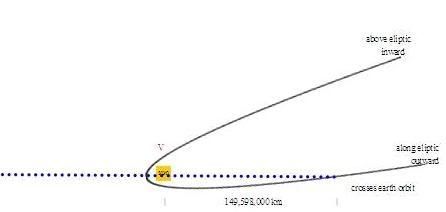
It was a never before seen comet, coming into the solar system from above the elliptic. Just a single-apparition comet, traveling a parabolic path in toward sun, it would swing around the backside, then sail on back out again, probably never to return. Well, that’s what the scientists told us once they found it, about the time it was to cross over earth’s orbit. comet orbit top
 comet orbit side
 comet before rounding sun
But it broke-up rounding sun, the sun’s gravity bent its path inward, it came out from behind the sun as many clumps of rock and ice. By the time the high-brows could figure it out, the bits and clumps of comet was on its way toward earth. The outward path now crossed earth orbit, earth would be in path of some of the fragments. We had 30 days to get ready.
But the clumps weren't bunched up, they came in rather more like long streamers of bits, like water droplets from a squirt gun. The science types or maybe them and the government types, they couldn't or wouldn't tell us how many clumps would hit or even how big the bits would be, until 5 days before. comet after rounding sun
Coming at the evening terminator, the first couple batches went by with just a few that reached the edge of earth, a kind of wimpy meteor shower. About a half hour later the next stream began coming in, starting over the central pacific walking northward and westward into daylight as the pacific rotated into night under the stream.
And about every hour another streamer would begin impacting around 15-25 degrees south and 25-45 degrees west of the previous stream. The impact lines, more like a bands, weren’t exactly steady or as evenly spaced as it sounds but close to it. Angling south to north and east to west, the bands stumbled across the face of our planet as it rotated into the oncoming fragments.
------------------------
continuing intro to A Rain Like No Other
It Was Beautiful, It Was Horrible
The bits and hunks and boulders sailed out away from the sun and into the path of earth’s orbit. Some people were able to see it falling upon their country-sides. Others watched it on television for a short time before the satellites or ground stations were taken out. The fragments came in all sizes, from dust up to boulders, from gravel and ice cubes, up to hillocks and mountains. Most of it, some 85-90% was the dust and gravel but the rest, the rest wasn’t.
A meteor (it becomes a meteorite only upon impact) is visible long before it is audible. It appears as a great mass of light, usually white, but also green, red, or yellow (the color can change during the course of the fall). People could see the meteors streaking down at a steep angle across the sky. The mass trailed by a long tail the same color as the head with great tails of smoke trailing the tail of light—this smoke trail would persist for hours in the upper portions of the sky. Imagine the dramatic image of several meteors streaking down through the sky simultaneously.
Starting with streaks of light of various size and length, interspersed with some ending in flashes of light, some small, some tiny, others big, and a few bigger. It seemed almost like watching a really big fireworks display. Then realization that some of the streaks were reaching the ground, and the low, distant thunder creeping in takes on new meaning, a distant cannonade, slowly growing louder. And there was a hissing, like approaching rain or sleet.
When they couldn’t watch on the TV anymore, people had gone out side to watch, to see the sky fall down. However, when they realized it was getting too close, they tried to run from it or hide indoors. For many, it was too late. Their safety, or lack there of, depended on how far they were from the centerline of the skyfall band. It was generally along the centerline that the bigger bits fell but the bands were nearly a thousand miles wide on average.
No longer low on the horizon or beyond the distant skyline but marching closer, flashes now seen as ground bursts. The sky was falling and it was coming closer every minute. then the rumbling grew louder followed with pulses of wind and a sense of vibration in your chest and stomach. A blazing trail streaking toward the ground, bright flash, then a “krump” of thunder, a pulse of wind, then the bump and shutter in the ground under your feet. Each time coming nearer and closer together. Then, with the flashes come pulses of heat, like opening the door on a oven. The ground jumps, things rattle, dance about, and crash to the floor.
--------------------------
I just saw a commercial on SyFy for a 2010 TV movie premiering on Jan 30th, and guess what!
It's called Meteor Storm!!
The brief few scenes were showing meteorite bombardment of San Fran!
SYFY quote:
Meteor Storm Premieres January 30 at 9/8c
Partly cloudy with the ultimate chance of destruction.
Update on A Rain Like No Other
-- overview map of impact bands (large image 3.5MB)
{edit: add this thumbnail}
-- building a few tables to give info on "local impact sites"
Well, how about this!
I just saw a commercial on SyFy for a 2010 TV movie premiering on Jan 30th, and guess what!
It's called Meteor Storm!!
The brief few scenes were showing meteorite bombardment of San Fran!
SYFY quote:
Meteor Storm Premieres January 30 at 9/8c
Partly cloudy with the ultimate chance of destruction.
And people think I'm being paranoid when I say we're being watched....
Really good stuff, Rustam. Looking forward to anything else you add.
Just a suggestion but before the big meteor shower maybe have a few micro-meteor start hitting satellites... loss of communication would play a part before the big one hits and hamper with the response times of emergency/military personnel
Yup, I think that's a good add. I don't know that every comsat, navsat, and spysat would be taken out but I'll assume enough knocked-out to cause a breakdown in linkage and service to ground nets.
A Rain Like No Other
And just to fresh up and reenforce the storyline, some [sblock real-life news:]
INCOMING COMET: NASA's STEREO-A spacecraft has discovered another comet plunging toward the sun. The last time this happened on Jan. 4th, the comet was destroyed, and history could repeat itself later today. The Solar and Heliospheric Observatory (SOHO) has a good view of the comet's death plunge.[/sblock]
okay, now for a little more crunch.
how about random crater encounter and random impact effect area.
A Rain Like No Other
So, our heroes find themselves in the area of skyfall impacts. Use the following to determine the crater size and area effects. Can also be used to determine effects if they are caught in the skyfall.
Random Crater Radius
1d20 x 50 (feet or meters, GM choice)
Distance from crater = damage
Radius x 2 = obliterated (and any other like adjective here)
Radius x 3 = 1000 HP damage
Radius x 5 = 800 HP damage
Radius x 8 = 400 HP damage (appropriate rolls for ½ damage allowed)
Radius x 12 = 80 HP damage (prorate damage for “between” distances)
Radius x 20 = 0 HP damage
Random Impact Effect (1d6)
1 = reduce radius 50%
2 = reduce radius 25%
3,4 = no change
5 = increase radius 50%
6 = double radius
(click on image for larger)
Meteorite Crashes Through Virginia Doctor's Office
[sblock FOXNews:]
A small meteorite fell from the sky and crashed through the roof of a doctor's office in Virginia, but luckily no one was hit, experts say.
The half-pound meteorite struck the Lorton, Va office of Dr. Frank Ciampi, a general practice physician, on Monday evening while he was on the second floor of his two-story building.
"It went through the roof. It through one wall partition and then passed through a particle board ceiling into the floor of an examination room," said Linda Welzenbach, manager of the meteorite collection at the Smithsonian National Museum of Natural History, which confirmed that the object was indeed a meteorite from outer space. "It's not really big. It's about the size of your fist."
It may be small, but the space rock packed a big wallop when it struck the doctor's office at up to 200 mph, Welzenbach told SPACE.com. It broke apart when it hit the concrete floor of the examination room, she added.
Witnesses described the crash as sounding like a bookshelf falling over, she added. Ciampi's practice in Lorton is about 14 miles south of the museum, which is in Washington, D.C.
"Apparently, it was quite loud," Welzenbach said.
No one in the office was hurt when the space rock fell. The meteorite split into several pieces when it hit the ground floor, Welzenbach said. But many people witnessed the brilliant fireball created by the space rock as it streaked through the Earth's atmosphere, she added.
A receptionist working in the office is married to a geologist, who recognized the meteorite for what it was. The meteorite was then carried by courier to the museum for confirmation, courtesy of a local TV news station, Welzenbach said.
Welzenbach said the meteorite is a chondrite, typical of most space rocks that fall to Earth. It is also a beautiful example of a meteorite, she added."It's pretty, it's very fresh," added. "It's a shame that it broke on impact.
"The meteorite is only the fourth reported to fall in Virginia. The first documented crash in the state was reported in 1878, with the most recent occurring in 1924, Welzenbach said.The meteorite and its fragments may eventually be donated to the Smithsonian's collection, she added.
[/sblock]
A meteorite fell from the sky and crashed through the roof of a doctor's office in Virginia. The small meteorite that fell from the sky into a doctor's office in Virgina Jan. 18, 2010.
A Rain Like No Other
-----------------------
A Grey Day Dawning
There's an old saying, "Red skys in the morning, sailors take warning." It was 'sposed to mean that a storm or bad weather was coming. Well, today's dawn was definately red, the sky looked almost bloody. At least it's finally morning. There is a an odd heavy haze, dirty sort of, or maybe smokey. The air smells that way too. It's a kinda dusty, trash-fire like smell. My head hurts and I think something is wrong with my my left ear, it hurts too and it seems like it has a cotton ball jammed in it. I'll go out and look around in a couple hours.
---
I can't see much around here that looks like it was a direct result of an impact. Actually, I don't really know what that would look like. Electricity is still off, it went off yesterday, been off all night. Windows are all broken and when I checked outside part of the roof was torn up, tree limbs down, stuff like that. Reminds me more of after a tornado goes through, except this time the ground jumped hard and the wind came like blowing out candles.
---
Neighbor's house is gone, but then it was one of those pre-fab, manufactured houses, not much more than a double-wide trailer house. I'm laughing, it just hit me -- and the third little pig built his house of bricks -- it's just too funny.
---
Walked down to the creek, got water, looks okay just real muddy. Two milk jugs and a three gallon bucket. I filtered it thru some cloth and then thru a couple coffee filters. Fired up the gas grill and boiled it too. Coffee, fresh perked. Third time I've ever used my camp coffee pot, guess I'll be using it alot for a while. Got to think of a way to get water from the well-pump...after I eat.
---
Actually looked in the mirror, looked at myself in the mirror. Washed my face and neck, washed blood off of and out of my ear. Still hurts, still can't hear, I think I got a popped eardrum. Wonder how long that'll last. Coffee and asprin helped the headache.
---
Went around and boarded up the smaller windows, weather proofed, too. The front window is bigger than anything I've got. So, the living room is open the outside, and therefore so are the dining room and kitchen. Need to scout around for something to cover that big window. Need to go get water again too. Sky continues to look grey, cloudy. Hope it don't rain for a couple days, I got to check the roof for big holes and fix'em as best I can. Need to fix a way to catch rain water if it does rain. Need to make a list of things. Damn, my head's starting to hurt again. More tomorrow.
---
Newsline Earth...
Unveiling Mysterious Possible Comet Strikes on Earth
ScienceDaily (Dec. 15, 2009) — It's the stuff of a Hollywood disaster epic: A comet plunges from outer space into the Earth's atmosphere, splitting the sky with a devastating shock wave that flattens forests and shakes the countryside.
But this isn't a disaster movie plotline.
"Comet impacts might be much more frequent than we expect," said Adrian Melott, professor of physics and astronomy at the University of Kansas. "There's a lot of interest in the rate of impact events upon the Earth. We really don't know the rate very well because most craters end up being destroyed by erosion or the comets go into the ocean and we don't know that they're there. We really don't have a good handle on the rate of impacts on the Earth."
An investigation by Melott and colleagues reveals a promising new method of detecting past comet strikes upon Earth and gauging their frequency. The results will be unveiled at the American Geophysical Union's Fall Meeting, to be held Dec. 14-18 in San Francisco.
The research shows a potential signature of nitrate and ammonia that can be found in ice cores corresponding to suspected impacts. Although high nitrate levels previously have been tied to space impacts, scientists have never before seen atmospheric ammonia spikes as indicators of space impacts with our planet.
"Now we have a possible new marker for extraterrestrial events in ice," Melott said. "You don't just look for nitrates, you also look for ammonia."
Melott studied two possible cometary airbursts with Brian Thomas, assistant professor of physics and astronomy at Washburn University, Gisela Dreschhoff, KU adjunct associate professor of physics and astronomy, and Carey Johnson, KU professor of chemistry.
In June 1908, a puzzling explosion rocked central Siberia in Russia; it came to be known as the "Tunguska event." A later expedition found that 20 miles of trees had been knocked down and set alight by the blast. Today, scientists have coalesced around the idea that Tunguska's devastation was caused by a 100-foot asteroid that had entered Earth's atmosphere, causing an airburst.
Some 13,000 years earlier, an occurrence thought by some researchers to be an extraterrestrial impact set off cooler weather and large-scale extinctions in North America. The "Younger Dryas event," as it is known, coincided with the end of the prehistoric Clovis culture.
Melott and fellow researchers examined data from ice cores extracted in Greenland to compare atmospheric chemistry during the Tunguska and Younger Dryas events. In both instances, Melott's group found evidence that the Haber process -- whereby a nitrogen fixation reaction produces ammonia -- may have occurred on a large scale.
"A comet entering the atmosphere makes a big shock wave with high pressure -- 6,000 times the pressure of air," said Melott. "It can be shown that under those conditions you can make ammonia. Plus the Tunguska comet, or some fragments of it, landed in a swamp. And any Younger Dryas comet presumably hit an ice sheet, or at least part of it did. So there should have been lots of water around for this Haber process to work. We think the simplest way to explain the signal in both objects is the Haber process. Comets hit the atmosphere in the presence of a lot of water and you get both nitrate and ammonia, which is what both ice cores show."
Melott cautions that the results are inconclusive because the ice cores are sampled at five-year intervals only, not sufficient resolution to pinpoint peaks of atmospheric nitrates and ammonia, which rapidly would have been dissipated by rains following a comet strike.
But the KU researcher contends that ammonia enhancement resulting from the Haber process could serve as a useful marker for detecting possible comet impacts. He encourages more sampling and analysis of ice cores to see where the nitrate-ammonia signal might line up with suspected cometary collisions with the Earth.
Such information could help humankind more accurately gauge the danger of a comet hitting the Earth in the future.
"There's a whole program to watch for near-Earth asteroids as they go around the sun repeatedly, and some of them have close brushes with the Earth," said Melott. "But comets are a whole different ball game. They don't do that circular thing. They come straight in from far, far out -- and you don't see them coming until they push out a tail only a few years before they would enter the inner solar system. So we could be hit by a comet and only have a few years' warning -- possibly not enough time to do anything about it."
--------------------------
That would have the kind of global impact to truely make this an Apocalyptic campaign. First of all, plant life would begin dying off at an alarming rate without sunlight for photosynthesis, then animal life dependant on the plants would begin to suffer, for a period of time Predatory animals and scavengers would have an upswell in population, making the environment the more dangerous.
The initial event would cause a fairly large loss of life, but the dying months after would claim many more. As sickness and starvation begin setting in, without proper medical attention or supermarkets, it would get reall ugly. Bands of rovers, intent on their own survival would rise up, taking anything that they could.
Then as the Dark months continue, the temperatures continue to drop with out the sun to warm the surface, a small ice age sets in. Those lucky enough might survive.
I like the plot. Your entry to the campaign is good as well. The meteor shower knocks out satelites, which kills the communication and such.
That will cause some chaos, and the devastation caused by impacts will definately have initial chaos as well.
Thanks DoublAught (00 - I like that.) That was my intent -- to create the stage upon which the PCs will be acting.
As they progress, it may be possible for them to find out just how bad it really is out in the rest of the world.
However, as humans will regroup and try to find stability in a changed world, without something substantial that happens it will be a mere hiccup in the history books. If, for example, the Meteor impacts were to put enough material up into the atmosphere, it could cause several months to a couple years of quasi darkness to some degree.
That would have the kind of global impact to truely make this an Apocalyptic campaign. First of all, plant life would begin dying off at an alarming rate without sunlight for photosynthesis, then animal life dependant on the plants would begin to suffer, for a period of time Predatory animals and scavengers would have an upswell in population, making the environment the more dangerous.
The initial event would cause a fairly large loss of life, but the dying months after would claim many more. As sickness and starvation begin setting in, without proper medical attention or supermarkets, it would get reall ugly. Bands of rovers, intent on their own survival would rise up, taking anything that they could.
Then as the Dark months continue, the temperatures continue to drop with out the sun to warm the surface, a small ice age sets in. Those lucky enough might survive.
The combination of impact debris and such dirt-n-dust that fell into the atmosphere is to be about the equivalant of several major volcanic eruptions.
I haven't got that far in my planning ahead but I'm giving them the impression mini ice age (like a nuclear winter type result.) Mostly it's been scavaging for enough resources to move on to safer ground.
I have also chosen to have fairly large meterorites impact the oceans, causing massive Tsunamis. These killer Tsunamis, have wiped out massive amounts of population along coastal areas. Also, I have chosen to have EMP's wipe out large amounts of technology and newer vehicles. Have not quite decided what the cause of the EMP is yet, or how extensive the damage will be. So far, I am just starting with the party surviving in the small rural town, then go from there.
you may not need an EMP effect to explain the lack of phones, internet, tv, radio, etc. electric power infrastructure is down and out. food and fuel distribution nolonger provided. no aircraft because of debris in air and lack of fuel. associated earthquakes from impacts break the nearby underground pipelines -- water, sewage, naturalgas, gas&oil, etc.
From a fragment of an old leather bound journal, found hidden in remains of some trapper's or prospector's cabin on the upper reachs of North Fork Big Thompson River.
__________________________fragment begins___________________________
//smugged-unreadable//... a vision as told by of Stalking Wolf.
//smugged sketch of seated man, arms up raised, bottom half front pg//
//smugged-unreadable//... the sky suddenly turned back to a liquid and then turned blood red. As far as his eyes could see, the sky was solid red, with no variation in shadow, texture or light... As sunset drifted to night, the stars shone red, the color never leaving the sky, and everywhere was heard the cries of fear and pain." //bottom half, back pg//
"This, then, is the third sign, The Night of the Bleeding Stars. It will become known throughout the world, for the sky in all lands will be red with the blood of the sky, day and night. It is then, with the sign of the third probable future, that there is no longer hope. Life on Earth as man has lived it will come to an end, and there can be no turning back, physically or spiritually. It is then, if things are not changed during the second sign, that man will surely know the destruction of the Earth is at hand. It is then that the children of the Earth must run to the wild places and hide. For when the sky bleeds fire, there will be no safety in the world of man... //smugged-unreadable, f pg//
"From this time, when the stars bleed, to the fourth and final sign will be four seasons of peace. It is in these four seasons that the children of the Earth must live deep in the wild places and find a new home, close to the Earth and the Creator. It is only the children of the Earth who will survive, and they must live the philosophy of the Earth, never returning to the thinking of man. And survival will not be enough, for the children of the Earth must also live close to the spirit. So tell them not to hesitate if and when this third sign becomes manifest in the stars, for there are but four seasons to escape." //b pg//
"The fourth and final sign will appear through the next ten winters following the night that the stars will bleed. During this time the Earth will heal itself and man will die. For those ten years the children of the Earth must remain hidden in the wild places, make no permanent camps, and wander to avoid contact with the last remaining forces of man. They must remain hidden, like the ancient scouts and fight the urge to go back to the destruction of man. Curiosity could kill many... //smugged-unreadable, f pg//
"There will be a great famine throughout the world, like man cannot imagine. Waters will run vile, the poisons of man’s sins running strong in the waters of the soils, lakes and rivers. Crops will fail, the animals of man will die, and diseases will kill the masses. The grandchildren will feed upon the remains of the dead, and all about will be the cries of pain and anguish. Roving bands of men will hunt and kill other men for food, and water will always be scarce, getting scarcer with each passing year. The land, the water, the sky will all be poisoned, and man will live in the wrath of the Creator." //b pg//
"Men will hide at first in the cities, but there he will die. A few will run to the wilderness, but the wilderness will destroy them, for they had long ago been given a choice. Man will be destroyed, his cities in ruin, and it is then that the grandchildren will pay for the sins of their grandfathers and grandmothers... //smugged-unreadable, top third front pg//
"Now the payment comes two-fold for those that feed upon... //smugged-unreadable, top third back pg//
__________________________fragment ends___________________________
I have also been putting together some stuff over on the group D20 Apocalypse.
How is your campaign "A Rain like no Other" going? I am interested to know. Talk at ya later, Rustam
well I think -- it's going smoother and smoother as the players learn their PCs (able to behave "in-character").
as ever, things up and down for the players, life does intrude on game time, but so far "in game" the PCs are carrying on. now up two levels and should make the next after next session.
they started out in suburbia outside large midwest city but quickly moved away from that area toward rural areas but were forced to move on toward more sparsely settled areas.
since the start there has been two PC deaths, first lost to food-poisoning and the second to melee injuries (one rolled up new PC and other player assumed role of previous NPC).

currently the party is four guys (2 players) and three gals (2 players) and four kids (1 player). yup, NPCs and PCs - one married couple with two kids, one non-married couple, two single guys, one single gal, and two orphan kids. they've gained a shetland pony to pull a two-wheel cart and two dogs.
((edit: insert pix))
just recently an interesting development, we watched the movie "The Road" and player's metagame awareness of the situations facing their PCs has gone way up. should make for some interesting turns of plot direction in future sessions.
saw your post on health in post-apoc... good work on the skill modification. I hadn't bothered to go that far but I've allowed the smart character to find books on herbalism, etc. using trial and error style "checks" while PC learns (luckily he hasn't killed anybody yet.)
I'm not much of a "blogger" so inputting biweekly (or post game session) thread updates ain't gonna happen. however, I'll try to answer whenever you ask.
"keep the fire burning"
Later