Feel free to include taughts on the real universe.
For starters, I have to admit I don't know for our own universe. I am leaning towards the finite universe, but that is more arbitrary choice based on esthetics. One of the settings that my players enjoyed pretty much was a finite universe with periodic boundary conditions. It had the shape of a dodecahedron with only three galaxies inside and when you exited one of it's face, you entered back from the opposing face.
EDIT: I should maybe explain how this came to play. I set them in a campain involving a war against an extra-terrestrial race. What the players could not comprehend a first, was that the aliens seemed to reach earth a whole lot faster then the people of Earth could (using technology stolen from the aliens). As it turned out, the aliens where simply using the periodic boundary conditions to there advantage. Showing two things: 1) You can steal there technology but there knowledge is still better then yours and 2) a bored solid state physicist like to include things from his field in his games.
Honestly, I've never thought about the size of any homebrew universes. All sci-fi games I've run have been based on our own, and for fantasy games it's not a topic that tends to come up.
As for our own universe...that's a tricky question. The radius of the observable universe is about 46 billion light years, but thanks to inflation there is a lot of the universe that isn't observable. How much is an unknown, at least until we can learn more about inflation. There is evidence for 'stuff' outside the observable universe in the dark flow, but that's all very new science (it was published yesterday!).
A big bang model suggests a finite universe if expansion rates are finite, but there's still the possibility that there's space outside our universe. Disconnected spacetime bubbles could exist, although there's no way to test for them, or our universe may be connected to another outside the observable universe or through extra dimensions. Multiverse hypotheses are pretty much unscientific at the moment, but who knows what we will discover in the future?
The size of the worlds I use is not infinite, rather a slice of infinite. Each of the planes would be yet another slice. There are always more planes. If the party used a spacecraft to reach the end of the plane, well I'd just have all kinds of terrible fun for them.
I've also hard said that a fraction of infinite is infinite within itself. Too big for D&D.
There could be a few simultaneous ones about to collide right on earth, and nobody would be the wiser until the solar system is vapourised.
My point is that, while we can speculate, and extrapolate from available data, nobody has a clue how big the universe really is or what it's up to right now, because we can't outrun light to go find out, and there's nothing that we can pick up that moves faster.
As for dnd universe, I'm still getting the hang of my hollow world. Basically the inside surface has a mini sun sitting in the middle, making it forever daylight, and it's inhabitants tell the time by the extremely ordered storm activity (since the entire thing is enclosed by the surface).
As for our universe, Dark Energy is making the universe bigger so meaning that it isn't infinite.
As for dnd universe, I'm still getting the hang of my hollow world. Basically the inside surface has a mini sun sitting in the middle, making it forever daylight, and it's inhabitants tell the time by the extremely ordered storm activity (since the entire thing is enclosed by the surface).
Have you looked at this? http://en.wikipedia.org/wiki/Hollow_World
As for the real world... /shrug
I'm no physicist, so I don't think about it too much. As far as I understand things, there quite possibly is a point where you just stop finding stuff in space, but I see no reason why things can't go beyond that point, just that things haven't yet.
My D&D world is Earth about 10,000 years from now, so the universe it inhabits is our own.
Have you looked at this? http://en.wikipedia.org/wiki/Hollow_World
Looks interesting. Didn't know that existed hehe. In mine the jungles of the surface is so rampant, most cities are either enclosed in a transparent bubble to keep the jungle out or have moved underground, I just hope delvers are in 4th ed, because that's how the highways were constructed in 3.5.
As for the real world... /shrug
I'm no physicist, so I don't think about it too much. As far as I understand things, there quite possibly is a point where you just stop finding stuff in space, but I see no reason why things can't go beyond that point, just that things haven't yet.
Physics? Bah, to really answer the question, go philosophical.
Does the universe even exist? Are the people I'm replying and conversing with simply figments and creations of my sub-conscious? If the universe really does exist, is all that we know contained in a tiny marble? Is all of this a "dream" of a A.I. supercomputer using behavioral analysis system to answer simple and complex questions?
But for the boring answer... physics says the universe is constantly expanding and that space is infinite, thus, the universe is infinite.
(But don't tell my players! It's actually a major plot point they haven't found yet! :D )
As for our own universe, I see no reason to believe the universe if finite. I've heard people talk before about the big bang and expansion and the radius of the observable universe, and that's all well and good, but matter and space are two different things. The extent of matter in our universe may be finite, observable, measurable, etc., but the space in the universe itself? Well, I see no reason not to believe it should be infinite, unless of course it curves in upon itself all four-dimensional like, which is the only way I can imagine any universe would be finite to begin with... Kind of like our Earth is a two-dimensional plane that curves over upon itself in the third dimension into a sphere.

I guess I could say that space-time, or at least space, is infinite but the livable space for creatures is most certainly limited.
(except Scifantasy)
I do however know a great deal about my worlds' solar system. It has at least four planets within it. Reality in that space is being disrupted by the Far Realm, and the closer to the star you are, the more magic there is. (and less incursions from the far realm as well)
I deal more with planes and what not than the material plane.
in Scifantasy, my universe is infinite. For the time being.
 big" is a better tack, I think.
My universes are always finite. Infinite planes cause problems--if you have infinite layers of the Abyss and infinite layers of Baator, there are infinite demons and devils, so the Blood War is pointless; if there are infinite outsiders of every alignment the universe must be static since no species could overwhelm another, etc. "Finite, but really
I doubt the demons really care if the blood war is pointless or not. "There's a devil/other outsider, kill it!"
Then there are strategic targets, both place and creature. I can see the chaos that would ensue should a bunch of demons bust in and free levistus from his prison, or even manage to somehow take out a prince. Also fighting over the souls of the schmos on the prime makes sense, since these souls are actually currency in the lower planes.
I doubt the demons really care if the blood war is pointless or not. "There's a devil/other outsider, kill it!"
Then there are strategic targets, both place and creature. I can see the chaos that would ensue should a bunch of demons bust in and free levistus from his prison, or even manage to somehow take out a prince. Also fighting over the souls of the schmos on the prime makes sense, since these souls are actually currency in the lower planes.
I'm not thinking of the demons' perspective; I'm taking the "big picture" view. Two infinite armies cannot defeat each other, so there's no point. There's only draw and drama if things can change, armies can progress, and so forth.
For my fantasy games, I like to abandon this approach... I usually have a flat world, with little or no "universe" at all. The plane of existance bleeds into other planes if you travel far enough in any direction.
The universe contracts until it becomes super dense and then explodes in a big bang.
The universe expands outwardly in infinite space.
Space is infinite, but the universe isn't. Eventually, it contracts again for another big bang.
That said, since space is infinite, there may be multiple universes out there, but then the word "universe" becomes a misnomer...uni meaning one.
For D&D, it depends on the world I'm using. Dark sun? Not infinite.
Ravenloft? Space is infinite, the universe is finite, and new domains get "added" from other planes, making the universe bigger.
My homebrew world is actually a planet inside of a shell. The shell actually is the night sky with the stars being angels holding up the blackness. If the blackness were ever broken, things from "outside" would get in. So that universe ends at the shell and a different plane is on the other side.
Our universe is a 3-dimensional surface in a 4-dimensional Cartesian coordinate system.
Although most professors will teach the arbitrary guess that the universe is an infinite plane, Einstein allows for 3 shapes:
the assumed plane
a hypersphere
a pringle/saddle shape
I particularly like the hypersphere, but the pringle shape is the only one with a center that you can visit.
But that is assuming the that if it is a plane, that it is not finite.
Remember anything a scientist tells you about the universe is an assumption based of an assumption based of somethign interesting math one guy wrote about 50+ years ago.
Remember anything a scientist tells you about the universe is an assumption based of an assumption based of somethign interesting math one guy wrote about 50+ years ago.
Mmm, not quite. Scientists have been working on verifying and testing those theories, adding to and refining them--string theory being one of the more...interesting results. The physics and math of our cosmology haven't exactly been in stasis.
string theory being one of the more...interesting results.
String theory isn't actually a theory. :P
Also...
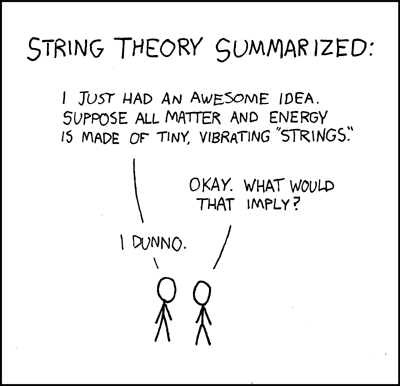
String theory isn't actually a theory. :P
Oh, I know, but it's called "string theory," so there you go. Why do you think I said it was an interesting result? ;) "So we have this thing called string theory. Well...more like string hypothesis. Make that string...idea, or string...uh...it's a stringy thingy. Call it a theory for now."
http://www.pinetree.net/humor/thermodynamics.html
I like this answer best.
http://www.pinetree.net/humor/thermodynamics.html
It's a classic
I'm not thinking of the demons' perspective; I'm taking the "big picture" view. Two infinite armies cannot defeat each other, so there's no point. There's only draw and drama if things can change, armies can progress, and so forth.
But they can progress, just because you have limitless troops, there is still only one asmodeus and still only one orcus, and the same for the other archdevils/demon princes, hence the second paragraph of my post. And when the demons attack you anyway, whether or not they can achieve final victory, the war must go on, as the alternative of standing there and dying isn't a good alternative. The devils probably know it's stupid and never ending, but that doesn't help if demons keep trying to eat you, they still need to fight.
Also strategic locations are important, If demons were to somehow overrun and hold Dis' fortress, that would be a serious problem for the devils. Likewise, should either devils or demons manage to hold a portal into the prime, likely the good guys will start to get very worried.
What you end up with is a never ending, ever shifting tide of war, which will affect the prime, and thus the campaign world. Hence 'ages of enlightenment' when the good guys have a solid hold on the accesses to the material, all the way through the dark ages, when the bad guys have found a way in to mess with the mortals.
for D&D, the borders of my world are a swirling mist that wax and wane like the tide, sometimes causing islands or even entire continents to appear where previously there was open ocean. Other times, the mist will hungrily consume the land, leaving only eerie fog-choked sea.
this lets me design continents, and freely discard them, and not worry about the world's geography beyond a single continent at a time.
in this way, I can give the universe dynamic boundaries that contain the story, but also remain malleable for new plot elements.
also, I keep the setting small at first, adding new areas to explore as needed. for perspective, the British Isles is a substantial enough land mass to contain an entire campaign, but is relatively miniscule on a planetary scale.
I like this answer best.
http://www.pinetree.net/humor/thermodynamics.html
I LOVE THAT!
Amazing.