Before we begin, I want to discuss how I came about what I'm going to say here. As you all know, and I'm sure you've all seen, there seems to be two camps when it comes to stats, the so-called 'ROLEplayers, not ROLLplayers', who seem to think that people wanting high stats aren't true gamers, as they put too much emphasis (for them) onto stats, and those who are called many bad and derisive terms, but prefer to call themselves 'optimizers'.
After witnessing yet another in a long line of threads which disintergrated after a person wanted to use a 28 point buy rather then a DM given array of 17,15,12,10,10,8, which was 29 points, due to the fact that he felt the array wasn't good for his paladin, and people on the 'ROLEplay' side of things derided him, calling him such names as 'uber' and wanting to hog the spotlight, I came to two conclusions.
One, the so-called 'ROLEplayers' care more about how stats are and which way they go then the so-called optimizers.
Two, that a person who was truly committed to roleplay wouldn't roll dice, use point buy, or use any array.
That's right. I said it. A TRUE roleplayer would look at his character background and class, and just say what his stats are, using the baseline 3-18 range, minus/plus racial/level modifiers.
Why burden yourself with something as mundane as rolling dice if you're truly committed to roleplaying for roleplayings sake? And why care what another person has for THEIR stats, if you're truly committed to the rp side of things? So the other person might have +4 to all their die rolls? Who cares? It's just a silly dice roll.
So if you want to be a true roleplayer, throw the dice away when it comes to stats, and give yourself what you think is appropiate. And play your character according to their stats, not your personal belief of what YOUR abilities are.
As for the guy who likes rolling 5d6, 6d6, or using a 40 point buy? Let him. After all, it's not the stats that matter. It's the personalities, right?
I come on these forums for help, advice and to help others out if possible not to deride people or to trawl through some idiots deriding someone else ‘cos they design and play their character differently. There is no right way to do things, as long as people are having fun it doesn't matter. People should consider this BEFORE slamming someone else's ideas and opinions.
Now, as for your idea--I'd have to more or less agree. If players were more like writers when they made their characters, they would envision the character, with strengths and weaknesses appropriate to the character, and then assign stats to the character that reflect the image in their minds. They would be able to justify ever score with a description of the character, and the DM would agree that the stats matched the character.
This wouldn't mean ever character created this way would necessarily have a low score. It also wouldn't mean that every character created would have at least one 18. If people could be trusted to do it right, most characters would probably end up fairly balanced. However, most players, I don't think, could be trusted in this fashion. I also think it could possibly lead to worse cookie cutter characters than there are with point buy systems. In a perfect world, though, this would be the way to go.
Since our world isn't perfect, I think it would be easier in the long run to just try to convince a certain minority of players that a character without an 18 is viable, and convince another certain minority of players that a character with a score below 10 is also viable, no matter how the scores are generated.
I like to mess with my character history after rolling him up. Why? Because than I have to be creative. I know I know, Pelor forbid I use my own imagination to build around the roll of a die.
I think that if it bothers everyone that much, ignore the thread. Let people play on their own terms. Argue the validity of a system, but not the intelligence or abilities of the person using it. Classify those systems so that people can choose what they think is best based on the way they want to play. Never tell them how.
A real roleplayer doesn't let his stats decide his character's background is more like it. I can see where you're coming from but it suffers the fatal flaw of being too open to min/max'ing.
....So? If you're the one who doesn't care about stats, but more about background, then why does it matter if someone else uses their stats to min/max? As long as both he and you enjoy yourselves, he with stats suited for his build and/or background, you with stats suited just for your background, does it matter? I think not.
The simple reason why a role player playing a game that is based on a particular style and ideal would want a particular point buy (25 for standard D&D) over simply choosing the stats otherwise is simple and obvious... game balance. The system in D&D was designed to work optimally for the 25 point buy. The entire CR system is scaled around that ideal. Why not use it?
A good question, and one that has a simple response: Because many groups do not enjoy such a game. By using my system, everyone wins. Your power gamer type can have as many 18s as they wish, if that's what makes them happy, the intensive roleplayer can have stats perfectly suited to his background and mental concept, and a min/maxer doesn't have to be yelled at for having stats that suit his build.
I myself whole-heartedly support DM stat arrays, or stat rolling before Character Creation "Welcome to the game Bill, Here's your Coffee Cup, 12 case of Pop, And your stats for the Night are 10 Str, 16 Dex, 12 Con, 18 Int, 8 Wis, and 14 Cha"

For instance, one that sticks out in my memory. 4d6, 7 times, two stat lines. Drop lowest die, drop lowest stat, every 12 or lower that’s left gives you one point you can add anywhere you want. This sounds -crazy-. But the DM balanced it by having a storyline short on treasure, so every magic item was a prized possession, and the campaign was -hard-
If your group works with picking stats, great, but you really have no basis for deriding those who do things differently.
Thus, perhaps this method may work on the small scale for your select group of individuals, but it will fail, and fail grandly, for everybody else overall.
eg:
Constitution measures hardiness, toughness, resistance to pain, poison and injury. Higher con types are more robustly constructed.
4-5: Frail and feeble - sick, bed-ridden
6-7: Fragile - elderly, recovering from serious illness
8-9: Soft living - office worker, academic, clerk, priest
10-11: Typical tradesman
12-13: Hardy - labourer, farmer, soldier, park ranger,
14-15: Leathery - foundry worker, blacksmith, "special forces", bushcrafter
16-17: Tough as nails - North Atlantic fisherman, backwoodsman, Inuit hunter
Well, I think the whole "Role"player vs. "Roll"player thing is an oversimplification.
Since our world isn't perfect, I think it would be easier in the long run to just try to convince a certain minority of players that a character without an 18 is viable, and convince another certain minority of players that a character with a score below 10 is also viable, no matter how the scores are generated.
I agree here, more or less. I don't mind a PC with nothing higher to start than a 16- or even "just" a 14 if the rest are around that number too! Or one stat below 8.
OTOH PCs should be heroic, and thus should have fairly heroic stats. That doesn't mean one can't have a flawed hero- Achilles would likely be rated with a rather low Wisdom. In general I find that folks who try and play a low Int are doomed to failure (I didn't do very well myself), and certainly some classes don't need a high STR either. CHA can be a 'dump" stat to many, both good & bad roleplayers. Thus an array like 13, 11, 11, 9, 8, 7 would--IMHO--suck. Roleplayer or not.
I have played in one "give me a background and I'll write the numbers" campaign. It'd be considered "Epic" level now-a-days, and the DM even assigned your classes and gear. It was all-too-brief, and I don't know how it would have worked in the long run. But it was fun to try.
Thus, I think a DM should consider the OP's idea. Might work. Then again, might not. :D
And there are certain classes, like the Paladin, that need more balanced stats than most. A Wizard could be weak, slow, and oblivious as long as they were smart enough to cast spells, but a Paladin must be strong enough to wear their armor and use their weapons, healthy enough to survive a battle, wise enough to cast the few spells they get, and hopefully charismatic enough to both power their divine spark as well as mediate in conflicts and inspire people.
....So? If you're the one who doesn't care about stats, but more about background, then why does it matter if someone else uses their stats to min/max? As long as both he and you enjoy yourselves, he with stats suited for his build and/or background, you with stats suited just for your background, does it matter? I think not.
Wrong, simply because the SYSTEM itself IS geared towards higher numbers. IT rewards the munchkin and NOT the role player.
If the role player concept includes being a powerful Wizard in spite of being sickly and with a weak constitution (and MANY very powerful Wizards in fantasy settings could be described this way) and he thus builds the character in this way, while the munchkin simply happily goes along setting everything well above average because he can, the SYSTEM will reward the Munchkin and penalize the role player.
For the DM having in the same party a set of stats that looks like this:
Str*8, Dex*11, Con*8, Int*16, Wis*14, Cha*14
and one that looks like this:
Str*12, Dex*16, Con*14, Int*18, Wis*16, Cha*12
is quite simply GOING TO cause all kinds of problems. The first is a standard 25 point build, while the second is a 50 point buy abortion. The RAW suggests upping the CR of all encounters where the monsters are based on the Elite Array by +1CR even though the difference between the standard and elite arrays is MINISCULE compared to the differences outlined above.
This means that to provide a level of challenge that doesn't allow the munchkin to walk all over it (probably an additional +3 or so CR), it will have to be jacked up to the point that the role players chances of survival are very poor indeed. So, does it matter? Absolutely it does!
Isshia
The whole "pick your stats" thing hinges on one supposition: that you can trust other people to be as mature, serious and dedicated as you are about roleplaying. Now, the individuals that you know may be mature, but people in general are not, and you can't make this sort of expectations of them.
If I can't trust someone to be mature...why would I play with them?
One of my preferred methods is to give out tables showing examples of each stat bracket and say base your character on these rather than rolling
eg:
Constitution measures hardiness, toughness, resistance to pain, poison and injury. Higher con types are more robustly constructed.
4-5: Frail and feeble - sick, bed-ridden
6-7: Fragile - elderly, recovering from serious illness
8-9: Soft living - office worker, academic, clerk, priest
10-11: Typical tradesman
12-13: Hardy - labourer, farmer, soldier, park ranger,
14-15: Leathery - foundry worker, blacksmith, "special forces", bushcrafter
16-17: Tough as nails - North Atlantic fisherman, backwoodsman, Inuit hunter
I would just love to see tables like these. They put the #'s into a context and make them more than just 'stats' to max. I've seen other games that do this (and older editions of D&D too?), I wonder why they aren't included in 3.5? Giving people the option to know the meaning of these scores beyond just modifiers would add a lot to the game, for RP (simulationist/narrative) anyway.
With these tables, it would be wonderful to pick the ability scores that properly reflected a character concept.
I would think that any character with above average stats would be an asset to any group or organisation. In-game, this should equal NPCs trying to involve the character in their schemes, either with fair rewards, or arranging matters to guide them that way (read: manipulation), or blackmail/extortion. This should extend to all the character has to offer - influence, cash, magic items, magic, combat prowess, cleverness, skills, etc.
This same character would be watched and maybe followed whenever they entered a new area, at least until the various local powers learned a bit about him and his views. If the character let show an attitude one of those powers found inconvenient, that power group might harass him, or even 'take him out' if he showed signs of supporting the opposition.
Also, any group that came out and asked for the character's support and was rejected might be miffed and either snub the character (no sale, or +30% cost, no service in the tavern, etc), or in extreme cases try to hurt them. This would only be an issue if the character was less then polite and understanding and very gentle or clever in saying 'no'.
Something else to think about, all rp characters should have a good backstory. People from the past should show up at times, especially for characters who are far above average. This could mean leeches, or trying to get them involved in major or minor troubles, or those who are envious/jealous and out to hurt or kill the character. Alternatively, someone who fell in love with the character ("he's so smart and hunky, and dances so well!", "she is beautiful, so athletic, and very witty!") and has tracked him/her down and intends to get married. (My thought here is that those who are naturally gifted are noted from a young age and tend to be remembered for various reasons, and in various ways.)
I don't mean any of this should be a punishment for a player giving their character uniformly high stats. I just mean that people who are better than average tend to stand out (the better they are, the more they stand out) and other people will start seeing how useful or dangerous the character can be to their plans.
The other characters, if they are smart, can get quite a lot out of this. For example, always being treated to drinks/food in return for stories about the uber-character, raking in 'gifts' in exchange for carrying ideas to the uber or just exerting some supposed influence, given less static due to well-known friend ("dude! I'm going to a party at Brittany Spears's place! I can't be late, c'mon" or "Do you know who I am? You try to pull your **** with me and we'll see what my personal friend Dick Chaney can do to you!"), etc. The big benefit is that the other characters aren't targets, the uber will outshine and capture attention while the others go about unseen but privileged.
The core issue is that in an rp game, highest stats doesn't necessarily equal best character. ALL character are great if they are played well, and the GM's job is to work all characters into a setting that is entertaining and makes sense. As long as the players appreciate both the added advantages and added burdens of a high-powered character (or a low-powered one) there is no reason for there to be any problems.
...the SYSTEM will reward the Munchkin and penalize the role player.
How exactly is the roleplayer penalized? This freestyle ability score generation in no way prevents a player from creating or roleplaying his character the way he wants to. Okay, so it "rewards" the munchkin; so what? As the saying goes, let the baby have his bottle. I don't see it creating any new friction between "roleplayers" and "munchkins"; if they can't get along with freestyle stats, they won't get along with 25 point buy either.
...the SYSTEM will reward the Munchkin and penalize the role player.
Then the experience system must be changed slightly. Instead of granting 95% of your experience and treasure rewards from combat, use many other things as well. There are plenty of RP opportunities. Ex. your group successfully finds out a conspiracy by a noble to oust the king. Even though the PCs only kill the noble, they must negotiate with the guards, evade capture, out-politik the noble's supporters, and convince the king. Well equal the challenge of defeating 13 1/3 encounters of your level!
How exactly is the roleplayer penalized? This freestyle ability score generation in no way prevents a player from creating or roleplaying his character the way he wants to. Okay, so it "rewards" the munchkin; so what? As the saying goes, let the baby have his bottle. I don't see it creating any new friction between "roleplayers" and "munchkins"; if they can't get along with freestyle stats, they won't get along with 25 point buy either.
The system is centered on fighting. Those who fight well are encouraged by the system. In comparison, the roleplayer (who, in this context, did not take extremely high stats) is penalised.
 I'm glad someone else thought of this. I've been playing D&D with the same group my entire career, and I was thrust into roll of DM from the second session I played onward. After a while, I realized that everyone in the group was interested in mainly 2 things: 1) Having fun. 2) Playing a character. I realized this after a play of mine demanded a reroll after getting the stats 17, 16, 16, 18, 18, and 15. Why? Because they were too high - his character concept was of an agile but otherwise physically pitiful and highly intelligent rogue with a memory like a sieve and enough charisma to seduce a nymph. So, I gathered everyone together, and told them that, from now on, they would just pick their own stats, choosing from 3-18.
Ever since then, everyone has had much more fun, and the highest score anyone in my group has ever picked was a 16.
Moral of the story: with a group of experienced gamers who know each other and are playing out of enjoyment of the game, you can introduce this rule and it will actually improve game play. Be very wary introducing it around new players, because then the temptation to take 18's for every stat would be too great. However, with veterans of the game, I see no reason why you cannot choose your own stats and still have fun.
As for the whole 'roleplay vs rollplay', I think the author hit the mark here, and I would like to note, with some chagrin as a roleplayer myself, that the people who start the arguments always seem to be the 'role'players, and the 'roll'players always seem happy enough to let live until us 'role'players jump on their backs and start berating them for playing the kind of character they want to play.
From my experiences as a player and GM I have seen a lot of different play styles. If you think a player is a munchkin and it affects the party then that is a problem for you to handle as mature adults. It's better to talk to the player than to implement rules or to resort to name calling.
As for the article, I think that if it is a system that would work within a group then it is excellent. I may just try it and see how it works out. I think that such a system adds more of a storytelling element to D&D.
When I run my games I don't really let the player stats get me down. Just because you end up with good stats doesn't mean that you are a munchkin. The 'roleplayer' and 'rollplayer' stereotypes are simply immature. Stats don't make the player, they make the character. If a person is a 'rollplayer,' then they are more concerned with being a powerful character than they are with playing the role of a character. This is fine. D&D is a game, and no single person can claim that their way is the only way to play it. If you don't trust a player's rolls then witness them. If a player wants to play a certain character then they will adapt it depending on the stats they roll, or make a deal with the DM to better accomplish the task.
From my experiences as a player and GM I have seen a lot of different play styles. If you think a player is a munchkin and it affects the party then that is a problem for you to handle as mature adults. It's better to talk to the player than to implement rules or to resort to name calling.
As for the article, I think that if it is a system that would work within a group then it is excellent. I may just try it and see how it works out. I think that such a system adds more of a storytelling element to D&D.
Oh come on. When a Player has bent every rule as far as it will go, ignored the intent of the game to "win" at a game where there are no winners or losers, the term is far from prejudicial. It's reactive. This politically correct non-sense of putting everyone in metaphorical dignity pants and declaring that anyone stating their opinion baldly is being immature is for the birds. It's more honest and THAT is something that Maturity values more than political correctness: honesty.
Isshia
Then the experience system must be changed slightly. Instead of granting 95% of your experience and treasure rewards from combat, use many other things as well.
So that "roleplaying" will give even more combat ability, mostly? Not a good idea.
So that "roleplaying" will give even more combat ability, mostly? Not a good idea.
That's true. I hadn't considered the fact that levels automatically grant better attack ability.
So there it is: with the current reward system, and the current advancement system, D&D is a combat-centered game. So I guess if you want a less combat-centered one, you'd have to make some modifications.
Did you read anything else Max? It is because of the difference those stats make to the role player. To present a challenge to the munchkin the CR has to be high enough to be all but sudden death to the RPer. You really can't see a disparity there?
There is a power disparity between heavily min-maxed and non-min-maxed characters in all games, regardless of the ability score generation method used. It's also a moot point: Why would a hard-core "munchkin" and a hard-core "roleplayer" be in the same campaign in the first place?
I'm getting sick and tired of this attitude that a "real roleplayer" plays a character with humble stats. I have a character on the drawing board, by the name of Bryaxis. He's a gestalt male drow elf; over his first twenty levels, he takes levels of Wizard, Fighter, Drow Paragon, Survivor, Incantatrix, Swashbuckler, and Ninja, and then he's good to go for epic levels. His ability scores aren't set now, but I could play him as a 64-point character (last time I checked, Manshoon was a 64-point character, btw) and be a real roleplayer at the same time. How? I'm a trained actor; character creation is my job. I have tools at my disposal for fleshing out a character's personality, mannerisms, memories, speech patterns and even posture in exacting detail. When I play Bryaxis, my focus will not be cutting stuff up (even though he'll be pretty good at it) or blowing stuff up (even though he'll be really good at it). I will focus on his interaction with the other characters, on whether he softens or hardens further on the surface world, and all the political intrigue that the DM can throw at the party.
A major reason that I want him to have high stats and a tricked-out level and feat build is that I have plans for him. If I'm going to go through dozens of hours of characterization work, I don't want my character to die before he reaches level four. I'm also downright bored with the archetype that intelligent spellcasters are expected to be frail and/or clumsy; I want Bryaxis to have the mind of a Nobel Prize winner, the body of a Cirque de Soleil acrobat, a silver tongue, and a heart of obsidian. Part of the fun of this game is escapist fantasy, after all.
Now, it's my experience that a "real roleplayer" will spend an hour or two writing his character's background, maybe sketch a family tree, and leave it at that. He won't dare make a character above 25 points. He might even pick an unusual race and class combination just for the sake of making a "unique" character. Yet if he were to bring this character to the same table that I bring Bryaxis to, he would scoff and dismiss me as a munchkin, claiming to be the "real roleplayer" of the group.
REAL Roleplayers make and play compelling characters. Whether they're down-to-earth or larger-than-life, they above all must be interesting and challenging. If a player has to deviate from the standard array of ability scores to bring a truly unique and memorable character to the gaming table, then so be it!
I have the awesome and, perhaps, most unique pleasure of gaming with the same three close friends for the past ten years. We have tried just about everything when it comes to character generation. What we settled on, for the most part, is a standard 4d6 roll from the PH. There are exceptions, however.
One of my most memorable characters was a wizard/alchemist whom I made stats up for to fit his backstory. He had an 18 STR and a 16 INT. He grew up on a farm and didn't learn of his magic potential until late in his life. I don’t remember the rest of his stats off hand, but they weren't great. An interesting thing about him, whenever he had the ability to raise a stat he usually chose to increase his INT. He also had some of his STR permanently drained by a monster. Eventually, through role playing, his stats began to look more like you'd expect a wizard's to look.
One of my friends is definitely an "optimizer". He prefers to roll for his stats because his luck with the dice usually grants him high abilities. My other friends have made up stats as often as they have rolled them. It usually depends on if THIS character is going to be "just some fighter. I'll figure him out later." or "the hunch-backed priest of Pelor who smells bad, but gives good advice".
I've played in games with super-characters teamed up with so-so characters. It all works. It just comes down to role-playing. As a DM I go out of my way to put the characters in situations where dice aren’t needed. Going along with something that was posted earlier in this thread, I do have the more "prominent" characters attract a lot more attention to themselves. My optimizer friend's high stats have gotten the party in trouble before that the weaker characters had to role-play him out of. As a DM, I also reward role-playing more then creature kills. In fact, in the latest series of adventures, this group hasn't received a single gold from slaying monsters. However, they have all of their needs met because they took the time to befriend people along the course of their adventures.
The bottom line for me is this: stats don’t matter. Mega-monster-killer or weakling with no skills, they all have their place in a party.
So if you want to be a true roleplayer, throw the dice away when it comes to stats, and give yourself what you think is appropiate. And play your character according to their stats, not your personal belief of what YOUR abilities are.
Are you saying that a TRUE roleplayer is TRULY inflexible when it comes to their character? That they can't just roll with the punches? I guess that works: you count me amongst the roll-players, taking it as it comes.
Some players have images of their character as totally great and without flaws. That is boring. Some get creative when adding their dice totals when creating characters. Our group decided that all characters should start out with the same chance, so we gave all characters a [08, 10, 12, 14, 16 & 18] to start with and arrange as they pleased. There were high stats for their important characteristics, and low stats for their weaknesses.
You know, I've thought of this before, and I'd have no problem doing it. With some maturity, it'd work out with every stat not being at 18.
I completely agree. I have one player who I've played with for so long that he always gets the benefit of the doubt, while I would never have an issue with him choosing his own stats... There is always at least 1 person in ANY group that this method won't work in a game balanced manner for (/glances back at the guy with 18 18 18 18 18 17). But then again, I'm very focused on keeping player balance so everyone gets their chance to shine.
A balanced party is a good party. I believe players should have some freedom in choosing their stats, but you would have to be playing in the right kind of party for everyone choosing their own stats to work out well. My solution is to present the players with 5 or so options for stats that I have deemed to be fairly equal. I'm not a big fan of point-buy, it also opens the door for minmaxing. People who are amazing in 3 areas and horrible in 3 others don't make any sense to me.
But I digress. DMs it's your world, you give out the XP, you provide a world that either supports or shuns the munchkin. It's all in our hands.
For a good decade of my RP time, I played with pretty much the same group of friends, and we mostly played the games from FGU that let you customize your PCs from the start with what are essentially point-buys.
I'm planning a new campaign using the 3.5 edition rules, and I have already written up some of my ideas for character creation in the campaign. I intend to let the players use a custom point-buy to set their character's attributes. I find that using a point-buy lets players make the characters that they want to play and requires them to make some compromises. If everyone starts with the same point pool, then things are mostly fair and balanced between the characters. Though, I have to admit PCs could be very unbalanced stat-wise in AFTERMATH!, but that never seemed to detract from the fun.
So, my point buy system? In case you'd like to know how it will work, I'll describe it briefly here.
Each attribute begins at 3. A player is awarded 75 points to spend on attributes. It costs 1 point plus any positive bonus granted at that attribute increment to increase an attribute by 1. Negative penalties count as 0. Thus, to go from 3 to 11 costs 8 points. To go from 11 to 12 costs 2 more points or 10 total. From 12 to 13 is an additional 2 points or 12. To get to 14 from there costs three more points or a total of 15 points, and so on.
An "average" PC on this system will have 3 14s and 3 12s. (I believe that PCs are heroes after all, and should be exceptional in their starting stats.)
After points are spent, racial adjustments are applied. Also, no one is allowed to begin with a stat lower than 3, so if you have a -2 on some stat from race, then you MUST spend 2 points on that stat.
The net result of the above is very close to what you get from the DMG point buy with a base line of 30 points. However, scores with a bonus cost considerably more in my system, so you actually see fewer PCs starting with a stat or two higher than 15. If you think this is too much, then adjusting the points to spend to 70 produces the equivalent of a 28 point buy from the DMG.
I much prefer using a point buy over rolling dice or just letting players pick their scores. I also think that the system I've outlined above, allow the most freedom for the players to customize their characters without getting carried away by lots of really high stats. I also believe that a point buy system is much easier to balance in the short and the long run.
I'm also not very fond of DM-assigned arrays as that leads to too much similarity between PCS.
For example, a person with a Cha score of 6-8 is probably a push over. Charisma is not just your physical appearance, it's the strength of your personality, and therefore it is actually a really important stat for determining how you play your character.
I played a fighter with 10 Str and 15 Int one time (our DM locked our stats in the order we rolled them). And so he was more of a tactician than an actual combatant, relying on his ability to use terrain and other sorts of variables in combat to his advantage.
I see good role-playing as being able to assume the role of a character with nothing but stats, and give them a backstory and be able to play that character within their stats. It can be pretty fun, and very entertaining.
Don't you just want to get the party in trouble with a 6 Int 8 Wis character, who just loves to touch "the shiny"?
One of my most recent characters was a Sorcerer with about average stats (a few sub 10's and slightly above average Cha, Str, and Dex), and set him up with a bunch of buff spells so he could go around acting like a fighter. He was very irresponsible and ended up killing an entire magic school in his old life by destroying ingredients which cause a chain reaction which caused a great ball of flame to consume the tower and the surround land within 200 ft. of the tower itself. How many of you have interesting characters that do stuff like that?
Anyway, my point is that although it IS fun to make a character and assign stats based off of their description, you should also take a look at the other end of role-playing, where you play a character based on their stats, accurately.
#1: Leukrythus states that part of roleplaying is roleplaying weaknesses. Then s/he incorrectly links flaws and weaknesses to stats specifically. Sure you have the brash and lacking common sense swashbuckler. And his weakness will revolve around a sub-par wisdom and impulsiveness. On the other hand, weaknesses don't HAVE to be stat related.
One character I'm playing has his lowest stat as 11 in Str (and much higher stats everywhere else). His weakness lies in his outlook on life and behavior. He's a Cipher (transcendent order) and generally goes with what his instincts tell him. This has lead him to do incredibly stupid and foolhardy things as often as he's been brilliant. His weakness lies in his inability to focus and plan things out. Sure I could have given him a low stat to represent this. Or I could (like I'm doing) Roleplay him effectively and to his character and the weakness exists purely in game without a mechanical minus. It works out just fine.
Or what about a character who has no "weaknesses"? As said earlier, the truly impressive people will attract attention. To borrow a fiction character, let's look at Alucius (Corean Chronicles by L.E. Modesitt Jr.) The guy has no weaknesses in regards to stats. His dexterity is amazing, his con is through the roof, he's brilliant, intuitive, charismatic. His only potentially low stat IS his str score and it's still above average simply from what he's lived through and had to do. He has weaknesses. Usually involving the fact that EVERYONE wants someone from him and they can generally force him to do it. Other flaws or weaknesses of note. He's arrogant. He's been through far too much and pulled it all off and it's lead him to overestimate himself on a regular basis, which gets him in trouble. He also has a family and a life back home that he's constantly separated from. Usually because it's at risk if he doesn't go do something for someone else. This character truly has flaws and weaknesses despite lack of a low ability stat.
#2: Disparity of stats equals unfair games and no fun for the low stats.. For this, I'd like to start by sharing the stats of the party in my group's war game.
Rogue/Mindbender has: Str: 11, Dex 16, Con 14, Int 18, Wis 14, Cha 22(Modified from 18).
Druid: Str 8, Dex 10, Con 14, Int 12, Wis 18 (Modified 16), Cha 12
Barbarian: Str 19(Modified 17), Dex 15, Con 20 (modified 18), Int 14, Wis 14, Cha 10
Warlock: Str 15, Dex 14, Con 14, Int 13, Wis 16, Cha 22 (modified 18).
Now, looking that over. We have total modifiers of +17, +7, +15 and +16
You want to know who the most vicious character in the group is, combat wise? The druid. The little haflling with only one high stat, one actually low stat and a total modifier at least 8 points below anyone else in the group. And if anyone wishes to bring up the "druid is overpower/broken/whatever". Feel free--that was kind of my point. Stats don't make the character. They never have. At level 1 a +4 bonus to everything might skew the scales some. By level 5-7 (Where we're at in the above group) it hasn't mattered.
In closing, of those two points I guess I have to ask: At what point did flaws and weaknesses HAVE to be related to ability scores? And, since when have the Ability Scores really defined the over all game?
There’s a little thing I often say that does somewhat apply to this discussion, that being,
"A player should never have to choose between flavor, and effectiveness." If your character concept is that of a gimp, then don’t be afraid to play a gimp, but personally, I like to play characters who are good at what they do.
Personally, the stat generation method I use for my games is thus: Roll 4d6, keep 3. You must roll sets of 6, but you can keep rolling sets till you get one that makes you happy. Sometimes I let them re-roll ones to save time.
I would just say "everyone pick your stats" but I’m not sure If I could trust myself with that, so I’m certainly not going to trust other people with it XD. Letting them roll them up allows them to hold out for what they want, while keeping us honest

All in all, roleplayers "role-play," - stats do not ALWAYS equal weaknesses, and they don't always have to influence your character's faults. Granted, they can, and most may play their characters that way, but I know my players really took a liking to the way I had played my character. Sure, his stats are good, not the greatest, but likeable (16 STR, 12 DEX, 16 CON, 12 INT, 11 WIS, 18 CHA), and depending on how you look at it you could say he has no weaknesses. Untrue however. This particular paladin is indeed well-liked and good at what he does, but has trouble forgiving himself for any thought of misdeed, and tends toward a grim, un-paladin-like sense of vengeance sometimes. Sometimes he'll over think a situation, particularly if it is a moral dilemma and conflicts with his own code and what he believes is right. Sometimes on the other hand, he'll have such a stroke of genius or insight that you'd think he was a wizard or sage w/22 in their prime stat. However, these weaknesses can sometimes lead to problems for the party, if the paladin refuses to act until 100% sure that the choice they make is the best & right one. Then, at the same time, that could be considered a strength. It's all in how one plays their character. Since having a glimpse at how I've played mine - a smart paladin so-to-speak, not an unthinking, rigid, bucket-helm as is the stereotype - my players have come up with flaws of their own, sometimes stat-related, most of the time not.
In the end, its all on how one chooses to play. Roleplayers can choose their own stats, but that's not to say that people that roll or optimize the point-buy system don't role-play either. Just keep sharing your ideas, maybe somebody will adopt a system you use as a house-rule. Remember that you can't force everyone to play the way you do. People will play the way they want to, and as long as they're having fun and enjoying the game for what it is - a way to get together with friends - then why does it matter?
To quote Max the Immortal in his above post:
REAL Roleplayers make and play compelling characters. Whether they're down-to-earth or larger-than-life, they above all must be interesting and challenging.
Vaya Con Dios
P.S. If you're wondering why I chose 12 INT and 11 WIS instead of the other way around, the answer's simple: I felt like it. :D
Sure, stats don't dictate good role-playing. Neither do rules, or dice, or anything else. We could all have wonderful games with no rules at all, purely story-telling, stating the outcome of battles or any other encounter with words and role-playing alone.
However, having rules aids role-playing because it gives the player limited options to improve their skills, forcing insight into what the character is -truly- like when they assign new stats or skill-points... and also makes encounters variable, risky and unscripted.
I am not trying to put down your views, I do understand them, but you also should see how others feel about it all as well, put yourself in another's shoes before posting a rant like this. Stats can be just as important to storyline as the characters persona depending on how the DM wishes the campaign to go, if he wants at least one smart member in the campaign, he isn't going to allow somebody to pick a 3-9 stat in their Int, not to mention, in 15 years of roleplaying, I haven't met to many who can play a character correctly, being as they still play paladins as shrugging off an evil act, or playing a Lawful character Chaotically in far to many situations.
Perhaps it is merely that those who favor low stats want a challenge, they want their character to conquer, most of all their own flaws, in their rise to greatness, and those who favor high stats wish their characters to be heroes from moment one, conquering all that the world can throw at them rather than their inner demons. Neither is more compelling by default, only the details of the characters could tell that, but each caters to different desires on the part of the players.
All that said I can't agree with the OP when he says players should pick their own stats. Stats do not make the character, they make the game. Letting players pick their stats solves the problem of a player getting saddled with a set of stats that conflicts with their preference (even in the case of the player out for a challenge wanting low stats) it creates the problem that these characters are forced to fight the same battles, face the same challenges, and ultimately play in the same game. The mechanics have a great deal of impact on how games and characters develop, if you don't want them to, I suggest you find something other than D&D to play, because in D&D two things provide the framework under which all the role playing and character development occurs: stats and die rolls.
How much a given group lets die rolls and stats determine in their games aside, ultimately when players want different things from the game the stats are there to serve as a level playing field, and to allow the heroes and antiheros to stand side by side. If that forces some players to feel less challenged and others to feel gimped then that is how it is, but when all is said and done, they have nothing to do with how well or poorly a character is role played.
I would last like to point out that most of the posts here assume that characters are built beginning with role playing elements and ending with stat elements, and this is by no means always true. I've found some of the most compelling characters I've played, played with, and DMed for began as a set of 6 numbers between 3 and 18, rather than ended that way. I personally find it easier to get a good character by starting with the stats, and asking myself why the stats would be the way they are. One is painting on white canvas, the other is putting together a puzzle, but they are both a picture in the end.
Some people like role-play. They could care less what their stats are. They might as well not have a character sheet, instead having a piece of notebook paper with their character's portrait and dossier. Then again, they could play the same campaign using a different rules set, like White Wolf's Storyteller system.
Myself, being midrange between the two extremes above, but leaning slightly towards the latter, prefer a rules-light version of the game. I have no need for fifteen different fighting-type classes or three-hundred different prestige classes to choose from. I take a simple fighter and place my stats the most appropriate places. If I want a swashbuckler, I place my highest score in Dex and second in Str. If I want a barbarian, instead of taking the Barbarian class, I place my best numbers in the physical stats, and my lower numbers in the mental ones.
However, the third edition of the game is geared more towards power players. The combat system, the over-abundance of bonus-giving feats, the horridly exhausting lists of class options (but only one bard-type class), and to top it off, you can increase your own stats! In any version of the game up to this point, that was unthinkable. Even a WISH spell--the single most powerful spell in the game--could only raise one stat by one point once per character--ever! The only exception to that was the classic (pre Advanced) D&D Immortals rules set, where a god-like being could exchange hard-earned experience for a higher stat. The game is intended that at the beginning of an adventurer's career, they're adults-or nearly so. After age 16 or so, a man doesn't change. He may gain more knowledge, but his capacity for learning hasn't changed. He may work out more or play sports, but in general, his physical prowess doesn't change. Why then do stats change in 3e? Because the game mechanics provide for a better power-play.
But a power-game can be fun. I've both played and DMed both types. I've used all kinds of stat generations, from 3d6 in ability order to point-buy to pick your own. After 20+ years of gaming, I've finally settled on a method which, for my play-style, suits my games best. At character generation, I give the player's, collectively, to choose either 1) 4d6 (drop lowest) seven times (drop lowest)... or 2) array of 17/16/14/11/9/8 (for humans) and 18/17/14/11/8/7 (demi-humans). All players must agree on which method to use before character's are created. This does two things. One--it ensure all players are equal to each other (who cares of the CRs match up? If the player's are too powerful, send more creatures or turn that vamp encounter into a lich) and it ensures that I, as DM, have a modicum of control over the player's overall strengths and weaknesses--and can design my modules and adventures around that, not having to worry whether this encounter is too weak or too strong for the players to handle.
If any of you readers have experience in higher math, you would note that the die-roll method and the array presented statistically match. Under "normal" conditions (a perfectly weighted die without flaw, rolled using the same method every time, etc.) the die-rolls are more likely to generate the numbers in the array than any other--providing an average of 12.5--two standard deviations above "normal"--one above the "average" NPC (the PCs are the focal point of the game, they're not just ANY old adventurer after all).
I suppose, beyond everything, regardless of what method of die rolls are used, the important factor is that all the players use the same method for rolling their characters. This will prevent player1 from arguing that player2 has an unfair advantage of survival or that player 3 is too weak to be of use and doesn't need to adventure with the party (ROLE-play not withstanding).
Again, I would suggest to any aspiring DM to take some advice from a gamer who remembers when gaming was a hard-to-find underground hobby. Determine, as a DM, two or three methods to use and force the player's to argue amongst themselves which one is used. That way you can keep control over the game while allowing your players the delusion, er... I mean the option of controlling their own character.
With that said, I'm going to have a smoke,
Roger
 Oh well at least we can still play.
Vern
All generalizations are false.
Ohh, I hope that was humor. Otherwise it may be the single best demonstration of the defintion of irony that could be found.
ROLLplayers wanna take chances and leave it to the dice.
ROLEplayers just wanna skip all the dang checks and go kill something.
/me shrugs, then walks off
Well the whole thing come down to, Is it chance or is it an array?
ROLLplayers wanna take chances and leave it to the dice.
ROLEplayers just wanna skip all the dang checks and go kill something.
*shakes head* Strangely enough I find that a lot LESS killing goes on in character driven campaign, while those with the dice-happy hands want to just kill everything in sight.
There’s a definite difference between roleplaying one’s character and bragging about how you just eviscerated that next of elder red dragons, bare handed, in your skivvies, and without having the initiative cause you are THAT uber.
I do agree however that dice are a great inspiration. Without them I wouldn’t have my stats, and how should I know if Dorns going to be able to fight off the effects of that particular poison? Or be under the mind control of that psion or not?
What the whole thing really comes down to is you don’t have to do just one or the other. The game is designed with the inherent chances of the dice and the built in story telling ability. Why would you waste half a game system by not taking advantage of either side?
To solve this problem maybe you could just have your players take that stat test? That would make sense.
1.) To everyone who keeps flaunting the balance of the point buy system: The point buy system is, in and of itself, an optional rule. The default rule is the 4d6 rule, which is theoretically entirely balanced. However, the 4d6 rule does tend to produce some horribly skewed parties. For example, in my current game, I quite literally rolled straight 16s (in various combinations). On the other hand, one of my fellow players actually rolled so poorly as to have almost every stat in the 10-11 range, and I believe his highest stat is a 14.
Do these disparate stats effect us in combat that severely? Nope, not at all. As a matter of fact, I make a far more regular habit of almost dieing than he does, and the only reason I'm not dead is some intelligent use of a homebrew changeling paragon that enhances my shapeshifting abilities and a homebrew feat. Do all these high stats mean I'm not a role-player? Heck no. My character is quite literally crazy. He thinks his wife (once permanently telepathically bonded to him as a wedding gift), now dead, still speaks with him through their bond. And he's about to get a severe change-up in which he gets permanently stuck in his whisper gnome form (which is the form he stayed in for a long time, as he lived with them [his wife was one]), only able to make minor modifications to that. The point is, balance is simply not only in the numbers, it just doesn't work out that way.
2.) To anyone who has said that true roleplayers play their characters around their stats, I have this to say: The characters are OUR characters. They are not our DMs, they are not the dices', they are OURS. We should not be forced into playing a weak-willed but strong ROGUE when we wanted to play a puny fast-talking punk who can get in and out of anywhere he wants, even if he can't take a shot worth a damn. This is a roleplaying game, it's a way to get away from the crappiness of the real world and to take things into our own hands. How're you escaping from crap you need a break from if you go to playing a character you didn't want to get stuck with?
And here's an interesting question for you: A lot of you seem to link an impulsive, 'jump in and do what feels right' character as lacking Wisdom. Now, at least in my eyes, impulsive essentially means you run off instinct instead of clear thought. This does not means you can't think things out, meaning it's not an INT problem, it just means you don't generally take the time to do so. The reason most animals have decent Wisdom scores and can fight tactically - to them, it’s instinct; to most of us, it'd be a planned process. So, if impulsive means you run on instinct, which, by the way, does not actually demonstrate an inherent lack of common sense but is definitely a pretty severe flaw at times, where do you stick that stat-wise? As many have already said, stats do not make flaws, nor does it work vice versa. They are separate entities for the most part, and that is why it's called a roleplaying game.
Numerous people have made the point that the PCs are HEROES (usually) so they should be at least a cut above the general populace. I agree with this completely. So I believe that characters should have at least one area in which they truly excel. I like to think of a background, write it up. Then start rolling for stats or using a point buy or whatever. I don't think that wanting your character to have at least one 18 makes you a munchkin. You might be able to label someone that if they insisted that their character have multiple 18s. I've been playing D&D on and off for the last 20 years (I'm just starting again after a 6 year hiatus) and I have never once played a multiclass character. I know some of you may think that sounds kind of boring but my philosophy is to pick something and be the absolute greatest in the world at that particular thing or die trying. I also like to add something that may not seem like a typical thing that most players spend time developing.
I'd like to give an example here of what I mean. I am playing a character on a website that uses a 28 point buy as its standard. When I first created this character I did not have any particular campaign in mind. So I said I want to create an Elf Wizard who grew up as a child prodigy. That’s a 18 INT right there with the other scores being pretty average. As I fleshed out the rest of his background I decided that he is descended from a family scholars, historians and wizards. So all of his skill points went to History, Arcana, spellcraft, concentration, and alchemy. Basically a fantasy nerd.
Next I stumbled on to a campaign where the main story line deals with the disappearance of an ancient cleric who had been delving into the origins of an extremely powerful city-state whose origins have been lost in the mysts of time. So I said perfect! This is right up my characters alley: a historical mystery! I immediately got accepted into this game and was told that this game would use a 36 point buy since the DM is planning on throwing all kinds of crazy obstacles at us from th beginning. All I did with the extra points was increase his CON so he wouldn't get killed the first time a fly grazed him and add 2 points to STR (resulting in a whopping 12!) so he could carry some more books!
Anyway my point behind my little description of my character is that its ok to have high ability scores if there's a good reason for it, but you can't have all high scores b/c 1st Level PCs are supposed to be young adults and after all if you spend all day developing one facet the others will suffer of necessity. You don't have to be either a roleplayer or a rollplayer to make an interesting character/game you need to balance both.
Kestelanthas
After 20+ years of gaming, I've finally settled on a method which, for my play-style, suits my games best. At character generation, I give the player's, collectively, to choose either 1) 4d6 (drop lowest) seven times (drop lowest)... or 2) array of 17/16/14/11/9/8 (for humans) and 18/17/14/11/8/7 (demi-humans). All players must agree on which method to use before character's are created. This does two things. One--it ensure all players are equal to each other (who cares of the CRs match up? If the player's are too powerful, send more creatures or turn that vamp encounter into a lich) and it ensures that I, as DM, have a modicum of control over the player's overall strengths and weaknesses--and can design my modules and adventures around that, not having to worry whether this encounter is too weak or too strong for the players to handle.
If any of you readers have experience in higher math, you would note that the die-roll method and the array presented statistically match. Under "normal" conditions (a perfectly weighted die without flaw, rolled using the same method every time, etc.) the die-rolls are more likely to generate the numbers in the array than any other--providing an average of 12.5--two standard deviations above "normal"--one above the "average" NPC (the PCs are the focal point of the game, they're not just ANY old adventurer after all).
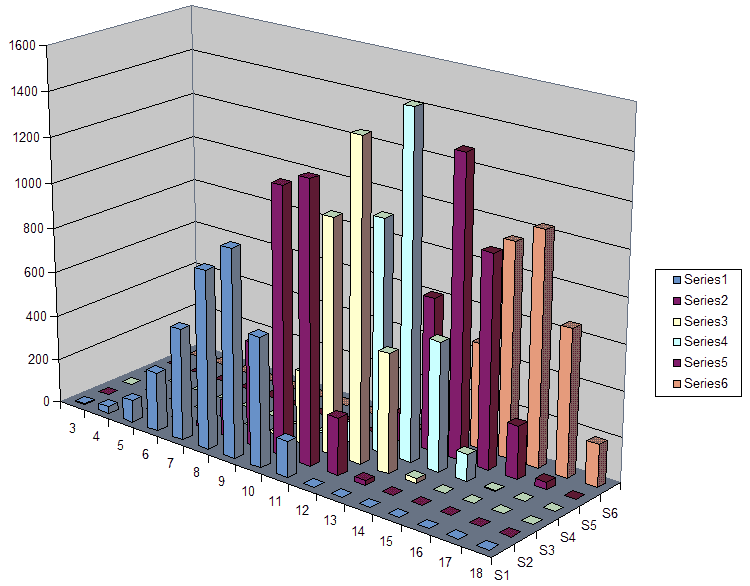
The statistical discussion here caught my attention. In an idle hour I generated 30,000 randomly-generated arrays of six abilities using 4d6-drop-lowest for each score (the average roll is actually 12.2). Then I generated a histogram if total ability modifiers, i.e. the sum of the six results of [ability - 10] / 2.
At the peak of the probability distribution of total ability modifiers, the most common modifier total is +5 or +6 (the probability of each is about equal).
Many combinations will have this result, but I was interested in the "typical" ability roll profile. So out of my 30,000 trials, I extracted those adding up to 5 or 6 and collected statistics on this subgroup (6,720 ability arrays). I determined the statistical mode of the lowest ability scores, then the 2nd lowest ability scores, 3rd lowest etc. to get a set of 6 statistically typical ability rolls.
typical: 9, 11, 12, 13, 14, 16 (modifier total = +6)
Each ability in the array has its own little histogram (shown below). You can see that, by looking at the sharpness of the peaks of each histogram, that it's most reasonable to reduce abilities S1, S2, or S6 by -1 if you want to make weaker arrays that qualify as "typical," because the peaks of these histograms are nearly two bins wide. To get a +5 total modifier array, I usually just make the highest score 15 rather than 16.
These are good to use for a "typical" character build. Note that this array should represent "average" yet it resembles the "elite" array offered in the DMG.
I think that a DM could reasonably offer this profile to players who'd rather not roll. However, in practice, I and others found this array quite difficult to apply to characters we'd already conceived -- especially with characters having interesting combinations of incompatible classes, requiring high values in three different abilities to be viable. Therefore, I like the idea proposed in this thread, of inventing a character and then simply assigning the stats without rolling dice. Getting my DM to agree with this might be another problem entirely.
-Alex
I developed something a long time ago that might help DMs with the concept presented in the OP. Use a stat point buy as presented in the DMG, or create your own; present these stats to your PC as a guideline for creating their character. Then ask that people tell you how many points they ended up spending on their character. Give people that go over the allotted amount a percent XP penalty after each adventure, and each player with less than the allotted amount a percent XP boost. This would dissuade munchkinism and every true roleplayer would realize that the XP penalty only further personalizes their character. On the other hand, go under the allotted points and you advance faster.
I developed this originally because people were getting remarkable "rolls" on 4d6. The inherent problem with the system was that it penalized people that actually rolled higher than the point limit I had. If you combined allowing your players to choose their abilities with the XP bonus/penalty, you could moderate munchkins and let the roleplayers have their chance to shine.
I won't post the exact system (because I've lost it), but don't give too harsh a penalty. It worked out that the munchkins would only be a level or two behind, but it should work well with this.
These are good to use for a "typical" character build. Note that this array should represent "average" yet it resembles the "elite" array offered in the DMG.
Nice work! However, I just wanted to point out that the "elite" array offered in the DMG is based off of 4d6, drop the lowest, while the "average" array is based off of 3d6. Otherwise, a pretty useful analysis!
The statistical discussion here caught my attention. In an idle hour I generated 30,000 randomly-generated arrays of six abilities using 4d6-drop-lowest for each score (the average roll is actually 12.2). Then I generated a histogram if total ability modifiers, i.e. the sum of the six results of [ability - 10] / 2.
The average is very close to 12 and 1/4 (12,25) for 4d, drop lowest.