| Post/Author/DateTime | Post |
|---|---|
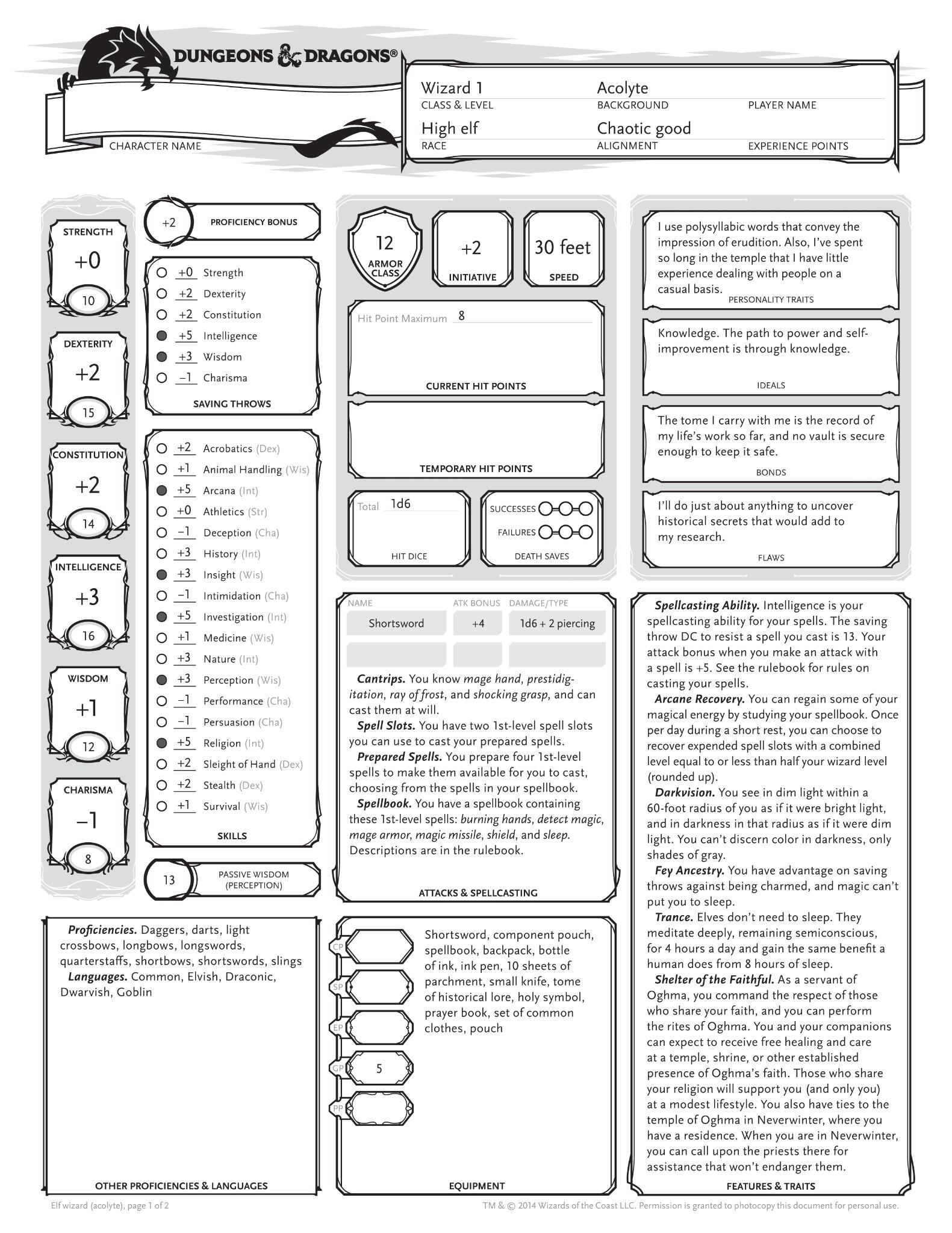
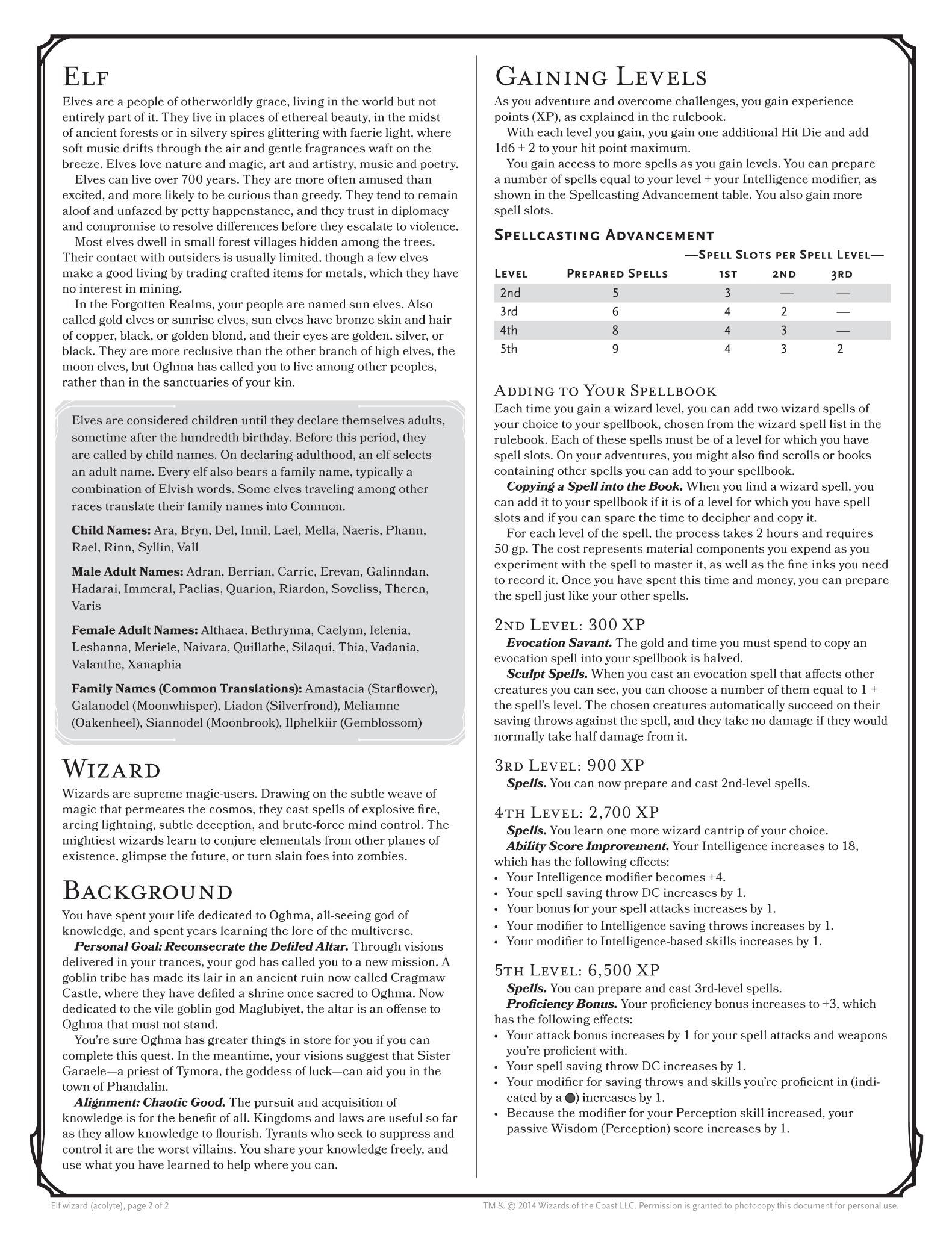
| #1Person_ManJul 03, 2014 6:35:44 | The Wizard has been officially posted by Mearls on his Twitter account. Here is page one and page two. And the Basic Rules are public, here.
Discuss. |
| #2melloredJul 03, 2014 6:40:03 | Yea, it's the same as it was in the playtest.
And spells where alwasy difficult to understand in any edition of D&D. Why can a level 5 wizard only cast level 3 spells? Except 4e where they where only moderatly difficult. |
| #3VanRicterJul 03, 2014 7:59:41 | The wizard seemed fine in my group. Allowing the wizard to memorize an assortment of spells and spontaneous cast was a big plus in our book; we always found that the 3.5 wizard had too many situational spells and it was hard to justify giving up a spell slot to have any memorized. Giving some substantial 0th level attack options lets the wizard have something to fall back on rather than the typical sling and dagger. Overall we were quite happy with the changes. |
| #4MiladoonJul 03, 2014 7:05:37 | IME, I didn't find attack cantrips to be as useful as the non-attack cantrips. Until my mage made it to fireball and lightning, I was prestdigitating a mystical sighting device above my light crossbow. Didn't do squat mechanically but it was an amazing visual in my minds eye. |
| #5AaronOfBarbariaJul 03, 2014 7:13:43 |
|
| #6ParaxisJul 03, 2014 7:38:17 | Wizards seem pretty easy to understand, sure they are probably the most complex class but they always have been and the option to play a complex class should exist.
If players want a simple class there are options for that, from what we hear there will even be a simple spellcasting class in the PHB, the warlock.
|
| (Reply to #6)AaronOfBarbaria |
|
| #8souldoubtJul 03, 2014 7:45:51 | I'm with AaronOfBarbaria, I think the OP is making the wizard's spellcasting more complicated than it needs to be.
One of my players who usually plays very mechanically simple characters is looking at playing a wizards or cleric in my 5e campaign, so I'll let you know how that works out, but I'm not overly concerned. |
| #9Jay_Ibero_911Jul 03, 2014 7:56:54 | 5e casting seems pretty simple to me. Much simpler than 3.5. In 3.5 a wizard needed to have a chart of what spells he had prepared in EVERY SLOT. Now he just needs a list of spells prepared, and a tally of available spell slots. Choose spell, decide what level to cast it at, tick off appropriate spell slot. Wonderfully simple. |
| #10melloredJul 03, 2014 8:00:03 |
|
| #11DemoMonkeyJul 03, 2014 8:32:20 | I think part of the problem is "unlearning" ingrained preconceptions. I think the best way is to start fresh by telling your players, whatever the edition they are most familiar with, "Forget everything you know about how you choose your spells. Now, here's how it works in 5E..." |
| (Reply to #9)Person_Man | I agree that the 5E Wizard is better and simpler then 3E/2E/1E Wizards. I'm not putting forth an argument about the relative power or flexibility of the class.
What I'm saying is that I have found it difficult to explain to others.
I have personally found it difficult to explain to several friends who played previous editions of D&D, because its basically new but sorta kinda looks like previous Wizards, and so they mentally try to understand it by directly comparing it to previous classes. It's not "here is the 3E/2E/1E Wizard but with rebalanced spells per day." It's "here's a new class that happens to be called the Wizard with a chart that looks like the 3E/2E/1E Wizard, but his spellcasting does not work like the 3E/2E/1E Wizard and spell scaling and resource management are different from how they worked for every previous magical class in every previous edition." It's basically an entirely new magic using class that uses spells in a way that no other system has previously used them, even though it shares a name and chart formatting with previous Wizards. Calling the 5E Wizard a Wizard (and not something else) makes them try and understand it in the context of their previously ingrained ideas about how a 3E/2E/1E Wizard (or Sorcerer) functions.
And I have personally have found that it's difficult to explain to my young (13 yr old) cousin, who feels like he should be able to just "press a button" or "play a card" and use a spell, because his context for using magic are video games and card games. In each case, it's a simple three step process: 1) Choose spells (or build your deck and draw cards). 2) Cast spells. 3) Wait x seconds so that you can use the spell again or wait until you draw another spell card. The 5E Wizard uses a longer multi-step process: 1) Choose spells. 2)Decide to cast a spell. 3) Decide what spell level to cast it out of. 4) Manage your spell uses per day for each spell slot. (Which can now apparently be renewed by a class ability and resting, and not just "at the end of the game day everyone rests and you get your spells back). It has an extra decision point that needs to be made every time you cast a spell, and it has an unituitive book keeping methodolgy that is not "use at will" or "use then discard."
|
| #13QmarkJul 03, 2014 8:44:25 | So a 9 int wizard has to somehow get to level two to have any spell slots at all? |
| #14FFSAAJul 03, 2014 8:46:01 |
|
| #15FFSAAJul 03, 2014 8:47:53 |
|
| #16ParaxisJul 03, 2014 8:52:27 |
|
| #17Person_ManJul 03, 2014 13:03:11 | I wonder if there's any chance that it could be simplified in the Advanced rules via a subclass option? I loves me some spells, but it just seems really hard to manage. |
| #18LawolfJul 03, 2014 13:04:34 |
|
| #19Tony_VargasJul 03, 2014 13:28:22 | One of the things that's historically served in the place of balance in D&D is a tradeoff between complexity & power on one side and simplicity & conceptual appeal on the other. The fighter was always a very popular class, because it represented the archetypal hero, so it was made simple enough that everyone could play it, but ineffective enough that not everyone would want to.
The wizard's high complexity is just the flip side of that. Since many players don't want to tackle it's complexity and/or don't find the archetype that appealing, it can be made more effective without 'crowding out' other classes at the table. The same is even more true of the Cleric and Druid, who, even in 3.x as the top optimization tier classes, were not exactly over-played.
Layer niche-protection on top of that, and you have D&D's classic way of achieving diverse parties. |
| (Reply to #19)Person_Man |
|