Hi. I couldn't find a discussion on the forum about alignment so I'm starting one. If there is a discussion already happening can you please point me in the direction?
In any event, I want to talk about alignment because I like the topic.
I think the way the system is treated as a sort of classification system for actions (this one good, that one evil) is not only completely wrong, but so short sighted for roleplaying. the root system I think is full of wonderful potential in that it can really be used as a way of really getting into the motivation of a character. we play these games to have an experience. sure it's done for fun, but the fun of it is because it's a bit deeper than a wargame.
The system can be used as an arbitration tool, but if that's all you do then you're missing out. saying that anyone from this alignment will only behave in a certain way is damaging because it prevents exploration.
there's the example of the way treasure is devided up after a dungeon crawl. the good guys talking about fairness and the evil guys being sefish. it's basically saying that all evil guys have all the negative motivation traits, and the good guys will have all the positive motivation traits, so all behaviour must then strictly adhere to a single behaviour code. but, for example, what if the evil character is evil because of say self hatred. so he wants to give all the treasure to they ravaged village they passed because he thinks they don't deserve to keep the stuff. his self esteem is so low that he's not able to convey this message effectively so threatens the others. the paladin is ashamed that he didn't think of donating the loot... on so on. there are great roleplaying chances just by thinking oitside of the box a bit.
Alignment is simply a mental framework to help you understand, at a glance, how a character will respond in a given situation. It's designed to enhance the story not, as in previous additions, to constrain it.
Feel free to ignore alignment entirely, I know I do.
Either that, or go ahead and use an alignemnt system from a different game (I've done that too). The Palladium games, IMO, do alignment well and I have used them as alignments in D&D before with no problems.
g8 b8 m8.
How many headaches have I seen about aligment system?
My houserule is easy, to add alegiances (from d20 Modern) to aligment. This allows spells to hurt enemies with same aligment but different allegiance, for example a a orc shaman vs a drow priestess. I also alow opposite aligment-allegiaces characters, for example a zealot anti-villain would be good allegiance and evil aligment (he could be affected by the same spell depending on to be casted by ally or enemy).
But my definition of chaotic aligment is different. For me chaotic is behavior with people of different allegiance and closer to minarchism than anarchy. In my setting a chaotic monk can be so disciplined and honorable like a paladin, but he is too "attuned" to primal forces, or passion, or personal conscience, is priority befor honor or prestige. And what is honor? Somebody who is executed because he doesn´t reject a forbidden religion would be a saint martyr for their church but a criminal for the government (let's suppose I am using for my example the religions from Westeror "Game of Thrones").
Embrace it (Planescape), or pretty much ignore it (Dark Sun). I have found both approaches to be very fun, it just depends on the type of campaign.
I don't really enforce alignment much other than the good/evil axis for my players, but it is helpful quick reference for NPCs and monsters to know something about them at a glance.
In addition, I don't look at alignment as a result of behavior (per se) but rather as how the creature views the world.
A good creature is more likely to have empathy for others and understand how the world looks from the perspective of others and understand how their actions will impact others.
An evil creature looks at other creatures as objects and will have no empathy for what others feel. They may care deeply about another creature but only in the same way that a good aligned person would look at a favorite tool. If the tool no longer has value, it can be discarded with no regret.
Lawful creatures look at the world and see a clockwork mechanism. Everything has a proper place in the order of the universe and things go best when things are done in the proper way.
Chaotic creatures look at the world and see no organization, no grand design other than (perhaps) order rising out of chaos. They may have a personal code of conduct they've constructed for themselves, but don't necessarily expect anyone else to follow it.
I use alignment. Always have.
Alignment can be a useful tool, if used properly and not abused. 100% of every example I have ever seen on the forums of someone making a claim about why aignment is bad comes from deviation from the RAW. DMs who force players to either take a secific action or forbid another, based on alignment, and so on.
The most important thing to remember is what alignment is, and what it is not. Alignment is a grossly oversimplified summary of a character's overall outlooks and attitudes. And, more importantly, it is NOT an absolute barometer of action or affiliation. That last bit is probably the biggest clincher.
Just because someone is of Good alignment doesn't mean that they are going to help the heroes, or that they even WANT to help the heroes. For example, I've written an adventure that has a LG paladin of Bahamaut start off as a quest giver, and as his renown grows (in no small part from being the PCs' patron), he gains more political power, and grows into something of a "moral tyrant", imposing a new order on the city, and becomes an anagonist that the PCs must overthrow. Never stops being Lawful Good.
Just because someone is Evil doesn't make them a villain. An Evil bartender may just be a miserly old man who loves nothing but money and cares for no one else. He's never murdered anyone, never broken any major laws, and he won't, he's a law-abiding citizen. If the players attack him, they'll suffer in-game consequences. "He detected as Evil" doesn't stack up in a trial (although it might in the court of the aforementioned paladin). Another Evil character might be a priest of a Lawful Evil deity (let's say the deity of Tyranny, Rulership and Fear). He's a ruthless monster, but he has a vested interest in the security and well-being of the city of which he is a part of the ruling council. He will provide the PCs with aid, backup, and reward for their work in routing out the cabal of doppelgangers that was murdering people, assuming their identities and taking their wealth. The priest is, personality-wise, without a doubt villain material, but he's not THE villain of that particular piece, and in fact he genuinely wants the heroes to succeed.
5e is a little more vague in regards to defining things like "Good" and "Evil". It was easier in previous editions, when they spelled it out, and you could say "this is Evil by RAW" or "RAW explicitly says this is Good". If a DM substituted his own ideas of Good and Evil into his ruling, he would be deviating from RAW (which used to account for a lot of "alignment problems". 5e alignment, like so many other aspects of 5e, leaves a lot in the hands of the DM. There's very little in the way of defining how alignment mechanics were meant to be used, but at the same time, alignment mechanics themselves are very sparse and unobtrusive in this edition. There's also no hard and fast rules on how alignment changing should be handled (like 3.x did).
However, it is still important to remember that alignment is NOT an absolute barometer of action nor affiliation. Things that were true in previous editions about alignment are still true. A Good character may have a temper, or a greedy streak. An Evil character may have loved ones that they behave selflessly for. Characters sometimes take actions outside of what might be prescribed by just looking at their alignment. This is because alignment does not force characters into one-dimensional personalities (like some alignment detractors claim it does). Nothing about alignment provides any kind of absolute in terms of what a character (PC or NPC) will or will not do. At most, it might provide a guideline, if a situation arises that isn't covered by the character personality that a player made for his/her character. But that's really a corner scenario that assumes a player is forced into a situation where they can't decide what kind of action to take, and they might look at their alignment and let that be a guide.
That's about as far as alignment SHOULD dictate action. As a guide when personality and characterization do not organically lead to decision. For the most part, alignment is DESCRIPTIVE, and not PRESCRIPTIVE. A character does not help orphans and helpless people because they are Good, they are Good because they do those things.
In discussions, some people will try to jam every aspect of a character's personality into their alignment. This is not useful to anyone. Sometimes alignment detractors will try and "prove" that alignment is somehow insufficient by asking "what alignment would this character be?" and provie some details of the character. They usually either do not provide all of the details in order to "trap" people that claim one alignment or another. That, or they intentionally make a character with wildly conflicting personality aspects (I've seen some that seem like they couldn't possibly work as an actual character), and wait for someone else to try and prescribe an alignment, claiming that the "conflicting" aspects of the character that they describe make whatever alignment someone else prescribes "unsuitable" as an alignment.
It is important to remember that alignment is a generalization, and not every facet of a character can be summed up in their alignment. It is important to remember that it does not force any character (PC or NPC) to act a certain way. Remembering these things can allow you to use alignment in your game, have it be productive, and not overly intrusive.
akhenmosis wrote:
in 5th our group tends to look at alignment less then in any edition before.
Prefering to add more personality traits like bonds and flaws to help define a characters personality instead.
For my aligment is:
Good: To take a great risk, sacrifice or effort for the justice or to help people from different allegiance.
Neutral: To help people with same allegiance (counrty, race, tribe, religion) or to take a benefit. No hostile if itsn´t necesary.
Evil: To cause a serious injustice or a evil action without any mitigating cirscustance. Evil characters can be "good" with people from same allegiance (for example tribe).
Caothic: Maybe too attuned to Nature and/primal forces. Maybe break rules waht aren´t from their allegiance. For example a caothic elf army would be like A-Team from 80's TV. Sun Wukong, Monkey King from Chinese culture would be a example of "caothic martial artist".Or a secret ninja clan in the forest would be a example of caothic group but with the allegiances discipline and honor (they are criminals, but with their own code). Have you seen the 1995 movie "The hunted" with Cristopher Lambert? Those ninjas would be like "caothic monks".
* Have you thought about when a character becomes too "honorable", for example a barbarian who lose neutral aligment.
Alignment not only describes how you interact with the world, it also describes what the rest of the world expects out of you. Drow are Evil because the "typical Drow" takes slaves, offers people as sacrifices, &c. This has happened over and over again, across personalities and through time.
But you personally might be Drizzt, and eventually people who know you will stop calling the City Guard when they see you walk into town.
Orethalion wrote:
I've really enjoyed reading all of your comments. Thanks a lot. I'd like to keep this conversation going. I hope you'll keep talking to me.
RCanine wrote:
MechaPilot wrote:
LuisCarlos17f wrote:
Brock_Landers wrote:
OoftaMeg wrote:
akhenmosis wrote:
Thank you so much for you comment, it's my favorite by far up til now because I find almost everything you say completely disagreable.
Of course you should abuse the alignment tool. This is a game of expression and exploration. You're right that there are a lot of complaints about how bad these rules are. But it's not because they're not following the rules, it's because they're not breaking them.
You make grand claims about the ills of prescriptive thinking and the blessings of descriptive thought , but your entire essay (lovely by the way, thanks again) is completely prescriptive of how you should be following the rules. I quote "The most important thing to remember is what alignment is, and what it is not. Alignment is a grossly oversimplified summary of a character's overall outlooks and attitudes. And, more importantly, it is NOT an absolute barometer of action or affiliation". Here be the ranting of a tyranical hipocrite.
Your Paladin of Bahamut raises the questions, if he becomes tyranical and stays good, does tyranny become a good act or has it always been good? is tyranny only good within this community? Is it only good because the means justify the ends? These may sound like picky questions, but it's this kind of thought provoking questioning that incites dramatic conflict and creates great stories. I love this character by the way because in a couple of sentances you've created a dynamic character with conflict. I want to know what he does when he becomes a tyrant and if he's brought down or if the player characters join him in his tyrany.
The Evil Bartender is a brilliant example of playing with the rules instead of playing within them, which you seem to be so against. what if this guy is arrested by the same paladin above for being evil. Or even different. I'm getting ideas of maybe a justice type story where the characters have to defend or convict the bartender. a bit like a few good men but in a dungeons and dragons setting. would you be interested in developing this story with me? it sounds like you have a real flair for coming up with intriguing characters.
You carry on to talk about how behaviour shouldn't be dictated by alignment, sounding a little bit like the people that rail against the alignment system, citing how good people can be greedy and evil people can be selfless to those they love. Cods wollop! (is that how you spell that?). greed is not good. Gordan gheko is charismatic, but greed is inherently selfish and any action that it inspires can only be an action of evil in the world. that's not to say good people don't commit greedy acts, it's just that when they do, it is an act of evil and so must conflcit with their consience. And that's the truth of it, People are conflicted, that's what makes us interesting.
To go back to the evil selfless person, love is always good. Any action motivated by love must therefore be good. Love entails things like compassion, kindness, courage, etc... So if the evil prtson is selfless, what is it about them that makes them evil? I've been thinking more about my chaotic evil character that's self loathing(evil) but commits acts of kindness. And I think his motivators are that he's obviously suffered greatly and can't handle the suffering he sees all around him. He can't handle his anger (Chaotic) but takes it out on himself. And he expresses that with vows of poverty and charity. Ok, so this character may be unplayable, but I'd sure love to tell his story. And maybe he'd fit in well in an avant garde group.
You're right. Characters don't ft into neat alignment groups completely, but we do have motivations, values and conflict between the two and these are morally definate. I think we need to be adventurous with the use of the aligment system. I find it intriguing. that's why I want to argue about it with people. again, thank you so much for your comment, I;ve had a great time answering it. And let me know what you think about developing that evi bartender story.
I'm a guy that can't comprehend people having problems with the alignment system. It's so natural and the rules so clear, it literally dumbfounds me that people have difficulty with the system.
I usually just use alignment to help narrow down what sort of moral compass the player is trying to present. More simply put, it's an approximation.
MechaPilot wrote:
arnwolf666 wrote:
akhenmosis wrote:
CCS wrote:
cowleymen wrote:
akhenmosis wrote:
The alignment written on my current character is literally "Neutral Good(ish)".
Personally, I like that 5e has introduced things like Bonds, Flaws, etc as I find them much more helpful in terms of roleplaying than just alignment.
akhenmosis wrote:
akhenmosis wrote:
akhenmosis wrote:
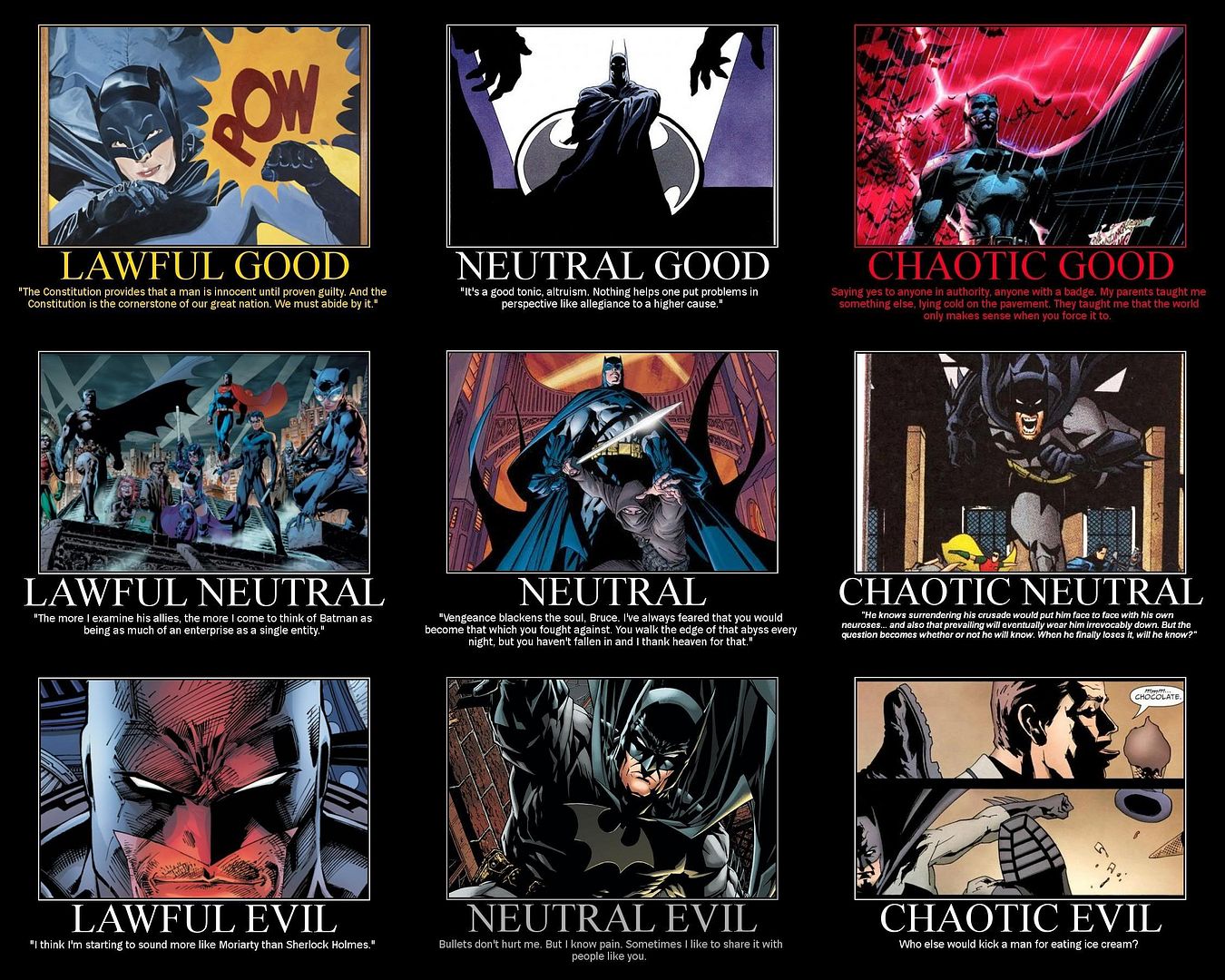
Batman, discuss.
For campaigns I run, alignment is your justification for your actions and not your actual actions. A chaotic good player might overthrow a tyrant because it's right by his moral code, and his neutral evil ally helps him out because he likes to hurt people and thinks he'll get away with it.
Alignment is a model. A model is an abstraction of reality which makes it easier to understand without necessarily being right about all the details. Gravity is a model. It's a very good model, and it does a lovely job helping us understand what happens if two bodies interact with each other. However there are details that it doesn't explain at all. For example, how tiny bodies like molecules and atoms interact with each other.
Alignment is a model and it does a fairly good job outlining 9 broad ways that people view the world and their place in it. Because it is such a broad model you can wind up with stuff like the Batman Alignment Chart where one person's actions can seem to fit any given alignment. Alignments are fun and interesting, but they are just a tool and a limited tool at that. You can do a lot with alignments, but they can only take you so far. Just remember that there are lots of other tools in your box for designing characters, npcs, countries, races etc. You've got history, bonds, religions, personality models like Meyers-Briggs and the Personality Colors (or four humors), and non traditional element models. In fact let's look a couple real quick to build some entities.
The Five Chinese Elements: Five nations war against each other, each specializing in a kind of elemental magic and warfare and each one holding philosophies that match their element.
Fire: Change, revolution, and progress at any cost.
Water: Adaptation, peace at any cost, and manipulation
Earth: Stability before personal desire, methodical decision making
Wood (sometimes Wind): Freedom at any cost, isolationism, chaotic nature.
Steel: Tyranically unyielding, subjugating, power at any cost.
The Four Humors: The Teenage Mutant Ninja Turtles, but actually a bunch adventurers. Super easy, moving on.
History: Each character embodies an age of humanity
Paleo: The Barbarian
Ancient Empirialism: A noble but fanatic Warlock
Feudalism: A chivalrous Knight
Enlightenment: A Wizard who believe that personal growth is managed through mental exercise.
And so on.
Well, now I will digress a little bit about alignment. Feel free to disagree.
I used to use alignment very much; it was an essential element of my D&D games. However, one day, I asked myself “But what about outside D&D? What they think?”
You know where this is going, right? I mean, most RPG/games out there don’t have a written up, codified good-evil, law-chaos alignment system. Yet this seems to have no bad effect for them. They still have good, noble Paladins, Clerics of light and dark deities, uncaring Druids or Wizards, and so on. Well, of course it’s hard to video-games (at least now) to make the same behavior rules as D&D once did. But, apparently, you can still have good and evil, law and chaos in your game without any sort of codification of them. Is it really the role of the rules system? To tell everything that is good and evil? I don’t think so.
Thing is, we don’t need alignment per si to have these polar opposites present in your setting. The next question is what do we gain with such a codified system? Well, I think that we all know in our hearts the answer: to have rules about them.
Think of some classical plot hooks about alignment. “The sacred tome heals the worthy but harms the wicked.” “Unicorns just approach fair, pure hearted women.” “This darkness are dangerous: people can become evil in there. Evil itself flows there, eternal.” “Samurai must respect the law of their lord: any disobedience is sign of unworthiness and strip them of their privileges.” “Creatures of law and chaos have battled each other across millennia: many weapons have been made to harm the other side: we might use one of them against the slaadi.” “Whosoever holds this hammer, if (s)he be worthy, shall possess the power of Thor.” (Not entering the question if Marvel’s decision was good or bad, just a friendly example of pop culture).
How exactly can we have this kind of element without a proper alignment system? By the will of the DM? That’s just asking for troubles at game tables. A codified alignment system gives some ground on that. However, since most of the rules concerning alignments are gone, it’s just a non-sense tradition who doesn’t even have reason to stay other than tradition. Now, without this kind of rules-fluff catch up, it’s useless.
Now, with that said, I’m not saying that is better for us to have an alignment system. I do not see the reason that these plot-hooks should be in every game. Many games have allegiance systems, such as opposite teams in a MOBA, or different nations, and so on. They are a lot different because it usually means different political/religious factions. More like sides of a football team rather than good or evil. Although even the ones that do so don’t tend to have many mechanics about this other than “this is your enemy”. However, some “story-focused” table top RPGs do have rules and a lot of work about different vampire clans, different mystical traditions, or different icons of the world. That is usually a well-received thing in RPG-world. Why they would be that different from D&D?
The thing is we always loose something in that mix. In the case of alignment, we lose the gray areas. I mean, we do have a “neutral” stand, but the codification means something more defined, not blurred. And there is an interesting discussion that we lose: “Is this guy good or evil?” Well, I can hardly explain more: how many times fans of A Song of Fire and Ice have discussed about the goodness or evilness of the characters. To be fair, that happens in all media which does not have D&D alignment: sometimes it may be obvious, other times not. But what about D&D? There are no such discussions. Because somewhere in the description they have two words that tells everything to you. “Why sahagin are evil? Because it’s written all right here.” “The slaadi are good or evil? Neither, it’s written in page Y that they are CN.” No discussion. No proper debate. It’s all decided. That makes the game lose something, right? But, by not having this codification, the effects mentioned somewhere above are much harder if not outright impossible to make in a table top RPG: remember: authors have total control over their characters, their actions and can decide “worthiness” at the end of its pen, but in a table? Things can get wild.
So, in the end, alignment and/or allegiance systems and their effects in the rules have more to do with what story you’ll make, and what discussions you want your players to make. However, the Alignment systems, as it stands in 5e (and in 4e too, for that matter), it’s just a vestigial organism who can disappear without traces of its absence.
Dougan_Axehammer wrote:
Vahnyu wrote:

Orethalion wrote:
Vahnyu wrote:
MechaPilot wrote:
AaronOfBarbaria wrote:
Alignment is really more or a loose roleplaying tool, particularly in 5e (where alignment effects on gameplay are few and far between). They have also not been consistently depicted across editions, both in use at the table, or in what they actually mean (2e was pretty extreme in both regards). The current personality system compliments alignments pretty well, and in a current campaign I'm running one character picked ideals and bonds based on his alignment (Neutral Good), while another rolled all that stuff randomly, then picked an alignment to fit.
I use it as a DM to get a quick sense of the NPC's behavior. But I also try to throw quirks into the character that defy alignment to keep things interesting. I played an Orc Chieftain as having a brutal kind of code, for example, which some may think as more a lawful behavior. The code was simple (never surrender, die fighting, and don't use tricky words to get what you want), making him a fairly honest, though merciless and cruel, type of antagonist.
I always loved the examples from the 3.5 Complete Scoundrel. They had Indiana Jones as LG, Robin Hood and Mal Reynolds as CG, James Bond as LN, and so on. Jack Black's depiction of Carl Denham as CE was particularly fun - at that point I could actually see an evil character functioning in an adventuring party.
AaronOfBarbaria wrote:
cassi_brazuca wrote:
Chaosmancer wrote:
The complete scoundrel has a chapet where aligment is explained, and there different examples of characters. Batman, Dick Tracy and Indiana Jones are examples of LG aligment.
Orethalion wrote:
CCS wrote:
CCS wrote:
Orethalion wrote:
FFSAA wrote:
Orethalion wrote:
FFSAA wrote:
dmgorgon wrote:
Orethalion wrote:
Orethalion wrote:
cassi_brazuca wrote:
Vahnyu wrote:
You guys do know I said "Batman, discuss" precisely because it devolves into the discussion you're all having now, right?
(I only did it to point out the pitfalls of the alignment system and of alignment discussions in general. Thought you all would have caught that. :-p)
Orethalion wrote:
MechaPilot wrote:
cassi_brazuca wrote:
MechaPilot wrote:
cassi_brazuca wrote:
I tend to view Alignment as being primarily to do with hats.
Good Alignments where white hats. Evil alignments wear black hats. Neutral alignments may wear different hats depending on context.
The trick I've always found with Alignment, as with anything else in D&D, is to treat it as an abstract signalling mechanism. The question shouldn't be "what is the alignment of this well understood fictional character", it's "which alignment best telegraphs my intentions in playing this entirely unknown fictional character to the players I'm in the game with."
To put it another way, "what's Batman's alignment?" is an unhelpful question. "What Alignment do you want your Batman-themed Vengeance Paladin to have?" can be an extremely helpful question, because it means I know if you're playing 1960s Batman or Killing Joke Batman.
It's tragic how poorly treated alignment is in the new edition. Alignment is still just as much fun to use as it has ever been, and at the least the designers could have re-used the standards from 3.x and had much better descriptions.
SirAntoine wrote:
MechaPilot wrote:
"The more numerous the laws, the more corrupt the government" . Tacitus.
Timothy 1: 9 We also know that the law is made not for the righteous but for lawbreakers and rebels, the ungodly and sinful, the unholy and irreligious, for those who kill their fathers or mothers, for murderers, 10 for the sexually immoral, for those practicing [..], for slave traders and liars and perjurers—and for whatever else is contrary to the sound doctrine
Could you explain me how a group of caothic characters could survive in a setting like the comics and teleserie "the walking deads", or the manga/anime/comingsoon movie "Atack of the titans"?
I don´t agree about the concept of caothic good. Could be good anybody who steals a pig, and a farmer family os broken because they save to feed that pig now they can´t sell? How is the inner conflicts in a caothic comunity who is going to be invadered by a hobgoblin warlord?
LuisCarlos17f wrote:
Disney's Aladdin was a thief.. wasn´t he Chaotic good aligment?
Another examples of chaotic groups from the fiction: the lord of the flyes and the beach..(yes, novel and also a movie with Leonardo di Caprio), or the movies Mad Max. The purge and the purge: anarchy, Doomsday, Escape from New York, Escape from LA...
From real History I could give a example: the fitna of al-Andalus, when the caliphal dinasty of Omeyas ended in the Muslim Spain.
To speak about anarchy and authoritarianism from a confortable armchair, but one thing is to watch the movie "V of Vendetta" and to live in a failed state is totally different. Players need rules for the games, and real people need common rules for coexistence. "Chaotics" groups couldn´t survive a real crisis like foregin invaders or criminal groups controlling the zone. Could you imagine a "caothic" kingdom in a setting like "Game of Thrones" where attackers by the "others", the white walkers?
My concept of Chaotic good is closer to minarquism than anarchism. The canon concept of chaotic aligment should to change.
* I have said sometimes in the past my house rule is to add allegiance, and even divine spells can hurt enemies with same aligment but different religious allegiance.
Mecheon wrote:
Orethalion wrote:
I like the alignment system, and am always a bit disappointed when a PC takes the Chaotic Neutral/ Neutral/Unaligned choices so that they can “Do whatever I want.” It feels like a cop-out, making the character more one-dimensional, one step closer to the generic murder-hobo adventurer.
Give me a code of honor of some sort to explore, or heck, play a vicious villain, and I’m much happier.
"Nihilists!...I mean, say what you want about the tenets of Lawful Evil, Dude, at least it's an ethos."
Ralif_Redhammer wrote:
But when the actions can change the aligment? For example a barbarian who is too "honorable"... could become "lawful" and lose some class features. Sun Wukong, the Monkey King from Chinese myths maybe an example of "chaotic monk".
How could a chaotic kingdom to survive a serious crisis? Do you remember the "tourney at Harrenhal" from "Game of Thrones"? It isn´t a spoiler if I say some "chaotic" actions caused a civil war. Let's imagine a D&D elf kingdom full of incidents like the tourney at Harrenhal. Let's imagine a "D&D chaotic" group in a setting like the videogame "Homefront" where your fatherland is invaded by another country.
For me chaotic aligment doesn´t anarchy and too much individuality, even the criminal groups need their own codes of behavior.
LuisCarlos17f wrote:
Maybe some of the confusion and frustration people feel for alignment comes from trying to apply alignment to behavior, instead of to characters. A character with a given alignment has certain feelings and intentions. The behavior, or actions they ultimately take do not have to match up.
arnwolf666 wrote:
The generalization of the alignment system acts as both crutch and ceiling for roleplaying imo.
It can clarify some of the differences of morality between characters but it can also shoehorn players into roleplaying that feels "artificial" rather than naturally immersive.
The debate for and against an alignment system reminds me of the differences between Brecht and Stanislavsky on acting for performance.
It seems that the writers and designers of DnD have approached roleplaying behavior from an external perspective, structuring it with generalized classifications; if you want genuinely convincing roleplaying however, you need to approach roleplaying internally otherwise it becomes more like ham acting - you portray a character in a way that makes it obvious that it's a fake personality, playing the emotion over playing the situation and objectives.
Of course, different tables will have different overall preferences for the style of play. It's up to the individual group how they want to take on the storytelling.
Here's the way I rationalize alignment. I came up with it while working on a subsystem for providing roleplaying rewards for playing alignment well (or punishment for playing against one's alignment).
First, you have to agree on whether certain things are "good" or "evil", "lawful" or "chaotic". This is where I see a lot of debate falling in. But for this discussion, lets just use "doing good" and "doing evil", rather than any specific situations.
Second, your alignment matters just as much to what you won't do as it does to what you will do. This doesn't mean that you will act in your alignment 100% of the time, though.
Third, your alignment determins how doing aligned things make you feel. A good person feels well when they do good, and feels bad when they do evil. Similarly, an evil person might feel bad when doing good (I've been used, I'm a sucker ...), while they feel well when doing bad. A good person or a bad person feel nothing from doing neutral. A good person can be forced to do evil, say to protect themselves, their family, or just to get by. An evil person can be forced to do good. They're just not going to feel great about doing it. If circumstances continue to make them perform out of alignment, then their player might decide to change alignment to stop suffering penalties and start earning bonuses again.
A lot of alignment discussions I've seen over the years describe Law in positive terms and Chaos in negative terms. I try to describe both in positive terms. After all, a Chaotic person wouold use negative terms to describe the Lawful person.
Law
Tradition, Order, Self-Discipline, "we've always done it that way", "accept the status quo", Logic over Emotion, Community over Individual, Conformity.
Describe Chaotic people as "unreliable", "flaky", "flighty", "easily distracted".
"You're so predictable" is a compliment.
Chaos
Revolution, Spontaneity, Creativity, "think outside the box", "question the status quo", Emotion over Logic, Individual over Community, Self-Direction.
Describe Lawful people as "boring", "stodgy", "traditional", "clinical".
"You're so predictable" is an insult.
For example - a sterotypical hippy is Chaotic. They are counter-culture, pro-independance, anti-government. But they still wouldn't steal (unless really, really necessary).
Both a Lawful person and a Chaotic person can follow laws. Both can be respectful of property rights and individual rights. Just because you are Chaotic does not justify theft or slander or trespass. In fact, a Chaotic person is more likely to respect an individual's rights (but by the same token less likely to respect a government's rights).
Just because you are Chaotic doesn't mean you won't keep promises, Because a Chaotic person believes in the Individual over the Community, a Chaotic person might be more likely to keep a promise made to a person, because failing to keep the promise is disrespecting the individual. A Chaotic person might be more likely to tell the truth, because lying to someone is interfering with their right to self-determination. The Lawful person is more likely to use "white lies", the things that they think keeps a society running smoothly.
Chaotic people do not lack a code of behaviour, they just have a different code than a Lawful person.
It isn´t only about roleplaying but also about gameplay. They are magic item, spells and even planes what affect characters depending on their aligment.
If Chaotic aligment means idividualism... then only some individual characters can be chaotic, but we couldn´t speak about a chaotic race. Groups need coordination to work together. Maybe the concept of chaotic aligment should change.
LuisCarlos17f wrote:
Exactly. That’s what I’m talking about – his alignment matches and helps define him. Rather than just being an excuse to not role-play, it brings more of the character to life.
randl wrote:
AS a side issue i find it strange alignment is not in the same list as your ideals bonds and flaws, when it comes to things a DM can reward inspiration for, when it is played well.
edwin_su wrote:
AaronOfBarbaria wrote:
Orethalion wrote:
AaronOfBarbaria wrote:
Orethalion wrote:
warpiglet wrote:
Ok. The act can't have an alignment but people of a certain alignment must have something in common. If not the act, then the motivation. If neither then the naysayers are right, there is no purpose to alignment even as a heuristic descriptor.
I think of Senator Palpatine's words, "Good is a point of view, Anakin."
SirAntoine wrote:
Orethalion wrote:
Orethalion wrote:
Orethalion wrote:
Orethalion wrote:
AaronOfBarbaria wrote:
Orethalion wrote:
"From my point of view, the Jedi are evil!". - Darth Vader, padawans killer.
* Let's imagine the PC find a magic sword created by fays...the prequisite is it can´t be used by lawful characters.. (because fay magic is linked to primal forces). When a character is too too honorable, too lawful to use that sword?
I say it again: Aligment isn´t only roleplaying, but also there are gameplay effects.
What is evil? To hurt an innocent, actions againts human dignity or to cause a serious injustice without any attenuating circumstances.
What is good? To take a risk, great effort or sacrifice to help people from different allegiance.
* What about players who would rather to be neutral characters to try avoid spells with aligment key? My solution is to add alegiance, and spells or powers with aligment key can hurt enemies with same aligment but opposite allegiance.
edwin_su wrote:
Orethalion wrote:
Orethalion wrote:
DarkSphinx wrote:
Macv12 wrote:
In my stories the anti-villains are possible. I used aligment and allegiances, even allegiance with opposite aligment, for example a xenophobe dwarf who is LG only with people with same allegiances (dwarf race, fatherland and religion) but it is CE for the rest of people. This allows me to create groups who are chaotic aligment, but "totally lawful" when is behavior about their allegiance..(for example the cult or a mercenary brotherhood).
Orethalion wrote:
edwin_su wrote:
Orethalion wrote:
edwin_su wrote:
I was just thinking about Indiana Jones being labeled as LG, in 3rd Ed's Complete Scoundrel, interesting, I mean, the guy did blow someone away with a pistol, nonchalantly, because they performed an aggressive weapon display to him in a market (also, from like, 30 feet away).
Orethalion wrote:
AaronOfBarbaria wrote:
Orethalion wrote:
Orethalion wrote:
AaronOfBarbaria wrote:
Orethalion, let me try to be clear:
This is an actual example of an action without any attached motive, justification, or information that colors the action in any particular way: Saving a life.
This is your example of supposedly "nothing but an action": Saving the life of a man known to be a paragon of good in the community.
Do you see how they are different?
AaronOfBarbaria wrote:
One of the biggest habits when using an alignment system is forming an assumption that a character of a particular alignment MUST act as that alignment dictates.
This can lead to 1-dimensional roleplaying that feels more artificial than it should be.
Since alignment descriptions are written from the perspective of one or a few, differences of interpretation will undoubtedly erupt.
In my opinion, it would be far more accurate to switch towards an objective system that takes into account individual motivations. It would be more hassle but more accurate in representing a simulated experience.
Orethalion wrote:
Storyteller-Zero wrote:
SirAntoine wrote:
An action doesn't has an alignment.
The actor performing the action probably does, but the action alone cannot tell you anything about the actor. You need the context.
For example: Figure A kills figure B with a sword. Quick, what alignment is A? There is no way to answer it, without more information.
Second, alignment is a two-word summation of a person's moral code. Their moral code will determine what actions they take, in general but not necesarily for every individual action. You can observe their actions and guess their moral code, but only if you observe for a period of time. Observing only one action (especially with no context) will not tell you anything about the person's alignment . You need lots of observations.
In other words, sometimes the chaotic evil figure just feels like rescuing the kid, rather than watching and laughing. Sometimes the lawful good figure just feels like killing the bad guy instead of trying to redeem them.
Such out-of-character actions might, or might not, cause the figure angst and internal conflict. The chaotic evil figure might berate themselves afterwards ("Am I getting soft? By the gods, harden up!").
Storyteller-Zero wrote:
Greenstone.Walker wrote:
The key question is.... if somebody does something... should his sould be condemned to go th the hell or infernal planes, or could he save his sould and go to the celestial planes?
About storytelling.. a character can be good, but with some "taints" in her aura because she did some actions weren´t good.. but not totally evil (or there was some attenuating circustamces.
Can a no-good character to do altruistic actions? Yes, but for people with same allegiance, for example race, tribe or religion. Can a character to have good intentions but do bad actions? With my house rules I allow characters with allegiance "good" but evil aligment, for example a zealot like the high-priest from Dragonlance, or a ex-villain who has just started his road toward his redemption.
* Do you remember that webcomic "Oder of the stick" about a spellcaster using "unholy blight"? page #11 That is the reason to create my house rule where spells with aligment key can hurt enemies with same aligment but different allegiance.
SirAntoine wrote:
Greenstone.Walker wrote:
Orethalion wrote:
Vahnyu wrote:
arnwolf666 wrote:
SirAntoine wrote:
Vahnyu wrote:
Orethalion wrote:
Greenstone.Walker wrote:
kalil wrote:
* Some actions would be evil, but there is some extenuating circumstance, and that avoid characters to become evil aligment.
* Can sex be "lawful" with a 40 years old female elf, but with the mind of a 14 years old girl? (Now elves are adults since 18 years old. In the dragonlance novels it was since 50 years, but then it was 2nd ed).
Orethalion wrote:
MechaPilot wrote:
Vahnyu wrote:
Orethalion wrote:
Chiba_Monkey wrote:
Orethalion wrote:
AaronOfBarbaria wrote:
Here’s what the alignments mean:
Good-Neutral-Evil: What motivates your actions? Do you try and promote others’ interests or your own? Good people tend to be selfless. Evil people tend to be selfish. Neutral people either (A) show no tendency either way, which is to say they act selflessly and selfishly in roughly equal measure; or (B) don’t determine how they’ll act based on whom it’ll help. An example of “A” would be the person who acts selflessly so long as it requires little to no sacrifice on his/her part. An example of “B” would be the person who zealously follows authority and does whatever it commands.
Lawful-Neutral-Chaotic: How do you respond to (internal or external) authority? Do you tend to accept or reject it? Lawful people tend to be “adjusted” and compulsively conform. Chaotic people tend to be “anomic” and compulsively rebel. Neutral people either (a) are “autonomous,” which is to say they question authority and either follow or reject it as they see fit; or (b) don’t determine how they’ll act based on what internal or external authorities might say. Note: A “personal code” is not the same as an internal authority, though it can be a type of one.
There it is.
Orethalion wrote:
Chiba_Monkey wrote:
The debate over murder's a waste of time for several reasons, the most important being that it's got no bearing on what alignment means in the game. And it's got no bearing on what alignment means in the game for several reasons, the most important being that alignment isn't, hasn't, and can't establish a system of in-game ethics. Instead it is, has, and should speak almost entirely to characters' intentionality, which is why good and evil, lawful and chaotic mean what I've explained they mean above.
Chiba_Monkey wrote:
Orethalion wrote:
5ft wrote:
SirAntoine wrote:
5ft wrote:
I'm quite neutral on the whole cannibalism thing. If I kill them in self defense and I am hungry, there is no need to let the body go to waste.
Greenstone.Walker wrote:
arnwolf666 wrote:
All this talk about cannibalism makes me hungry for pork chops. And makes me want to play a cannibalistic paladin of Pelor. As soon as the last rites are performed its dinner time!
Are you talking about storytelling, background? To know about why an action is evil you only to wonder this: If the character do it... should his soul to be punished in the afterlife by the gods?
* Eating flesh of sentient creatures isn´t allowed to good creatures. Maybe it can be done by neutral characters when the body are dead by legitimate fight, just execution or natural death, but I doubt it to be good of the aura/karma/chakras.
Mmmmm, could a wizard use magic to create a half-troll pig, to sell half-troll ham? Have werebeast lost regeneration power? Convicts could be infected with wereboat curse to get wereboat ham...
This link just cropped up in my Facebook feed.
http://easydamus.com/alignment.html
LuisCarlos17f wrote:
Brock_Landers wrote:
* What is to be good? When that character die she should to go to the celestial planes. What is to be bad? When the character dies and he ought to go to the infernal planes.
* What is the aligment of the main characters from cartoon show "G.I.Joe: Renegades", lawful or chaotic?
* We should change the concept of chaotic aligment, because it is too individualistic for groups (tribe, cult, kingdom, race). For me lawful-chaotic would be the behavoir for people with different allegiance. A Chaotic character could be totally "lawful" for people with same allegiance.
Shasarak wrote:
These discussions about things like murder, forced sex and the like...all they do is reinforce my problem with the alignment system: the application of the player's real world understanding (one lack thereof) of morality, and philosophy in general into the game.
In order for a system that attempts to condense such broad concepts into two words to work, morality would have to be absolute and universally accepted as such.
Whether morality is universal and absolute or it isn't, people certainly do not agree on the issue. As such, people can make arguments that suggest that killing can never be "good", sex is merely "neutral", and someone who is "chaotic evil" cannot have a soft spot for children, even in a moment of pure, mindless reaction to danger. These are things that I strongly disagree with, but 3 of my players would disagree with me about just as strongly.
In my game, I try to keep alignment in the context of sum of a characters actions in a broad sense, rather than focus on the minutia. This helps alleviate idiotic arguments about whether the lawful good fighter should be drinking alcohol or the whether the paladin of Tyr is allowed to have sex out of wedlock (both real table discussions that happened in the middle of a game).
"Est enim iudices haec non scripta sed nata lex quam non didicimus accepimus legimus uerum ex natura ipsa arripuimus hausimus expressimus ad quam non docti sed facti non instituti sed imbuti sumus"
You aren´t talking about D&D rules, but about Cicero's natural law. For him "this law is not written, but innate, which we have not received by instruction, hearing or reading, but the elements of it have been engraven in our hearts and minds".
* Chaotic good characters can´t make injustice... then... chaotic good characters can´t behave againts the natural law because it would be evil actions.
arnwolf666 wrote:
To be good doesn´t mean to be totally perfect, but the aura/karma with the lighter side more powerful than the "darker taints by the sins".
Sometimes good characters can "evil" actions but they don´t lose good aligment because there are extrenuating circumstances.
+ For me the true trouble is about chaos-law axis. Individuals can be chaotic, but the groups to survive serious crysis need common rules to cooperate, even the games. I would like to show two examples of "chaotic societes" from Spanish History: the fitna of al-Andalus (Muslim civil war) and "el dos de Mayo Uprising" (the indepence war againts Napoleon starts). Groups need coordination.
* Are you talking about gameplay, storytelling or about philosophy?
I don't expect to get much agreement here because I basically completely disagree with a number of the positions I see presented, but here goes.
I think alignment should be rigidly defined to enable players to know when they are doing something that is Evil or Good, Lawful or Chaotic. To that end, I give bright line rules that you either cross intentionally or do not cross intentionally. My players always get to choose the alignment of their characters; their intentions are the one thing I would never steal from them by proclaiming them Evil by DM fiat. I hate that crap. The only caveat I leave for myself is the right to declare a character insane. For example, a player says his Lawful Good paladin believes he is following all my alignment rules, but thinks redheads are demonspawn and kills them on the spot. I would allow him to be Lawful Good (Insane) and he would probably be put to death for murdering all of the innocent redheads he came across. However, he would register Lawful Good. In fact, I love making Lawful Good paladins a little bit insane.
My rules, which never have Catch-22's, and which I wouldn't expect that many DMs to like so much they would adopt for themselves:
Evil means you kill potentially innocent beings and not profit thereby. Most Evil creatures would also kill evil beings, too. You can save innocent people and still be Evil as long as you are willing to kill potentially neutral or good beings "for free." A more likely alignment for my urban bad guys is (Evil), which means you will kill innocent beings if it is profitable. "Innocent" means sapient and seemingly potentially neutral or good. Neutral means you will not kill innocent beings even for profit. (Note: Self-defense falls under the category of a creature is trying to murder an innocent person (you); so it is not innocent and you can kill it. And if you aren't innocent, you can kill for profit, such as to save your own sorry hide.) (Good) means you will sacrifice resources to save the lives of innocent beings, which generally means you will do everything in your power up to, but not necessarily including, risking your life. Good means you will risk your life to save the lives of all innocent beings, though this does not mean you will necessarily sacrifice yourself. Do the ends justify the means? Depends on the character, not the alignment. Can you sacrifice an innocent to save another innocent? Depends on the character, not the alignment.
This system gives me enough ammo to reinvigorate the alignment spells because it is sufficiently rigorous to have real meaning. I don't care about anything other than murder (for free of profit) and preventing murder (risking resources or your life), though it tends to be the case that players will roleplay Good to include certain other characteristics, such as not torturing cats to death, even though my alignment system does not include anything about that. If somebody wants to play a Good character who is horribly abusive to animals, I would say that would strike me as evil in real life, but not in my game. I don't like alignment handcuffs.
My Lawful/Chaotic axis just tweaks the meaning of the word "innocent." Lawful means you believe everything is property (owned by people collectively or individually, or by god) and you will risk your life to ensure the property is protected. (Lawful) is willing to sacrifice resources to ensure property rights are protected. Neutral don't steal, but they also don't feel obligated to protect the property rights of others. (Chaotic) means you are willing to steal. Chaotic means you are a vandal (willing to destroy property without profiting from it). I think there are other Lawful/Chaotic bright line tests that I would be happy with, but this is what I am using right now.
Totoro1968 wrote:
SirAntoine wrote: