For example, "elf" and "minotaur" are well known in the public domain, but is "halfling" a copyrighted term? "Drow" is a corruption of the Scottish "trow", which is essentially the same creature in Scottish folklore. Both forms were used. Is "drow" copyrighted? "Bugbear" and "kobold" are another pair that walk the line. "Bugbear" used to be synonymous with "Bogey Man", and "kobold" has been applied to any number of fey creatures both helpful and harmful, and are sometimes called "redcaps" in the Old World. They are best known these days by their D&D manifestations, however, and you'd be hard-pressed to convince the modern gamer that the little bearded fellow in the red cap sweeping your kitchen floor is a kobold.
I have no trouble renaming creatures in my work. What I'd like to know is where, exactly, the lines are drawn. Where should I look?
Names of things are not copyrighted. They can, however, be trademarked. You can search for trademarks >>here<<. For example, if you go there and search for "player's handbook" (including the quotes) you'll get two records. Both are from WotC, and (again, I'm not a lawyer) appear to be extending the trademark already claimed by TSR back in 1978.
The database is tricky to search, so just because you don't find it doesn't mean it's not registered. But it's a good start if you want to do some of the research.
Another potential method is to compare the Monster Manual to the SRD, and note what's missing. For example, you'll notice beholders and mind flayers aren't in the SRD. These are generally good things to steer clear of. (although World of Warcraft has a creature that looks a lot like a beholder, but it functions a little differently.)
Finally, the best advice of all, of course, is to consult a lawyer who specialized in Intellectual Property laws.
"Halfling" was another term used by Tolkien for hobbits, though far less often. D&D started using halfling after Tolkien's estate complained about their use of "hobbit". I have nothing but my own understanding of statutes and what not to base this on, but since TSR/WotC didn't coin the term, I'd say that use of "halfling" to represent hobbit-like critters is safe to use. You might read up on http://en.wikipedia.org/wiki/Halfling to familiarize yourself more, and avoid a complete duplication of a current D&D halfling...
Drow are a little stickier. http://en.wikipedia.org/wiki/Drow_(Dungeons_%26_Dragons) has this to say:
Except for the basic concept of "dark elves", everything else about the Dungeons & Dragon drow was invented by Gary Gygax.
If you were going to make your own race of dark elves called Drow, I'd steer far away from concepts such as matriarchal societies that worship spiders, etc. Were you to research folklore about dark elves and utilize that as your background material, or create entirely new material, I'd imagine you'd be safe.
http://en.wikipedia.org/wiki/Bugbear shows references that confirm (at least to me) that WotC can't legitimately claim copyright/trademark to the term. As always, though, WotC's depiction/expression of a Bugbear may be copyrightable, so do your research.
Kobold would seem to be another unprotected term, but I'd imagine a good case could be made for their depiction/expression as weak little lizardpeople being copyrightable, since the folklore doesn't describe them as such.
Chances are, if a creature (or race of creatures) is based off of a source of folklore, rather than D&D (or other copyrighted expression), you're good to go.
Example: Duergar. http://en.wikipedia.org/wiki/Duergar_(folklore)
The Duergar of folklore are quite different than the Duergar of D&D. WotC doesn't have a legitimate claim on the title of "Duergar", but they do on evil psionic dark dwarves that live in the Underdark and can turn themselves invisible.
One thing you'd probably want to keep in mind - simply renaming a race isn't necessarily protection from infringement. If you create said matriarchal society of dark elves that worship a spider queen, and in most respects are identical to the Drow of D&D, only your race are known as Melvins, well, Melvins are still pretty much an infringing use of D&D Drow.
Below are some of the monsters that you might get a spanking for using.
Beholder
Carrion Crawler
Displacer Beast
Kuo-Toa
Mind Flayer
Slaad
Umber Hulk
Yuan-ti
I am working with someone who's a bit more savvy on this sort of thing, but I thought I'd look to see if there was a quick-n-dirty answer. I'll check out the 3.5 SRD. Thanks!
It's actually very easy. If you aren't using the GSL, then stick to monsters that were in the 3.5 SRD - those are not WotC IP for sure.
Just because something is in the SRD doesn't mean it's not copyrighted, or WotC IP. It just means that WotC has licensed that IP under the OGL.
I'd imagine that a fair amount of the critters in the SRD are likely fair game, but you still have to be careful
Below are some of the monsters that you might get a spanking for using.
Beholder
Carrion Crawler
Displacer Beast
Kuo-Toa
Mind Flayer
Slaad
Umber Hulk
Yuan-ti
These are WotC-claimed PI, which differs a bit, but even these aren't clearly prohibited. Displacer Beasts are rips of the coeurl by A.E. van Vogt. Mind Flayers are clearly Cthulhu-inspired (and Reaper does a fair business in Cthulhu-inspired Bathalian minis).
Carrion Crawler? Centipede.
Kuo-Toa? Deep Ones (Cthulhu stuffs)
Slaad? Frog people.
Yuan-Ti? Snake people.
The Umber Hulk, as an insectoid-ape thing, is more of an original creation, but even then, if someone else made different looking bug-monkeys and gave them a different backstory, what then?
The Beholder? This might be one of the truly original monster creations.
Just because something is in the SRD doesn't mean it's not copyrighted, or WotC IP. It just means that WotC has licensed that IP under the OGL.
Everything is copyrighted, including the SRD. (and, in fact, this post is technically copyrighted.) The concept for a monster isn't something that gets copyrighted; the writing and artwork used to describe it is, though. A unique monster that is identified with your brand can, however, be trademarked.
The Beholder? This might be one of the truly original monster creations.
There's beholder-esque creatures in World of Warcraft, actually. Not exactly the same, certainly, but they have the whole "giant floating eyeball" thing going on.
There's beholder-esque creatures in World of Warcraft, actually. Not exactly the same, certainly, but they have the whole "giant floating eyeball" thing going on.
I believe you're refering to these: http://www.wowwiki.com/Floating_eye
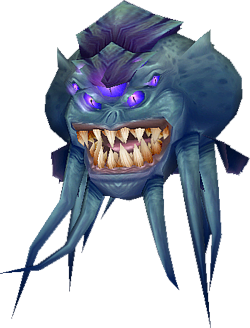
Which are interesting in that they are also referred to as Beholders. The physical interpretation is different though, so I wouldn't call those the same creature as D&D's Beholder.
Which I think just further demonstrates why talking to a lawyer for this sort of stuff is a good idea.

An old 8-bit game, "Alternate Reality" had something called the Devourer in volume 1. We walked into a tavern and the crowd was singing:
"The Devourer,
Is it him or her?
Is it scale or fur?
Does it occur
In the dead of night?
Crystal cavern light?
Will you run or fight?
I want to know
You
I want to know
You
I want to know...
IT
WILL
EAT
YOUR
SWORD!"
What you encountered looked very much like a Beholder (as far as 8 bit graphics could produce). On a hit, it would take something from your inventory, essentially eating it.
"Some thought it a wishing well, filled only with dreams,
Some thought it a magic spell, some still hear the screams..."
The one that surprised me was Treant. From what I've searched so far, though there are many "animated trees" in stories and the like, the term treant is specific to the D&D game (I was expecting it to be an old middle english mythological term).
These are the RW monsters I've located so far, however the real world mythological creature may be very different from the D&D creature, so I suggest researching it a bit before using it:
Amphisbaena, Angel, Baku, Banshee, Barghest, Basilisk, Berbalang, Boggart, Brownie, Bugbear, Bunyip, Cambion, Catoblepas, Centaur, Chimera, Cockatrice, Deva, Doppelganger, Domovoi, Dragon (but not chromatic or metallic), Dragon Turtle, Dwarf, Duergar, Dryad, Hamadryad, Oliphant(?), Dark Elf (Drow), Light Elf (High Elf), Firebird, Pheonix, Gargoyle, Garuda, Dao, Djinn, Efreeti (Ifrit), Marid, Ghost, Ghoul, Fire Giant, Frost Giant, Glaistig, Gnome, Goblin, Clay Golem, Flesh Golem (as Frankenstein's monster), Iron Golem (as the Colossus of Rhodes), Griffon, Hippogriff, Opinicus, Black Annis, Harpy, Hellcat, Hippocampus, Hobgoblin, Homunculus, Death Dog (as Orthus, brother of Cerebrus), Hell hound, Yeth Hound, Hydra, Jaculus, Kelpie, KiLin (QiLin), Kobold, Korred, Kraken, Lamia, Leucrocota, Leprechaun, Lizardman, various Lycanthropes, Manticore, Medusa, Merfolk, Minotaur, Mummy, Naga, Nereid, Nightmare, Nymph, Ogre, Ophidian, Orc, Pech, Pegasus, Penanggalan, Peryton, Pixie, Puka, Al-Mi'Raj, Rakshasa, Revenant, Roc, Rusakla, Satyr, Sea Lion, Shadow, Shedu, Lammasu, Siren, Skeleton, Spectre, Sphinx, Criosphinx, Hieracosphinx, Spriggan, Tarasque, Tengu, Titan, Troglodyte, Troll, Unicorn, Vampire, Vodyanoi, Spider Eater (a type of wasp), Wight, Will-O'-Wisp, Warg, Wraith, Wyvern, Yale, Zombie.
Thanks!